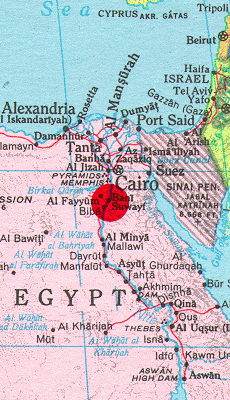
The village of Bayad, meaning "the whiteness", is located on the east bank of the Nile River. It is one of eight hamlets with a population of more than 10,000. The villagers are descendants of the fellahin (plowmen) who have lived on these very lands along the Nile for the 5,000 years of Egyptian history.
The village is accessible by paved road from Cairo through Helwan, or by crossing the Nile in a ferry or felouka from the city of Beni Suef. The major commercial area is located on the west bank of the River in Beni Suef, as minimal commercial activity takes place in Bayad and its neighboring villages. The Nile is still the major means of transporting goods to and from Beni Suef's markets. At any moment one can see a string of sailboats,each plying its course between the east and west banks.
Village water for all purposes is obtained from a narrow canal leading from the River along the boundary of the village. Three fertile and largely uncultivated islands representing a total of 750 feddans lie between the west and east banks of the River. A limestone quarry lies to the east of the village and clay deposits suitable for brick making are available.
The livelihood of the village depends on a narrow strip of arable land. Maize, cotton, vegetables and citrus fruits are the staple crops. Turkeys, chickens and goats are raised and kept within the house complex. The houses are lit by kerosene lamps and have ventilation holes near the ceiling. Education is available through the primary school level, but work requirements in the fields preclude further education for most students.
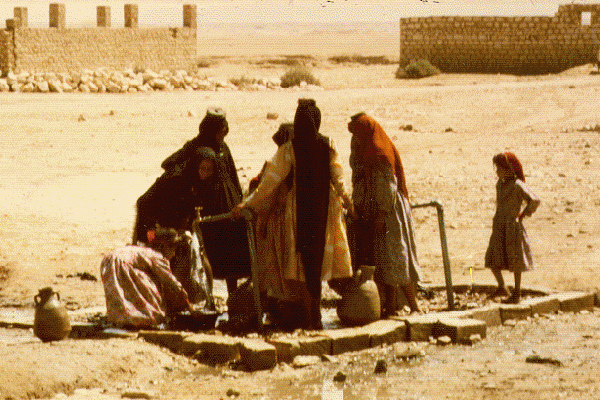
An ancient farming community that dates back to the days of the Pharoahs, Bayad stands between the great Eastern Desert and a strip of arable land barely a kilometer wide. The villagers still use the agricultural tools and methods of their ancestors, though new a pumping station lifts the Nile water into a long canal for irrigating farmed land. Women, draped in black, walk erectly along dusty paths from the canal to the village, a distance of one-half kilometer, with water jugs balanced gracefully on their heads. From the same canal that quenches Bayad's thirst comes the water that provides a cooling place for people and animals to bathe.
Men struggle behind one-share plows pulled by water buffalo. At noonday, the farmers seek shelter from the intense sun in huts constructed of cornstalks. The primary school's six classrooms are crowded with twice the number of children as desks and chairs. The village's eight small stores carry an inventory of eight or fewer items: oil for kerosene lamps, cigarettes, matches, tea, sugar, sesame seeds and beans. Half a kilometer south of Bayad Al Arab is a small limestone quarry, a sun-baked pit that provide employment for several heads of families and a handful of apprentices. In the late evening, men return to their homes which are fashioned from hand-crafted rock insulated with a clay coating.
The thin irrigated strip of cultivated land comprises 1800 feddans and is bounded by the Nile on the west with the desert to the east. The 337 households are divided into 11 clans which have their own care structure, and are represented on the Village Council by three men.

24 Projects