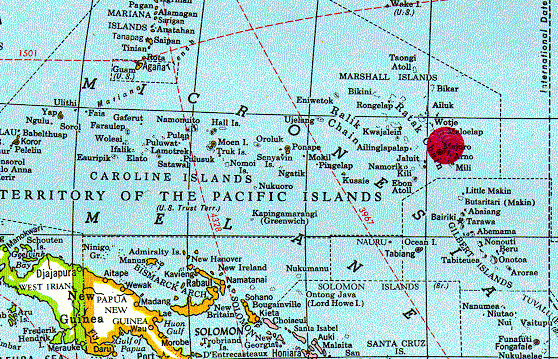
The Majuro Consult is the initiating step toward a comprehensive local development project by the people of the Marshalls, one of the three island groupings which comprise Micronesia. The Marshall Islands are located north of the equator in the heart of the Western Pacific and occupy one million square miles of ocean approximately half-way between Japan and Australia.
The Marshalls Human Development Project is a comprehensive effort that involves both the social and economic advancement of the islands. It was conceived in collaboration with territorial and federal government officials. Local leaders and citizens who provided the substance of the project design are ready now to begin to implement it. Their intention is to significantly upgrade the islands' economy; to provide the functional structures for practical training and social participation in development efforts; and to transpose their ancient heritage into forms relevant to the challenges of the twentieth century. The MHDP is seen as a pilot program which can be replicated in other districts of the Trust Territory and can stand as a demonstration of useful methods for the development of other communities in critical need across the world.
The people of Micronesia stand at the threshold of a new phase in their history. Their social development has been both encouraged and aggravated by five centuries of colonial subjection to a succession of foreign nations. This ended after World War II when the Islands fell under United Nations mandate and the United States assumed the role of trustee. Since that time both national concern and local vision have given momentum to an emerging new direction for the future of the Pacific Trust Territories: the development of a dependable market economy and inclusive social renewal. Appropriately, this reconfirms the United States' intention to function as the guardian of Micronesia's welfare and continued growth in progress and self-determination.
Increasingly, efforts to enable this kind of change are receiving broad support from both the public and private sectors. Those who are serious about the future are aware that the key to the destiny of these islands is the creation of a sign of new hope for local socio-economic development. It is at this point that the Marshalls Human Development Project might be of signal value as a pilot effort on behalf of all 2,000 tiny islands and atolls which comprise the Micronesian trust.
The Marshall Islands represent one of the six districts of the Trust Territory of the Pacific Islands and are comprised of twenty-one inhabited coral atolls. Half of the Marshallese people who inhabit the approximately seventy miles of exposed land are under eighteen years of age. Approximately fifteen per cent of the adults are employed for wages; the balance are either engaged in subsistence work forms or are unemployed.
The Marshallese people bear the scars of their unique history. Despite the significant social, economic and political changes that have occurred in the short period of the past decade, they stand in a relationship of time-enforced dependence upon out-siders for modern skills and expertise. They presently function within social care systems which dramatically lag behind those adequate to meet current needs.
However, there exists within the Marshallese a remarkable determination to build and, a deep desire to alter the nature of their home from a collection of remote, fragmented outposts to a productive social entity which contributes creatively to the mainstream of world culture. In and through such people there could well be realized a new manifestation of the Pacific Island peoples' ability to shape a new time.

24 Projects