Imaginal Education 1981
MEAL CONSTRUCT V
PROFOUND VOCATION
| MEAL
OBJECTIVE |
RATIONAL OBJECTIVE
To look at the necessity of the role for our times and reflect on our place in this. |
EXISTENTIAL AIM
To experience the cruciality of being a trainer for the sake of the globe's future. |
| CONTEXT | There are many ways to symbolize the journey of a group. A song created by a group in the midst of a task is one exciting way to symbolize their journey. Let's sing which was created by community. |
SONG RITUAL |
ACTION REMOVES THE DOUBT...THAT THEORY CANNOT SOLVE. |
| MEAL | Let us eat this meal in gratitude for those people across the world who see possibility for greater understanding between all the peoples of the world and who act out an awareness of the future global village in their everyday lives |
| CONVER
SATION |
We all find ourselves in situations as trainers/educators. |
| objective |
1. Name a situation this last year where your skills as a trainer were stretched. (Get an answer from everyone) |
| reflective | 2. What was your response in this situation?
3. How do you talk about the historic gift of the assignment you have in society? |
interpretive |
4. What do you say to yourself when the questionarises:
"Is this
task worth it?" 5. Why is your training role necessary to history? (Why is that role important?) What are the new forms that are called for in your arena of training? |
ANNOUNCE MENTS SEND OUT |
ACTION REMOVES THE DOUBT....THAT THEORY CANNOT SOLVE. |
Imaginal Education 1981
4 TALK SUMMARY # 5
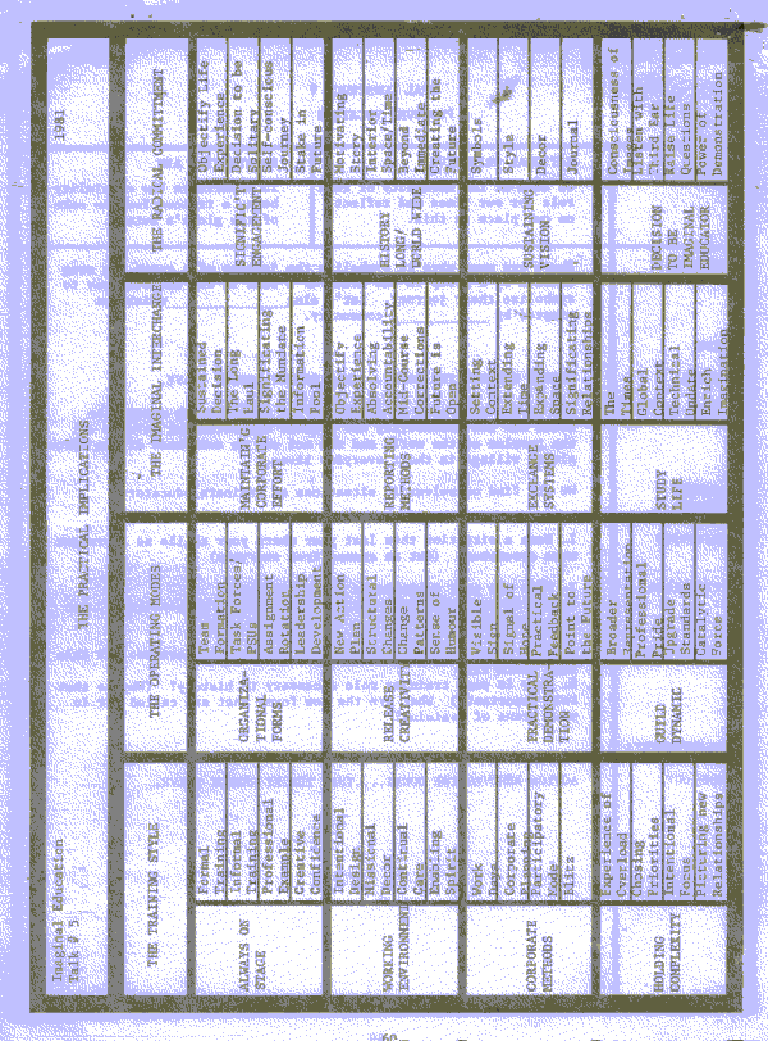
THE PRACTICAL IMPLICATIONS
A. TRAINING STYLE
Training is more than teaching designated sessions. The
team will look at the trainer not only for effectivity but for the ability
to continue to relate to all situations with creative confidence. The trainer
is always on stage, wearing the environment of intentionality. As soon
as the trainer goes off stage the team assumes that learning is something
you only have to know about or memorize rather than the style of facing
whatever comes. This means this working environment of the trainer reinforces
the images that are helpful to learning: intentional design, missional
decor, and practical care. This style reflects the corporate methods which
the trainer uses, not as a gimmick, but in order to always include the
group as part of the consensus building. No one in our times can hold the
complexity of the world without reducing values and priorities down until
they can operate as a corporate team building new relationships as the
occasions arise.
B. OPERATING MODES
It is easier to talk about corporateness in a single event
than it is to create an environment or atmosphere of corporate activity.
AI1 the organizational forms have to be about the formation of the team.
This involves assignment rotation to have everyone have a working knowledge
of the different fields of activities. It involves different groups of
people in specialized task forces and PSU's. This not only releases creativity
to find yourself with fresh blood and new ideas, it is a practical demonstration
that a team works together because of their task and not by personality
or long familiarity. The Guild dynamic, on the other hand, is the deliberate
focusing of your team's specialty into a professional pattern. Every member
of the team sees itself as part of a guild who keeps up its own standards
(intentionality), protects its members (corporate care) and is proud of
its products (celebrations). The guild i8 not
for the purpose of making achievement its goal but of forming the team
around its decisions to intensely (with quality) and intentionally do its
assigned task.
C. IMAGINAL INTERCHANGE
To maintain this environment of corporateness, a system
of interchange within the department is necessary. People who are not "in
power" feel left out of the information pool of the "executive"
level. Interchange thus becomes necessary for the whole team to see how
they participate in consensus. This involves reporting methods and an exchange
system. To bring intentionality into the interchange, it is also helpful
to have an intentional study life where each member of the team kee ~ updated
professionally, culturally, and contextually.
D. RADICAL COMMITTMENT
Finally, no team is formed or learning attained without the commitment of each individual. Without an understanding of the engagement as significant and longer lasting than the individual task, the team cannot sustain the vision. This is not something that has to be talked about frequently but there has to be a
consistent effort to coordinate the symbols, style, and decor to remind everyone of the fulfillment of this task. Finally, it is the one who decides to take this role of the Imaginal Educator who will determine if the team is to be formed as a cor9prate entity, if the task is to be seen as meaningful, if the working conditions are conducive to creativity. This is done primarily as the educators demonstrated style that she or he is broadcasting images that encourage the team to continue to see that it is not the withdrawing but the expenditure of your total being that brings you fulfillment.
Imaginal Education 1981
READING WITH TALK # 5
JOURNEY TO IXTLAN
by Carlos Castenada
"Why are you doing all this for me, Don Juan?"
I asked.
He took off his hat and scratched his temples in feigned
bafflement. "I'm having a gesture with you," he said softly.
"Other people have had a similar gesture with you; someday you yourself
will have the same gesture with others. Let's say that it is my turn. One
day I found out that if I wanted to be a hunter worthy of selfrespect
I had to change my wayof life. I used to whine and complain a great
deal. I had good reasons to feel shortchanged. I am an Indian and Indians
are treated like dogs. There was nothing I could do to remedy that, so
all I was left with was my sorrow. But then my good fortune spared me and
someone taught me to hunt. And I realized that the way I lived was not
worth living...so I changed it."
"But I am happy with my life, Don Juan. Why should
I have to change it?"
He began to sing a Mexican song, very softly, and then
hummed the tune. His head bobbed up and down as he followed the beat of
the song.
"Do you think that you and I are equals?" he
asked in a sharp voice.
His question caught me off guard. I experienced a peculiar
buzzing in my ears as though he actually shouted his words, which he had
not done; however, there had been a metallic sound in his voice that was
reverberating in my ears.
I scratched the inside of my left ear with the small finger
of my left hand. My ears itched all the time and I had developed a rhythmical
nervous way of rubbing the inside of them with the small finger of either
hand. The movement was more properly a shake of my whole arm.
Don Juan watched my movements with apparent fascination.
"Well...are we equals?" he asked.
"Of course we're equals," I said.
I was, naturally, being condescending. I felt very warm
towards him even though at times I did not know what to do with him; yet
I still held in the back of my mind, although I would never voice it, the
belief that I, being a university student, a man of the sophisticated Western
world, was superior to an Indian.
"No," he said calmly, "we are not."
"Why, certainly we are," I protested.
"No," he said in a soft voice. "We are
not equals, I am a hunter and a warrior, and you are a pimp."
My mouth fell open. I could not believe that don Juan
had actually said that. I dropped my notebook and stared at him dumbfoundedly
and then, of course, I became furious.
He looked at me with calm and collected eyes. I avoided
his gaze. And then he began to talk. He enunciated his words clearly. They
poured out smoothly and deadly. He said that I was pimping for someone
else. That I was not fighting my own battles but the battles of some unknown
people. That I did not want to learn about plants or about hunting or about
anything. And that his world of precise acts and feelings and decisions
was infinitely more effective than the blundering idiocy I called "my
life."
After he finished talking I was numb. He had spoken without:beIligerence
or conceit but with such power, and yet such calmness, that I was not even
angry any more.
. _
4~ Journey to Ixtlan pg. 2
We remained silent. I felt embarrassed and could not think
of anything appropriate to say. I waited for him to break the silence.
Hours went by. Don Juan became motionless by degrees, until his body had
acquired a strange, "almost frightening rigidity; his silhouette became
difficult to make out as it got; dark, and finally when it was pitch black
around us he seemed to have merged into the blackness of the stones. His
state of motionlessness was so total that it was as if he did not exist
any longer.
It was midnight when I finally realized that he could
and would stay motionless there in that wilderness, in those rocks, perhaps
forever if he had to. His world of precise acts and feelings and decisions
was indeed superior.
I quietly touched his arm and tears flooded me.
._
. . _ ~_
Imaginal Education 1981
WORKSHOP # 5
INTERCHANGE FORMS
| RATIONAL OBJECTIVE: To create the tools for communicating image changing messages | EXISTENTIAL AIM: To experience the excitement of returning to .the job with image changing tools |
| STEP |
PROCEDURES |
CONTEXT |
We want to examine the question of Interchange. Communication is more than letting people know information, although it is that also. An Imaginal Educator beams new messages that alter operating images. |
CORPORATE CONVERSATION |
1. What types of interchange currently take place in your situation? 2. How are these helpful not helpful? 3. What has occurred to you these last two days as more creative/ imaginal modes of interchange? |
| Let us look at the data we created during the
first session re the new behavior we anticipate/the new images that would
require/and the new messages that would release those images. (hand out
sheet with session 1 workshop data just the second line of "new
behavior") 1. What strikes you about what we said. 2. What excites you seems on target seems to need something different. 3. What would you add that we didn't think of then. 4. What are the tools means of communication that you might use to communicate these messages. (List on the board) Short Course: The issue of motivity is central to the question of "communication". People are motivated to do a task when their sense of time is extended, their space has been expanded and intentionalized, and relationships are expanded. Therefore, we want to look
at tools that will do the job. Brainstorm all of the possible tools of communication that can be used in their situation. Time: plan an event workday, celebration, lunch time happening, etc. Space: decor, space arrangement, etc. Relationship: corporate writing of a memo, etc. |
|
TEAM WORK |
Divide group into 3 or 4 teams and assign each team one of the tools to create: Decor plan, space arrangement plan, writing a memo, planning an event, etc. Remind teams that they are working with the messages that they created to create new images that will release new behavior. |
Imaginal Education 1981
| STEP |
PROCEDURES |
TEAM PRESENTA TION |
As teams return sing a song. Teams present their tool creations, with questions of
clarity until all have been presented. 1. What do you remember from these presentations. 2. What excited you? 3. What seemed to be an effective tool in beaming new images. 4. What tools do you want to use in your office (class room) starting next week why? 5. What else occurred to you that you want to use. |
| REFLECTION | Every word we speak or write, every visual
image we put up for
others to see communicates images that reinforce or change behavior. 1. What image stands out in your mind that you heard during this workshop during the whole course. 2. When did you discover yourself saying, "aha". 3. When did youfeel uncomfortable. 4. What does it take to be an imaginal educator? 5. How will you talk to yourself about being a trainer now what will be different what will be the same. |
..
. .
_ . .