
|
|
[partially corrected -- see end]
 |
 |
IMAGE
A Quarterly Publication
Vol. Xl No
Prepared the Research Station
THE ECUMENICAL INSTITUTE
THE INSTITUTE OF CULTURAL AFFAIRS Copyright
c ICA 1!
GETTING DISTANCE
Modern society is experiencing what
Daniel Bell has described as an "Eclipse of Distance":
individuals are bombarded with the "immediate now" of
electronic communication which threatens to obscure their historical
perspective. Margaret Mead also noted this phenomenon, observing
that the consequence of this eclipse is the loss of our reflective
power and a reduced ability to make considered judgments
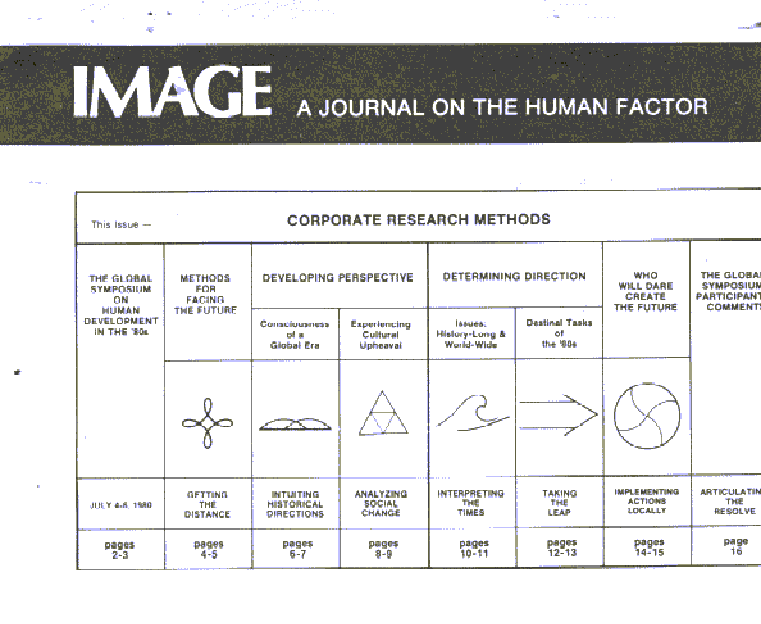
Methods Overview
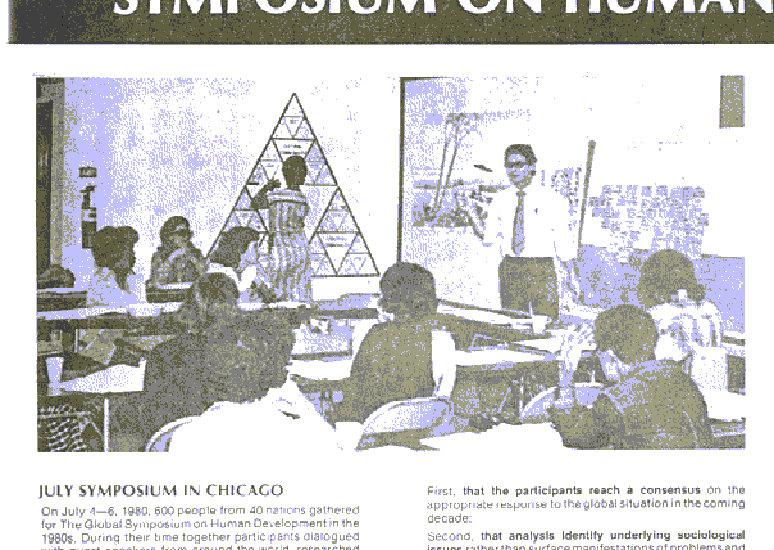
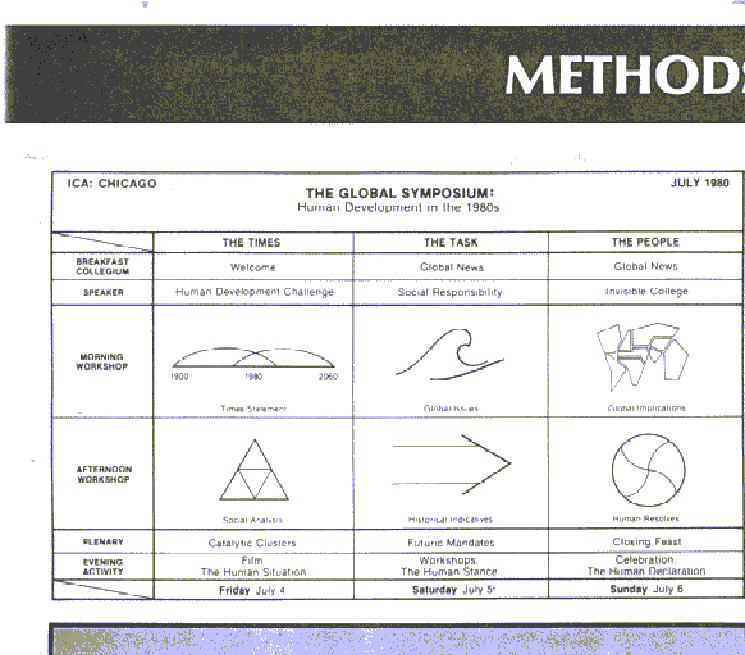
The Symposium used a variety of approaches
to enable participants to get distance from immediate pressures
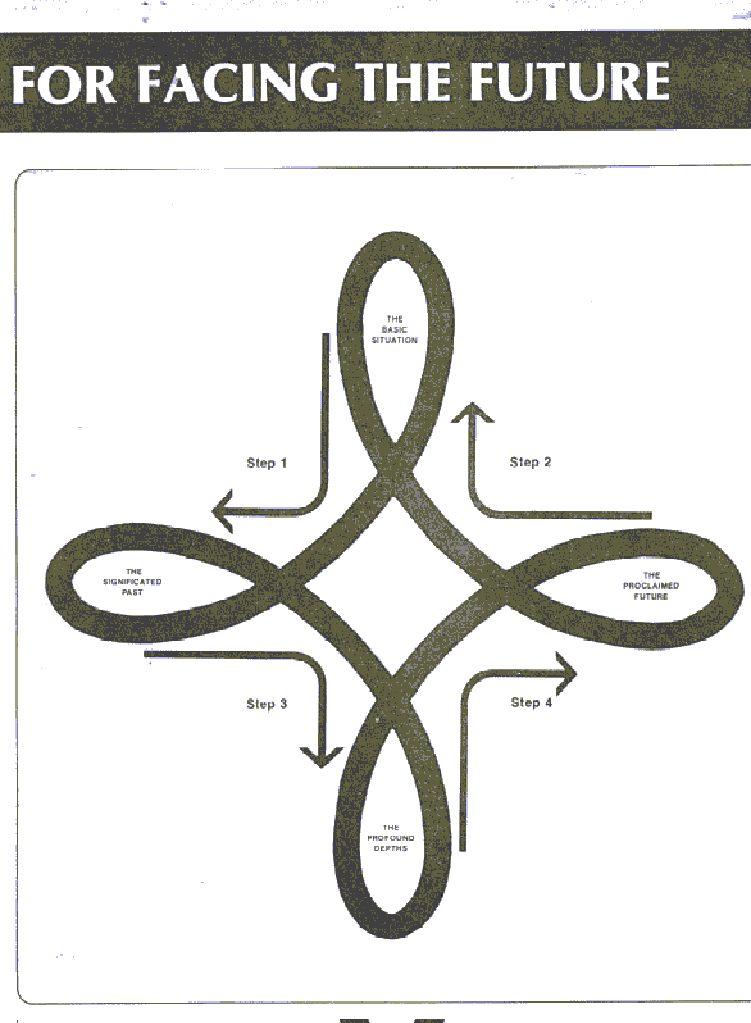
in order to make realistic judgments about the future. The Distancing
Method used had four aspects: (1) an examination of the
past in the light of contemporary questions and concerns, (2)
an analysis of the present situation, (3) an exploration of deep
universal issues and <4) a projection of future directions.
in the Symposium participants used four techniques: a Timeline,
to recall the significance of past events; Social Process
Triangles to analyze changes happening in society today; Wave
Analysis, to discern underlying issues, and Flistorical
Mandates to state intentions for the future.
Methods Reflection:
The Distancing Method provides a way to use responsibly the vast amounts of information made available by today's technology. It allows an individual or group to organize abundant data so input becomes meaningful rather than c haotic. Participants develop a new perspective on the l rends of history. They overcome the tendency to seek simple solutions and' limited tasks in response to complexity, and they experience their ability to make
informed judgments and considered decisions. ~
~_
 |
THE TIMES
The participants in the Symposium on Human Development in the '80s composed the following statement reflecting their corporate images of the meaning of the Twentieth Century.
The Task Before Us Now
Within the last century, forces of both humanization and dehumanization rapidly accelerated. Each force influenced the farthest reaches of civilization and each ran a course that the lessons of history had not prepared people to predict or control. The future of mankind is uncertain: mass destruction and universal utopia seem equally plausible. The time has come when it is vital for people to heed history's mandatesto commit their actions to ensuring that every person on earth might experience their potential for a fully human life. No greater task has ever been required.
World War l:
Genesis of Global Awareness
Early in this century, inventions of technology began to bring peoples of the world into close contact. Responsibility for the effects of these innovative technologies, however, was not recognized, and human suffering was multiplied when the marvels of new technology were applied to the ancient art of war. The First World War brought an end to the age of political innocence and at the same time set the stage for global concern for human development.
The Depression:
Shaking Society's Foundations
New social responses sprung up all over the world in the attempt to rebuild in the altered environment created by the war. National and minority liberation movements emerged as men and women around the globe demanded a fair share of benefits. The Great Depression, resulting from chaos in the economic sector, signaled the collapse of the old order. The foundations of our society were shaken. At the same time, like the World War, the depression revealed that the interdependence of the earth's peoples was inescapable.
World War II
The Urgency of Coexistence
Throughout the middle decades, the clashing of ideologies resulted in a struggle for intellectual foundations upon which to build a new global society. Many political systems, as well as economic structures, made their points and proved inadequate to account for, or to give guidance to the complex world at hand. The Second World War put an age of ideological naivete to rest. Neither fanaticism, skepticism nor neutrality could protect the most remote villager from the forces of history. The holocaust and the bomb brought home the urgency of coexistence.
Earthrise:
A Vision Of Global Identity
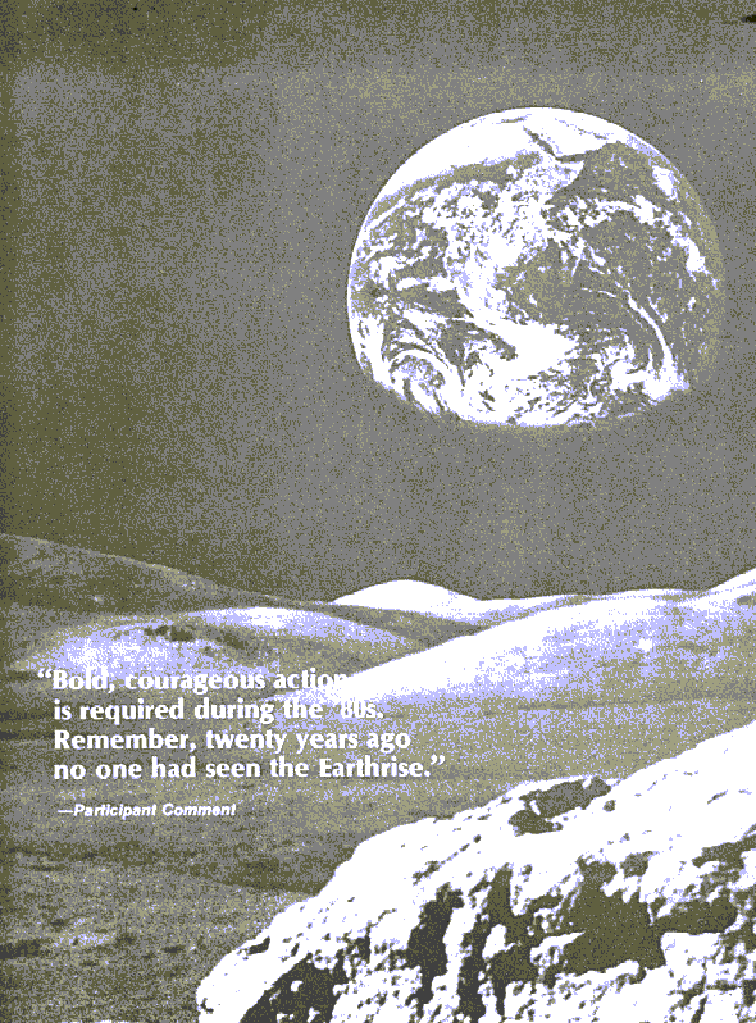
In recent years humanity has viewed the earth from the vantage point of the moon. This vision-human beings as passengers of spaceship earth-precipitated an age of social experimentation and gave form to notions of global interrelatedness. Once disenfranchised peoples shook "the powerful" into acknowledged dependence and exposed them to dissatisfaction with a life based on acquisition. Clearly neither science nor ideology, neither class nor culture, neither education nor geography, neither youth nor age was sufficient to exempt one from participation in the gifts and responsibilities of passage on spaceship earth.
1980:
A Cry for Practical Visionaries
Bound in geography, in economics, in hope and in vulnerability, the peoples of the planet stand at a pivotal point in responsibility. If the potential for universal destruction is at hand, so also is a vision, manifest throughout society, of a human globe-rich in diversity, local in responsibility, global in cooperation, universal in participation and profound in spirituality. Out of every race and cultu re can be heard a cry for visionaries who yet have the practical wisdom to safely usher in a new world of profound human living in all communities.
BIRTH OF THE GLOBAL VILLAGE

CONSCIOUSNESS OF INTERDEPENDENCE EMERGENCE OF ONE WORLD
EARTHQUAKE OF CRISIS OF STRUGGLE FOR
ASSUMPTIONS TRANSFORMATION GLOBAL CONSENSUS
Awareness of Fragmenting | Awakenment Spaceship | Worldwide
International Earth-
Human Frairy Conflicts in Space Ch 11 | dependence
TRUSTEESHIP OF
PLANET EARTH
Structunng the Means
of Universal Survival
1900 1940 1960 1980 2000 2020 2060
INTUITING HISTORICAL DIRECTIONS
Facing the Future by Appropriating the Past
"Man anticipates, more or less clearly, his entire future at every moment." wrote Ortega y Gasset. This was a fundamental presupposition of the Symposium.
Brainstorming the Timeline
To objectify the experiences and consciousness of the participants, each task force brainstormed events which characterized the past decades of the 20th Century. These events were recorded on slips of paper and placed by decades along a six foot timeline representing the period from 1900 to 2060. Then they listed additional information about this century-the historical figures, the style and mood of different periods, the inventions and innovations, and the dominant images. Finally they discussed the information and what it revealed about the past 80 years.
Charting the Era :
The task forces then began to chart the era by deciding major events and turning points. These turning points were used to create the major and minor sections of the chart. A title was given to each section. Using the same method, future events were brainstormed and charted. A title was decided for the whole 160 years. The charted timeline above is a composite of several developed by the various task forces. Later, small groups in each task force wrote paragraphs on assigned sections of their timeline. An editorial board representing each task force was formed. The product appears on the opposite page.
Methods Reflection
This process assists individuals and the group as a whole to organize data intuitively and assess the significance of events, people and inventions of this century. In essence, participants create a gestalt that gives meaning to
multitude of seemingly disreiated occurrences.
This:process allows people to stand back from the tangle of their
immediate experiences and look toward the future with greater
comprehension of where they have been and where they are going.
ANALYZING
SOCIAL CHANGE
Facing the Future
by Thinking Comprehensively
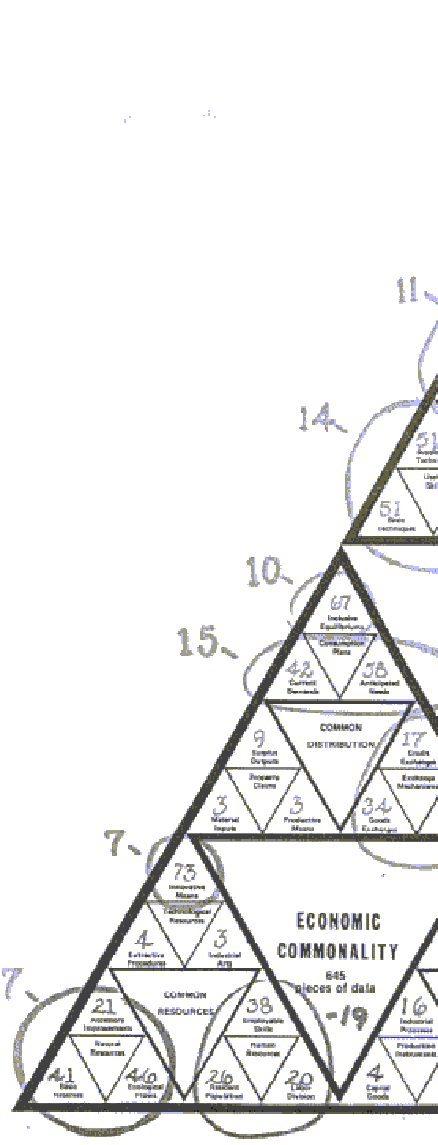
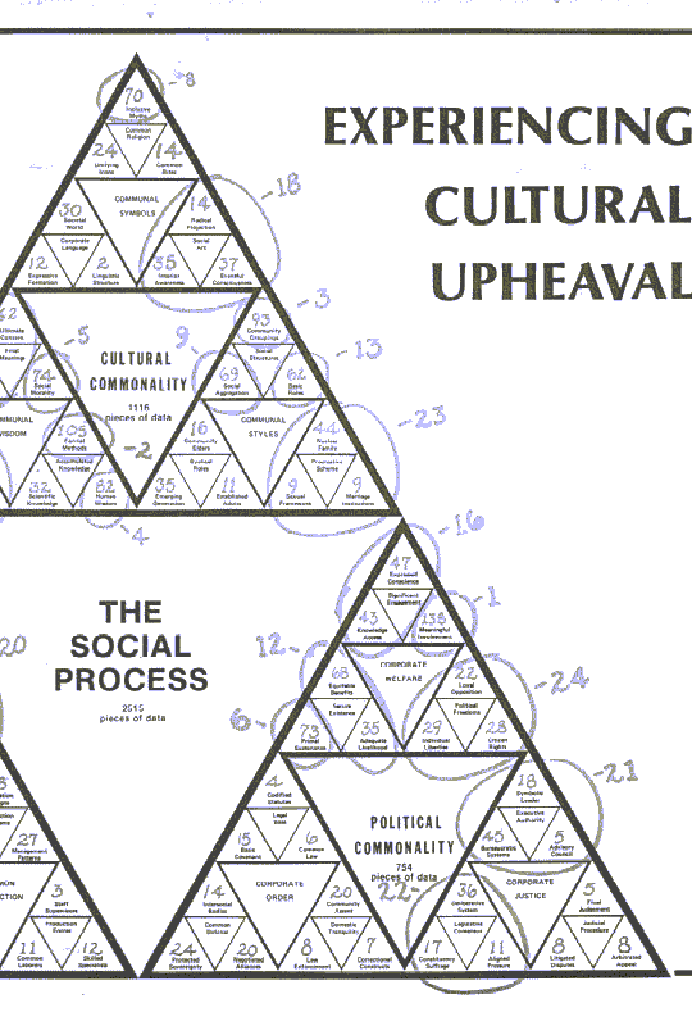
Society is like the proverbial elephant being described by the six blind men. None could see the whole elephant and no person has ever seen all of society Yet society is one integrated whole and understanding social changes today requires: some means of comprehending the whole. The Symposium used a model cailed the Social Process Triangles, which is an inclusive framework for analyzing al1: dimensions of any particular society in any period of history.
Use of Outside Materials
Working in task forces, participants looked for indications of future trends in films, articles and excerpts from contemporary writings, speeches and interviews. Each of the indicators was recorded, numbered and located on the Social Process Triangles. Then the participants listed and plotted their own concerns about the future.
Clustering the Data
The task forces gathered to compile their findings using one large set of triangles. Clusters of data were identified, as indicated by the numbered circles on the diagram to the right. The clusters with heaviest concentration of data show points of the socia1 process which are in greatest transition. The most data
(Cluster No. 1) fell within the category
of meaningful involvement.: The clusters as a: whole reflect
a major upheaval taking place in the cultural dynamic: of the
2511 pieces of data, almost half fell here.
Methods Reflection
This process allows participants to
organize are massive amounts of information about social change.
it enables people to view their everyday activities objectively
and to see where the critical changes in society are occurring
Just as the Timeline gives an historical perspective. the social
process analysis gives a social orientation.
INTERPRETING THE TIMES
Facing the Future by Anticipating
Longrange Effects
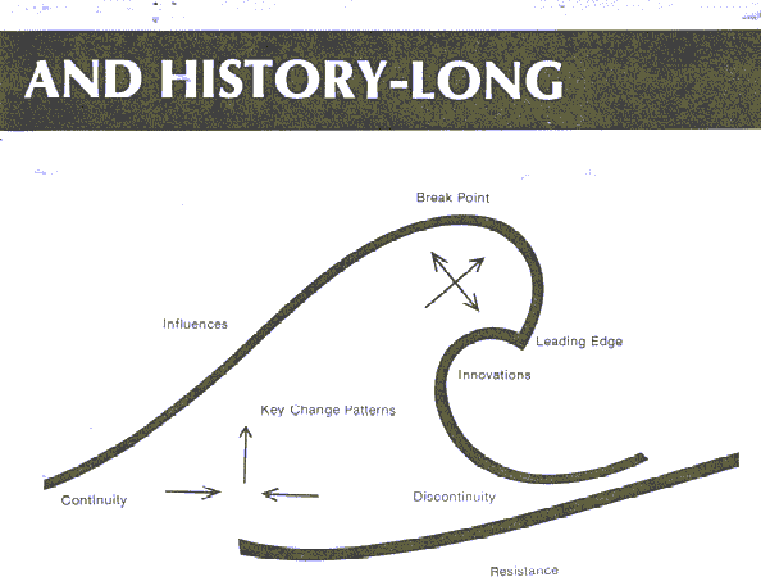
Ancient Polynesian people were able to map ocean waves by using &'stick charts" to guide themselves across vast unmarked water. The complexities of history have often been compared to waves. Having identified 24 major points of social change, the Symposium used a simplified wave diagram to combine data from both the historical timeline and the Social Process Triangles.
Wave Analysis
On the second day of the Symposium, each task force was assigned one of the numbered clusters. Each studied the data cards for its assigned cluster and selected data from its timeline. Data from both the timeline and the cluster were sorted for items which were part of the dominant historical trend. These were arranged chronologically in the continuity and influences positions on the left of thc wave diagram. Along the right of the wave the elements of opposing trends were arranged sequentially as discontinuity, resistance and innovations. Conflicts between old and new trends were plotted toward the center of the wave diagram as key change patterns. The most current change pattern was plotted toward the top of the wave, as the breaking point where the trend of history is forced to take a new direction.
Scenario Generation
This wave diagram provided the basis for discussing social situations of great complexity. The group discussed what the future would look like in the following three eventualities: first, if the present dominant trend were to continue; second, if it were to be overwhelmed by an opposing trend; and third, if it were to take a completely new direction. The possibility and probability of the various scenarios were discussed as a way to anticipate the long range effects of these conflicting trends. From this discussion participants discerned the critical issues facing human development in the 80s. They ranked these issues by priority and wrote paragraphs to describe the relationships to the historical trends.
Methods Reflection
The wave analysis creates a map of the myriad trends and counter trends shaping society today. Generating scenarios provides an opportunity to weigh up many options for affecting the trends. This process separates foundational issues from surface problems and illuminates new social directions.
THE ISSUES
The participants in the Symposium on Human Development in the '80s discerned the following issues to be the primary ones in the decade ahead.
1 DECISIONMAKING PARTICIPATION
Perhaps the greatest issue confronting those concerned with human development in the 1980s is directly related to equipping local persons with the Context and the structures to participate actively in making the decision
which affect themselves, their families, their communities and the world. Widespread lack of involvement makes apparent the frustrated creativity of both local citizens and care agencies which desire to respond to human need.
2 DYNAMIC EDUCATION DELIVERY
The isolation of education from the direct needs of the community has led to a questioning of its relevancy. Methods are required for transmitting accumulated wisdom in order for effective decisions to be made; for transferring the useful practical skills needed for the ongoing life of the community; and for interacting with other communities which area part of the larger society in which the community exists. Those concerned about human development in the 1980s will address this issue by delivering needed methods for enriched learning to audiences of all kinds.
3 SELFRELIANCE METHODS
Mistrust of government and uncertainty about the effectiveness of political and social systems have occasioned concern in local communities across the globe for selfreliance and selfsufficiency. The complexity of global issues creates a need for practical
social, economic and human development methods applicable at the local level. Continued reliance on outside expertise for meeting local needs of sustenance and welfare fosters cynicism and perpetuates the very malaise development efforts are out to combat.
4 RESOURCE USE PRIORITIES
Natural and technological resources of the world are limited. Fossil fuels, clean air and water, arable lands and metallic ores are some of the resources which are becoming judiciously guarded, globally valued and highly priced. The task before nations, local communities and individuals concerned with human development in
the last twenty years of this centu ry is creating a mechanism for setting priorities for both the use and distribution of global resources. Local input which transcends political and geographic boundaries is needed if the available resources are to be used in the best interest of all peoples.
PROFOUND LOCAL MYTHOLOGIES
In an age abundant with cultural diversity representing a myriad of socioethnic traditions, a major issue facing those concerned with human development in the present decade is illuminating local mythologies and other art forms so they reveal the universal human condition. Development depends on cooperative efforts of people
from diverse backgrounds, and their efforts are hampered when the myths by which they live and find meaning are divisive. Yet within the myths are components that reflect universal life experiences. Highlighting these components could develop new levels of cooperation and understanding among groups, and could serve to bond the efforts of their members.
6 ENGAGED HUMAN RESOURCES
Human resources around the world are wasted daily through poor health, sanitation and nutrition, through mental and physical illness, personal alienation and family separation. Continued isolation of peoples from creative participation in the historical process not only deprives them of developing their potential, but it also denies their community the benefits of that same potential which could radically and positively affect the future. Those who care about human development in the next decade will seek to enable individuals and families in every part of the globe to engage in practical action directed to local and global human concerns.
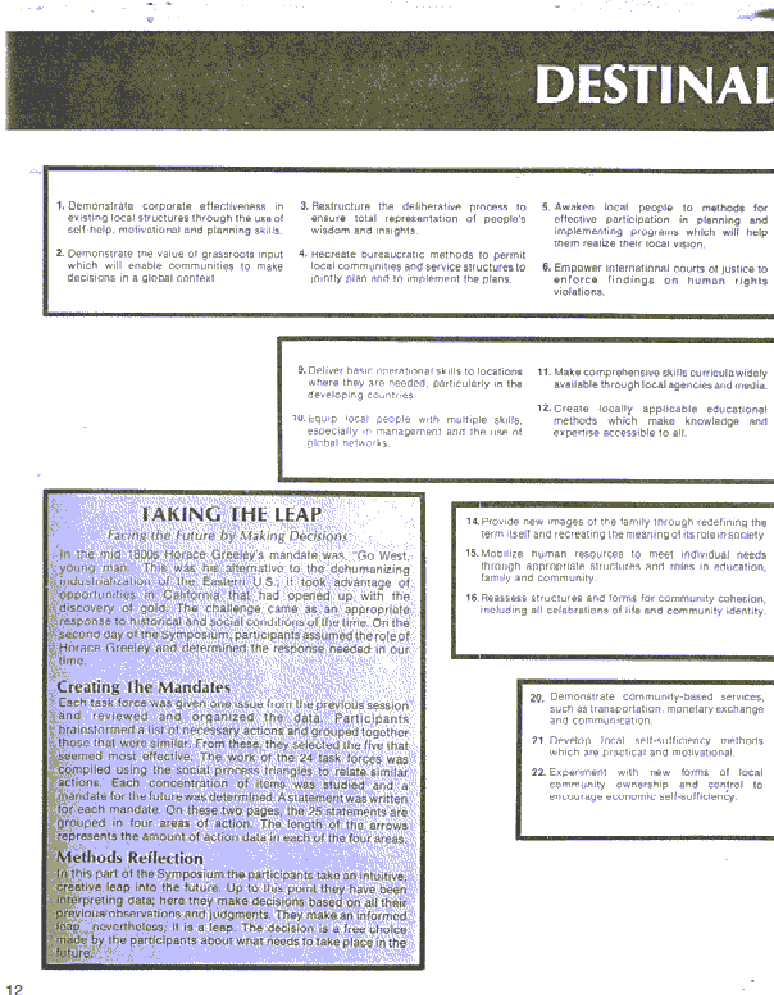
IMPLEMENTING ACTIONS LOCALLY
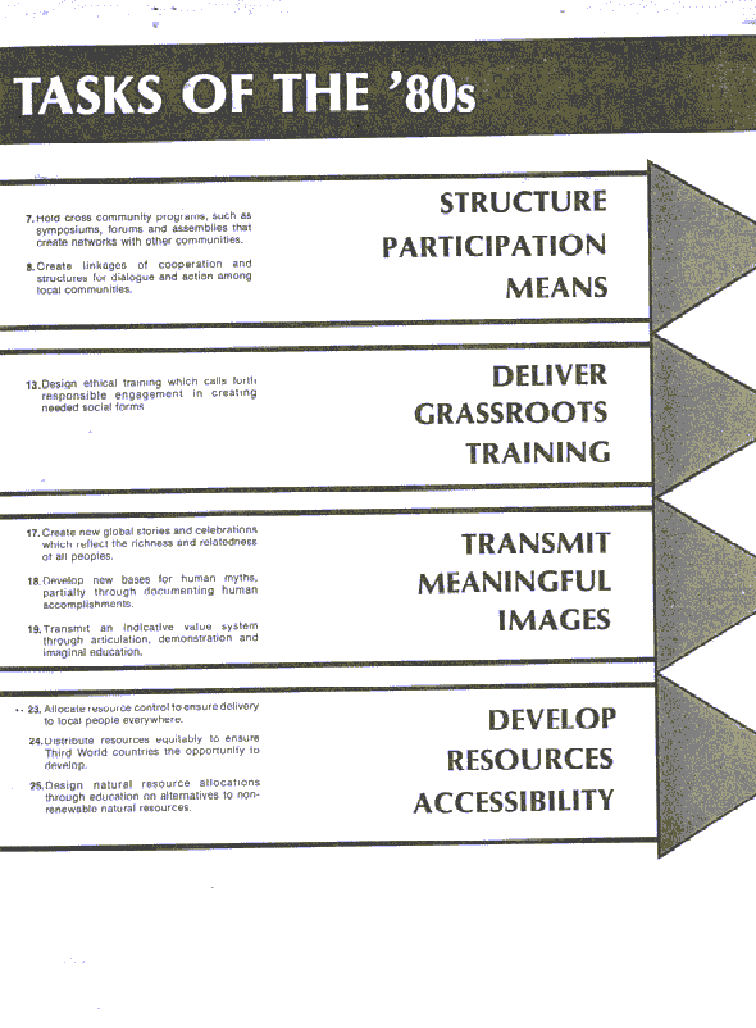
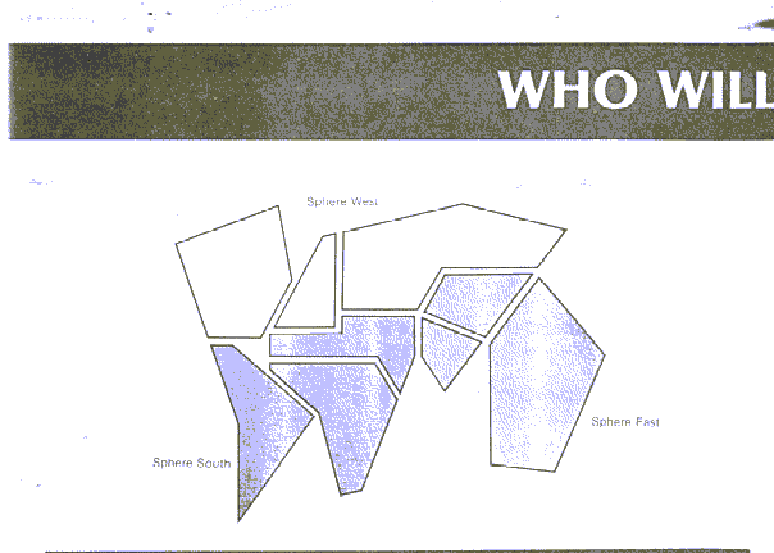
Image farmer, a graphics designer from a Houston businessman, a community organizer rcm Rio a rural reconstruction expert from indict, and a =. :~vw~ arM rn~yor create common directions for the .'80s? The Symposium participants represented such diverse backgrounds. Having determined the destinal tasks for the coming decade, they used two simple social diagrams to put particular situations in a global context. These diagrams were a Global Grid and a Sectors Analysis.
i Bold Moves
The Globai Grid is a simplified map of the world which groups nations into three spheres, each with three geosocial continents. Using the grid, each task force took a different mandate to think through its application. Members of each task force shared their knowledge of the current situation in each continent and recommended bold moves required to implement their mandate. Four specific bold moves-challenging new actions-were selected for each sphere. ~;
:::
Implications
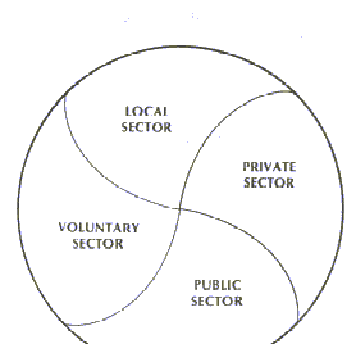
Task forces combined into four larger groups to review the bold moves for each sphere. They brainstormed the implications of these actions for each of four sectors: the private sector of business and industry, the public sector of government agencies, the voluntary sector of nonprofit service groups and the local sectorof community organizations.
Implementing Qualities
After conversations in 24 task forces, representatives from each formed a writing team. They prepared a statement on the human qualities required by those who' would take it upon themselves to implement the mandates. A paragraph from their statement appears on the opposite page.
Methods Reflection
During the last session participants benefit from a wide spectrum of practical insights for local implementation. These serve as guidelines for action as participants return to their homes and workplaces.


THOSE WHO CARE
The Symposium panic/pants created the following description of the stance required of individuals who would carry out the task of human development in the 1 980s.
The task of those who care is to articulate a vision of needed change and to demonstrate courage in the face of obstacles. Those who care formulate or influence official policy. They focus attention on essential concerns rather than following the issues of the moment. They take humanity as their ultimate constituency. Those who care represent the poor and forgotten with tenacity and steadfastness. They talk with kings and they walk with paupers. They provide a bridge between conflicting groups. They are sensitive to the just demands of both tradition and innovation. They preserve and protect the environment. They back up their beliefs by investing all of their resources and they solicit others to do the same By pointing to pressing needs they call forth the consciousness of others. They lead, organize and help to channel energies in the most productive directions. They think globally and act locally.
IMPLICATIONS

The participants in the Symposium on Human Development in the '80s articulated the followina implications of the mandates for the private sector, the public sector, the voluntary sector and the local sector.
For The Voluntary Sector
The implications call for notforprofit and service agencies to:
· establish the voluntary role as one of innovative social leadership. · strerigthen the voluntary sector in areas of the globe where it is weak. · increase effectiveness by forming a network that bridges the private and public sectors. · create new symbols and myths. · sponsor seminars on the family. · sponsor local village and neighborhood exchange visits. · encourage women's groups to take a more active role at policymaking levels.
· create a comprehensive approach to community life, including all four sectors.
For The Local Sector
The implications call for community and neighborhood organizations to:
· form a network for training and support. · recapture the meaning of old traditions and create myths for the future.
· document their needs so the other sectors would be better able to respond. · develop and share local leadership methods. · give input toward redesigning currently debilitating welfare systems. · demonstrate local and regional selfsufficiency. · create a document which declares local community rights and responsibilities. · encourage regional demonstration communities.
For The Private Sector
The implications call for business and industrial enterprises to:
· make plans on the basis of a vision of twenty years ahead. · consider the effect of their decisions on local communities and neighborhoods. · develop and maintain collegial networks of concerned people. · expand training programs to encompass all the vocational needs of employees. · project needed images of global public service. · consider alternate uses of capital resources and management skil Is. · establ ish professional task forces to assist small businesses by sharing expertise. · invest a percentage of corporate income in innovative projects on behalf of Third World development.
For The Public Sector
The implications call for government and bureaucratic structures to:
· shift from a directive to a cooperative approach in working with the local and voluntary sectors. · turn attention toward small business and local community as well as toward the massive problems of the city. · create a mechanism to receive input from local people. · recreate forms of accountability for public office. · develop training programs for new dimensions of management and service delivery. · develop regional and national infrastructures to relate to and release local communities.
· determine content for communication by satellite. create integrated planning processes at all levels.


~T~
At the end of The Global Symposium the participants had an opportunity to write statements reflecting their personal resolves for the future. Selections from these statements are included below.

"In the 1 980s a whole new demonstration needs to be seen in the regional support system that provides backup for developing villages and urban communities."
"Institutions will find a more effective way to relate to those they serve by exposure to human methods for research, nurture and planning."
"I believe that the field of public education is in need of renewal along the lines that we have discussed here. Having been a teacher for several years, I see the great potential that education has; but I see a need for new forms to emerge. More dialogue needs to go on between experts and laymen. The strategic planning process that I have observed here could be well used in this field."
"Now is the moment for local people. History calls for new ways to allow this moment to empower every human to participate creatively in his own life and that of the broader community, without fears and without being totally consumed by providingforminimalsurvivalneeds.
"We must continue to give people methods for their work and urge new questioning and evaluation of the roles for the '80s."
"This is the time to claim our vocation as Yhos,
"We have, from this Symposium, gained an overvi
what the world n~
"There are millions of people who care for each othr the earth. The Symposium demonstrated the powe the hope that emerges when just a few hundred p who care get together to plan for the future."
"The 1980s will be the decade for
responding gioba those issues which affect us all. Our mandate
is t locally in ways which are beneficial for all and to bri consciousness
a new global myth which transcend