July, 1982
THE RITUAL PROCESS
In the name of the Father, and of the Son and of the Holy Spirit. Amen.
In the name of God, the creator and destroyer of all of life, in the
name of the Christ, the permission giver and redeemer of all oflife,
in the name of the Holy Spirit, the God within all of life. Amen.
In the name of the limits, the possibility and the free decision of
life. Amen.
Which is to say, life is never the way we want it, we refuse to accept
its promise, nevertheless, we are free to live. So be it.
I have been greatly blessed this year with the opportunity of going
back to school. I requested that assignment for several reasonsone
was a great concern about our symbolic life. I was not ever so naive as
to think that all of the answers could be found in one year of study, but
I was hopeful that we would find a few of the directions that we should
go.
I want to share four things with you today. One is the context of rituals
which has exploded my imagination during the last year. The second is the
function of ritual. Next, I will talk about our own tremendously rich experiment
in the ritual process. And finally, I will outline some implications for
the future.
This is from the writings of Raimundo~C. Panikkar.
The most positive way to overcome a tradition is not to step out of
it (as if it were a bullock cart) or to cancel one's membership (as if
it were a club), but to live that 'tradition', i.e. to 'pass it on', to
continue it, to climb to the top where other peaks are visible and/or to
descend to the depths where the throbbing of the world is perceptible.
I feel that I owe it to many to explain the continuity of my path in spite
of the mutation that has taken place both in me and in our world.
I can only be free from a certain type of Christianity or Hinduism (and
for that matter from a certain type of Buddhism and Secularism) if I become
a better Christian and a better Hindu.
I want to spin a story of how rituals got started. There were not always
rituals. The earliest evidence of ritual that we have found so far dates
from 180,000 BC in a cave in the Alps. Those who have read Clan of the
Cave Bear will appreciate that what was found was 20 bear skulls arranged
in very careful order, pointing to the east. Now, what was the story? How
did they get there and what do they mean? Nobody recorded it, so the story
is ours to invent. My story is that one spring day, as the people of a
very early human form were looking for the first fresh food of the season,
they came upon a huge cave bear. After much struggle they finally killed
it. But, then another cave bear appeared, then three more appeared. Finally,
there were 20 cave bears. This little group of human beings had to face
and conquer the bears or be destroyed. It was a totally impossible situation
out of which to forge a victory. No little group of human beings can conquer
20 cave bears! But they did. Obviously, there was some greater power within
them or behind them or acting through them that allowed this mighty victory.
They could not explain it, so they carried the skulls into the cave and
laid them in place. They said, "There is something here that we do
not understand. Let's not forget it. There is something more to life than
oneonone. Let's remember it." So they laid the skulls on
the ground and probably had some sort of reenactment with it. The important
thing is that from that moment on there was time. There had not been time
before that, but an amazing event had happened. Then there was a time before
and a time after the encounter with the bears. There was a memory of an
event which changed history. In due time, paintings appeared on the wall.
Later words emerged to rehearse the story until there was a total acting
out of that great adventure, that great event when the impossible happened.
What came into being was the first ritual.
Some scholars talk about that as a hierophany or kratophany or theophanya
mysterious encounter, a manifestation of the power of the sacred or God
in the midst of human life. We have a hard time talking about that kind
of encounter today. We know it still happens. It occurs in all of our lives.
There are some events that so fill us with the awe, wonder, power and mystery
of life that from that time on we struggle to even get a picture of what's
happened. We dare not forget it. All of time becomes focused in the power
of an event and in recalling the event. We reclaim the wonder and the terror,
the fear and fascination which is involved.
The book Ancient of Days gave a fair description of how another
understanding of time came into being. It was quite a reasonable thing
to be scared to death in that time. The days kept getting shorter and shorter
and the weather colder and colder. They had reason to fear. A dim memory
of the Ice Age remained with them. Perhaps the trend would continue until
it was only night and only ice. But someone, the book names Ronstrom but
any name might do, conceived of the notion that there was a pattern to
the weather. He believed there were cycles of time. Stonehenge was built
to mark the time. They said, "The sun will move south until the shadow
is here, then it will move north again. For the rest of our days we do
not have to be afraid. We can rejoice at this shortest day because it means
longer days are returning. This is life and therefore we can live before
it." Not only the people of northern Europe, but the people of the
whole world had this experience. They came to realize the cycles of time.
Every culture on the face of the earth has some sort of celebration, some
sort of feast of lights, that marks the shortest day and says that there
is something comingthis is part of the cycle.
The Jews lived out of a cycle of festivals until they went into exile.
But when they were carried off into captivity these rituals alone did not
sustain them. The rituals did not meet the yearning and pain and anxiety
in their souls. They found themselves remembering specific events like
the Passover and the Exodus. They remembered the Red Sea and when they
came back to Palestine. They remembered their whole calling and their covenant.
They put an overlay on the cycles. There was a spring solstice
Passover, an autumn solstice Atonement, and in time a winter
solsticeHannukah. An overlay of depth meaning allowed time to
become lineal. People saw that it was not just one cycle after another,
but that time was moving. There was change and possibility and that is
what life is about. Thus a whole new understanding and a whole new ritual
came into being.
In the 20th Century I want to suggest we have a new grasp after the
timespace continuum, or what Einstein calls processualized space/time.
Time is not the same everywhere. Around the globe and throughout the universe
the experience of time is not always what it is for us. At the same time
there is a new sense of the wholeness of all of life. There is a sense
that the past and the future is ever present. We are ripe for new rituals.
It is very clear that none of the old rituals hold the new understanding
of life that reaches out and gives you something to live out of. Therefore,
we have a task before us of dealing with rituals.
Before I say more about our future task, let me talk about particular
rituals. I want to say very clearly that I am aware that I am speaking
as a white Christian. That is the only perspective from which I can speak.
I look forward to the day that a Buddhist, a Hindu, a Muslim and others
stand here speaking of ritual from their perspectives. But today I can
only share insights from one perspective, that of Christianity.
In the Christian story we spent our first 300 years being underground.
We were in fear for our lives. The rituals which were developed were designed
to teach us how to die with courage, with meaning, with significance for
all of life. We baptized people into the death of Jesus. The sacrament
was an oath of allegiance unto death, because life was soon to go out of
being. The only possibility for meaningful life was to be faithful until
they died.
But then in 313 AD the Edict of Toleration declared that we were no
longer the hideaways, no longer being sought out to be killed. Christianity
was in fact the state religion of the most important state of the western
world. Well, that created quite a crisis! We did not know what to do. What
on earth do you do when all your rituals have been saying this is the way
to die and suddenly you are being called upon not to die but to live? Well,
they went back to the earliest rituals and tried to recover the meaning
of them.
|
It took more than 200 years to resolve the ritual crisis. The liturgical
system was formalized and put in concise form by the time of Benedict in
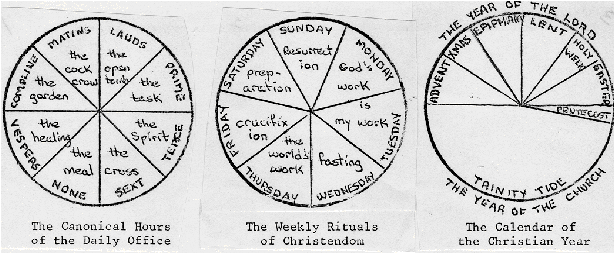
527 AD The liturgy was designed to create a model for daily life out of
the paradigm of the life, death and resurrection of Jesus the Christ. Benedict
devised a fantastic system of the gaily office. The canonical hours include
the eight seasons of prayer during the day. The seven days of the week
each rehearses again expenditure, crucifixion and resurrection. Every hour
and day tells the story that allows life to count and states what your
life is about. There was a calendar of the Christian year which rehearses
the mystery of life once more.
There is the year of the Lord and the year of the Church; there is a
time for remembering the expectations, a time for remembering the gifts,
the kingships, and the fallenness and the brokenness and the resurrection.
It rehearses the whole of life again very concretely in order to say that
our lives as human beings are all about longing for something that isn't
here. That longing is human and good. To accept that longing, repent of
it, and live in it every day is the message. Our life is full of being
gifted, being unworthy and being magnificent. The rituals say rejoice,
you do not have to earn this gift. It is yours. Every bit of the structure
of the day, the week and the year dealt with the existential life of human
beings, with sanctifying it, bringing life, healing and significance into
all aspects of life.
In our modern day, we have a hold of a new reality. Canonical hours
no longer are as relevant for the church. It took them 216 years to come
up with that ritual answer to their dilemma. We too have time to continue
work on the ritual process for our day. We are in a similar period of betweentimes,
when the old ways are no longer adequate and the new ways have not yet
taken root. We have talked about it as being between modern and postmodern
times. Here is a familiar chart of the premodern, modern and postmodern
times. It has a few different words from what we usually use. I found it
refreshing to go back to school and find out that other people are talking
exactly the way we have been. They use different words and sometimes have
a fresh way of grasping what it is all about.
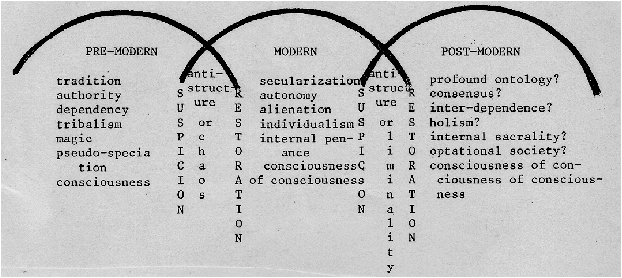 |
In the premodern time, we lived with a very clear understanding
of our relationships. We lived the structure of society. Our loyalties
and our feelings were limited to our tribe or nation or race. Pseudospeciation
is a formal word for naming the attempt to make narrow loyalties a natural
order of things. Our religion and our piety were akin to magicthough
it can be argued that this was an accretion to the deep grasp of reality
to which our ritual life has always pointed. Whenever the zenith of creativity
is passed, accretions begin to build up like barnacles to disguise and
weight the freedom of the spirit.
In the modern world, our times have been marked by autonomy, by reaction
to societal structuring and to anything which is not scientific and empirical.
We have experienced the collapse of all structures with the result that
we fight with our lives to discover what a family is, what a community
is, and what it means to be human. Alienation, suspicion and immediacy
mark our time. But we are weary of the chaos and long for peace and a commonsense
approach, a new structuring that will bring full life for all earth's inhabitants.
People on the street are aware of the powers and mystery in the midst of
life, but as a society and a world, we have not found the way to ritualize
or to dramatize that the power, that enabled the killing of 20 cave bears,
is within us and with usa power which is not our own and yet
which we possess. We are camping out in the last days of the modern era
with a vision of what could be but no clear way to move toward it
The categories under the postmodern world section are suggestions
made by Victor Turner and others as they see the world and the emerging
paradigm. The wholeness and profundity of life which are in the midst of
this life are emerging again. We have to grasp the mystery, power and wonder
that is life and live it all over again. But in the meantime, we live in
a time of liminality. We live in a time of antistructure. We live in a
time that is no lonner modern and it is not yet postmodern.
Liminality is a term used a great deal in writing and speaking today.
It comes from the word "limen", which means threshold. It means
standing in the doorwaywhen we are not outside and we are not
inside, we're really nowhere. We stand in the chaos and in ambiguity. We,
as a society, struggle particularly with the breakdown and collapse of
all the things on which we thought we could depend. We constantly face
the leveling of human groups and the neglect of tradition. We face unknown
anonymity, reversal of status and ambiguity that is upon the face of the
whole earth. We, in this particular body, The Order: Ecumenical have built
that structure into our yearly, daily and weekly time designs. Perhaps,
our greatest gift is what we know about liminality.
Society is very clear about how to perform the ritual of suspicion,
or as Ricouer calls it, the hermeneutics of suspicion. People know how
to cut themselves off from the past. They burn flags, tear up draft cards,
revolt against another nation that has held them in league and stage protests.
There are many ways to say no to the links to the past. Society has learned
that well, but society has no way to deal with the rituals of restoration.
We know we will never go back to the old traditional autocratic, hardnosed
ways. The question now is how do we perform the rituals of closurethe
rituals of restorationthat allow us to structure the unity, wholeness
and stability that can nurture all our lives? How do we say no to the partial
and yes to the wholeness of life? I believe this is the arena where we
have something to offer.
As long as society does not have the rituals of restoration, we can
only continue in the chaos, pain and suffering which are seen in every
home and on every city street. Victor Turner says that religions no longer
have the power to create the healing society needs. Now religion has not
lost power, it is the religious institutions which have lost power. Other
components of society are picking up the religious dimension. For instance,
artists, great novel writers and poets are doing a tremendous job of getting
the religious perspective into life.
Another one of these components is the legal sphere. Sally Moore suggests
that the most acceptable rituals of healing in our society today are the
legal ones. These pronounce guilt and innocence, existence and termination
of relationships, penalties and rewards decreed by society at large. Society
as a whole tends to support and acknowledge legal rituals when it flaunts
all others. Yet legal rituals, by their very nature, cannot deal with the
depth human issues of people and society and cannot bring healing and transformation
into the spirit depths of life.
Thus, there is a strange anomaly, for at the same time that we look for rituals of closure we are desperately in need and of rituals of restoration. Victor Turner says that the base of all these rituals is the root paradigm. He says that the society appears to be operating smoothly at the surface level, like a fine veneer of soothing interaction until some break or dysfunction appears in the social structure. If this deepens into crisis, then suddenly the panic syndrome causes us to act with a passion we were not aware we possessed. This diagram looks a little bit like the Ur image diagram we've used. When rupture occurs we act, not out of our self images, not out of our family traditions, ideologies' religious
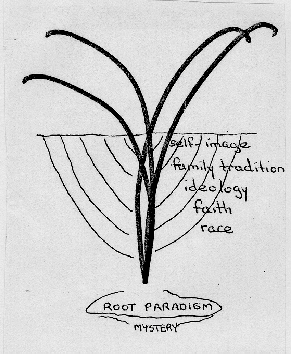 |
faiths, race. We find exploding within ourselves, erupting
out of ourselves something that we cannot explain. This happens not so
much in the time of crisis as when we try to heal the crisis, bring redress.
Then we find ourselves other people acting out of strange, deep, perplexing
motives that are far below the levels of our consciousness. Turner calls
this level the root paradigm. Now a root paradigm may be totally destructive
or it may be totally helpful and creative. We have seen both in our day. I find I have great anxiety when we use the line in a ritual, "life only comes from a death." Of course, life only comes from death; everybody knows life only comes from death. The Jews understood that dynamic. That's why they killed pigeons for sacrifice. They rehearsed that dynamic on the Day of Atonement. That's why |
today people killed an old man on the street a few blocks from the Chicago
Nexus. They believed that life only comes when you get the opponent out
of the way and you grab what is his. Behind these deaths, you find the
root paradigm that says life only comes through the death of the enemy,
or life only comes through human sacrifice.
We come from another tradition that says life only comes when life is
given up on behalf of another. That is a totally different paradigm. Do
you remember the Spanishspeaking black man in the book The Pawnbroker?
He worked for the pawnbroker. Near the end of the book when the shots were
fired by the thief, he flung his body in front of the pawnbroker. As he
lay dying the pawnbroker asked him, "Why did you do that? Did you
think about what you were doing? Was it intentional? Was it just reaction?
How did you happen to give your life for me?"
This decision is not a cerebral process, it is something from the very
depths of our being that forces us to act in one way or another. Of course,
we are clear that we have the paradigm we choose to stand before, and we
have a great many images already within our own minds. Yet at moments of
great decision, a deep passion already within us bursts up, explodes and
erupts. How do we judge and decide? Why do we act this way and not that
way? Is it because of some sort of stoic decision? I don't think so. Is
it an intellectual decision? I don't think so. It happens through something
which we have trained ourselves to understand with our bodies, with our
minds and with our senses. For we realize that ritual finally has almost
nothing to do with intellect. Ritual comes out of a depth life experience
in which we stand before the awe and the mystery of life. We use some way
of deciding which involves all our senses. It involves touch, the smell
of spring, the sign of blue, the sight of a candle and the feel of the
cold. These kinds of things become icons first. They recall the span of
our experiences. Then, in reflecting, we slowly discover words that help
us articulate those experiences. These words form in our memory, in our
visioning, in intuitions, in hoping, and in dreaming. These ways of articulating,
these ways of recalling our experiences, we call myth.
We take all of thisthe pictures, the sound, the feeling, the
articulationand we put them together in an acting out, a drama
which rehearses life all over again, for it recreates the event. It recreates
the possibility of the wonder and the power. The drama allows us to bring
the "happening" into this very moment. This is the ritual, the
enactment that involves all of our powers, all of our senses and all of
time and space. This body of people have done a superb job in this arena,
but we must not forget the scope of the ritual process lest we become traitors
to life itself. We must not cling to what we have done in the past, but
we must cling to the wisdom of the past. We dare not slip into any notion
that just reciting a few words is doing the ritual.
 |
The ritual in which we are involved is more than the ritual of Daily
Office done at 5:30 in the morning or the rituals we may do around collegium
tables. They are part of the ritual process, but the ritual process is
much bigger. The ritual process includes everything we do, everywhere we
go and every action in which we participate. It is our whole life together.
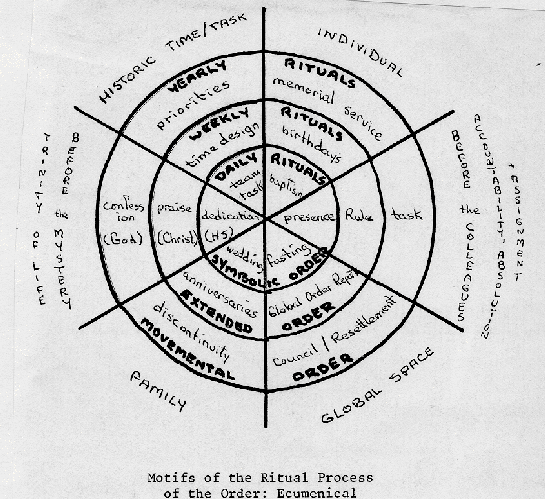
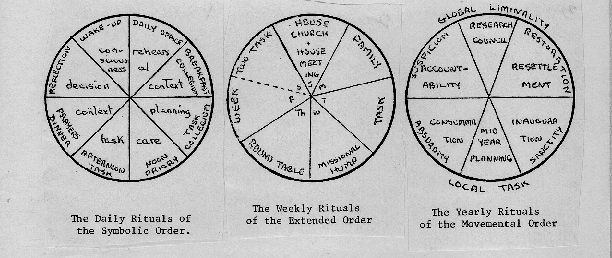
This is tremendously important! If we look at this next image we will see
that we have put an overlay on the Christian symbols of the canonical hours.
Seven times a day we publicly rehearse accountability and absolution. This
is a major, dominant theme of our ritual system. Accountability, absolution
and assignment may be one of the most important things that we do. That
dynamic is desperately needed by the world today. People are not held accountable,
except by accusation. They are not absolved, except by being told that
their expenditure is insignificant and doesn't matter. Assignment comes
as drudgery and burden. But, for us, accountability is the significating
of every human being's expenditure. Absolution is acknowledging that it
is out of the very failure of our corporate and individual lives as well
as the success that the future is birthed. We must remain conscious of
that gift of life. Our task every-time we gather together, every time we
send each other out is to acknowledge that we are those people who have
a task to do and the task must go on. That is our gift
|
|
Within all of our time as an Order, there is an overlay of the themes
and motifs that run through our rites. For instance, in the historic time/task
section of the image above there is a team task every day, a time design
for every week, and priorities that are named yearly. Each step has a highly
defined ritual that overlays our time.
We also bring all space into our engagement at every moment. Each day
at breakfast, the ritual of reading the names of the houses which are fasting
brings the globe into the collegium room. This may be the first time in
history that time and space have been united in rituals in this way. Every
week as we read the Global Order Report, all of space is with us selfconsciously.
Every year as the priors gather in this room and as the assignments are
made, people bump up against the global dynamic. Finally, there is no way
that we can live before only one local situation, yet the local is present,
too.
We celebrate the individual and the family. Weddings and baptisms take
place in the context of Daily Office. Birthdays and anniversaries are celebrated
every week. Memorial services and discontinuity to visit extended family
are held within our patterned time. All of this allows every dimension
of our lives to be part of our rituals and existence and to be a healing
dynamic in life. Therefore, these things are tremendously important but
not just for ourselves. If all of this were just for the sake of having
a great community, then we should forget it. But if you remember the way
society erupts and has no chance to ritually become a community again,
then understand that what we have here is a way to serve society. We have
a way to bring that closure, that healing to society again. We already
do that. Town Meeting brings ritual healing. The Global Social Demonstrations
are doing exactly that. LENS does that. All our social programs are, in
fact, ritual processes for the healing for all of society.
We have to be clear about the rituals we regularly enact because we
are now in the position where we have to create new rituals. We have to
create new ways of acting out and dramatizing our rituals. We have to hold
onto the fact that ritual in its simplest form is about only three things.
|
|
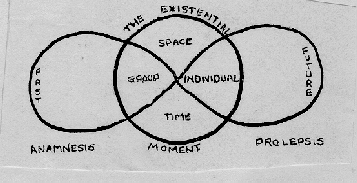
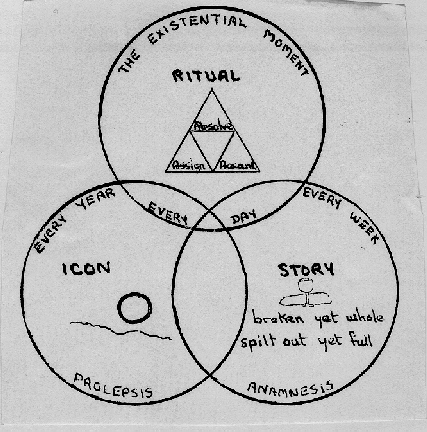
The first one is anamnesis. Anamnesis simply means against amnesia,
against forgetting. It has to do with the intentional recollecting of those
things and those events which life has taught us are crucial. In every
ritual we have to selfconsciously ask what is it that we have to remember.
Why is it that we dare not forget? What are the mysterious intrusions of
power and wonder into our lives that are necessary for our livesthose
without which we would be destroyed or taken out of existence? We traditionally
celebrate this on Sunday when we break bread and spill wine. We rehearse
or remember that this is the way life isbroken and yet whole,
spilled out and yet full. All of life is this way. That is what we are
saying we have to remember.
The second thing that ritual is about is called the prolepsisthat which allows us to make the leap into the future. For any ritual which only holds onto the past, which only remembers the past is unhealthily attached to the obsolete. What good does it do to remember the Holocaust except for the sake of seeing that it never happens again? What good does it do to remember the mistreatment and the pain that minorities and women have suffered unless it is linked with a will to transcend the past, to break through into a new relatedness which uses those agonies to produce sensitive concern for all human life and all cultural manifestations. What good does it do to remember all of the gifts we have received in the past as a nation if it is not for the sake of the future and for visioning what it could mean for all people to live free and to live with the goods that they need in this world as human beings.
Anamnesis and prolepsis are the two bookends of ritual and they are
easy, in one sense, to deal with intellectually. The crucial aspect is
the middle part which is the existential momentthe existential
engagement. Our feelings and intuitions, our particular experiences of
the heat and the cold, the task before us, and the pain and the struggle
of that task are all dimensions of that moment. It is the existential moment
that defines what we are doing. This is why it was fantastic in the old
form of the Daily Office when a colleague spontaneously got up and danced
down the middle of the Great Hall. In the formality of our daily ritual,
we must not lose the spontaneity, the possibility of calling out what must
be in the future. We must continue to rehearse in depth our history. We
must continue to involve our whole body, for ritual is not a cerebral matter,
it is corporeal. It is not a matter of speculation, it is a matter of praxologythe
practice of living out our lives. It is not a matter of stepping aside
from life and being detached from it. It is a matter of really engaging
in all of life for 10 to 20 minutes a day in order that the rest of our
time may be lived out of the wholeness and healing that is there.
A symbol of the existing rituals of the Order: Ecumenical suggests that
of the many symbols, myths and ritual acts which have developed in projects
and houses around the world, one dominant set of ritual components can
be discerned. I want to suggest that the existential moment for us has
to do with the accountability, absolution, and assignments that we rehearse
over and over again. I see as the icon we stand before being the earth-rise.
This tremendous visual symbol allows us to see there is one world and that
it is only a part of the entire universe. It reminds us that it is our
world. There is not any power beyond which is going to deal with it, but
that mysterious power is within, about, and
|
|
ever-present creating wholeness and fullness. The story that we need
to rehearse and not forget is that the brokenness of life and the wholeness
of life is that by which we are all allowed to live life fully.
The thing that is so exciting to me as I study the ritual process is
the discovery that it is our ritual life which society needs. It is our
ritual life as revealed in our secular courses and daily activities, although
we have just barely scratched the surface of the process. We need to be
working at two levels. One is our external ritual mission, and the other
is our internal ritual enactment. The two together bring healing. We cannot
forget either one. Unless we are very intentional and very careful of what
we get said in our internal life, our external mission will go down the
drain. When we get rituals into secular language, we forget so easily what
is at the root We forget the root paradigm that is the basis of all our
ritual.
Therefore, we have a tremendous task, not to invent something new, but
to discern where the spirit of God is moving across the face of this earth
today. We need to put form on the emerging stories, icons, bodily actions,
dreams of the earth's peoples, the whole ritual process that we see is
needed for the globe. There are some things which we do that will never
become global. They are far too limited in their applicability to the way
life always is. We need to understand again relative to our ritual process
what we have always said about our courses. It is the structure that freights
the meaning. Thus, we do not have to be too excited if the person giving
the absolution uses terrible poetry and horrible theology, in the first
instance. Because it is the absolution, it bears all the weight of what
absolution is and therefore is effective. On the other hand, we better
be extremely careful what we say for absolution and how we articulate our
memory of the past. We must be very careful in everything we do how we
articulate the way life really is.
We have to be sure we do not point the finger at some other place to
talk about where life really is. We say "This is life!", not
"That is life!" It is here; it is not over there. We must carefully
articulate what it is and what it is not. We have to be concerned about
these aspects and yet at the same time we have to be totally relaxed. I
figure we have been working at this seriously for ten years now. We may
be able to work a little faster than Benedict, so let's say we are going
to try for 200 years to work on the ritual system. Let's be relaxed and
yet be careful about our work. Time and concern will allow us to articulate
the new ritual system.
The most amazing, frightening, terrifying and wonderfilling thing about
the symbolic arena is that presumptuous statement that we do not do
the Daily Office, we are the Daily Office and the reality which
is behind it. Any ritual begins with an event from which pictures and images
emerge which are eventually articulated and finally acted out. What is
the event which marks the new global age? Was it the earthrise? Maybe,
but I do not think so. Was it the atom bomb? What is the global event?
This sounds so presumptuous that I am scared to say it, but I think we
are it.
We are a bunch of nobodies, an insignificant group. But when we work
togetherblack, white, red, tan, brown, and yellowin
the villages and cities around the world; when weHindus, Buddhists,
Muslims, and Christianswork together in a Religious House for
the sake of the world, we become the spirit that is moving in us to create
a new possibility. We are it. That is a frightening thing to say. We do
not believe that we could be it. Do we realize what it means to say that
we believe in the spirit that moves and changes life, that we believe in
the spirit that is in every human life, and we believe in the power that
creates the entire universe and yet moves in individual human lives? We
believe in the God in you and me and in every human life that continually
creates new life. How do we get it said that the creative power, the process
of the universe, is not outside the reality of life but is found as we
stand before the limits in life with a stance of possibility.
My seminary professors were baffled with us. They said, "You people
are so realistic and yet you are so optimistic. It doesn't make sense."
Then we said, "Well, that is the dynamic of God the Father, God the
Son and God the Holy Spirit." Our task is to continue to stand in
the limits with a stance of possibilityto be our free decision.