Order Council
August 12, 1972
THE HISTORICAL ORDER :
Movemental, Extended, Symbolic
MASTER INTRODUCTION
TWENTY
YEARS
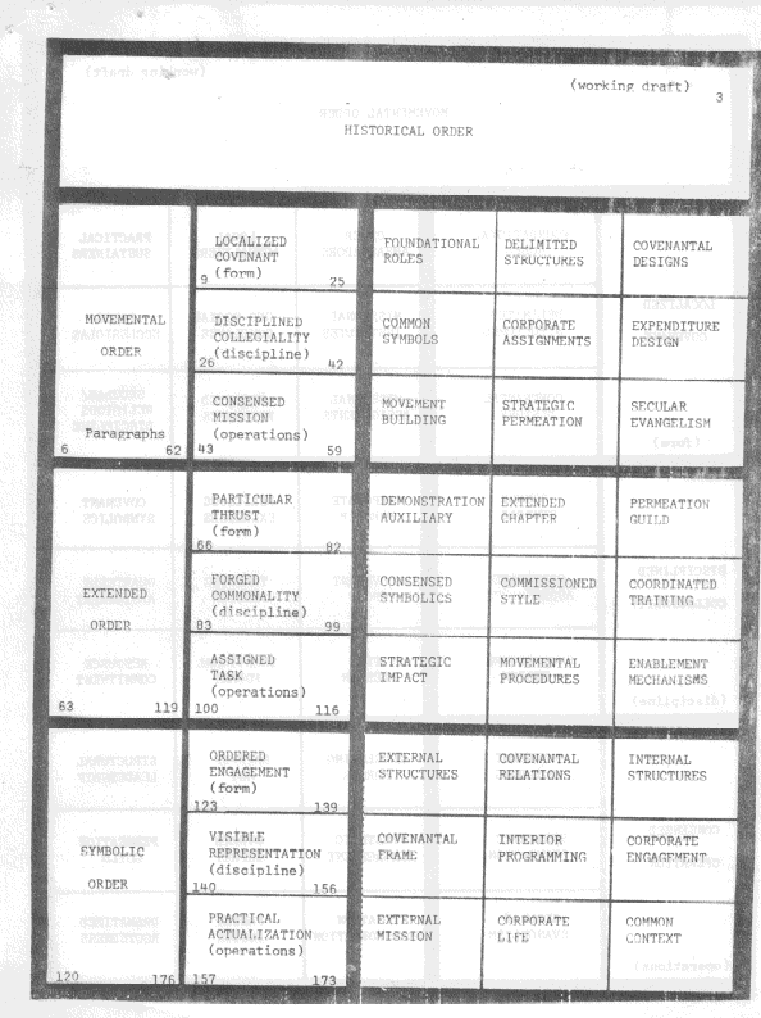
| 1. As an Order, we stand at the end of twenty years in our life and mission, facing a turn toward the world during the next 20 years. The time has come to set forth our present wisdom about the continuing experiment of being an Historical Order. This document is our first inclusive reflection on 20 years of practical experimentation with the Order dynamic. It describes the arenas toward which we point to portray an historical order in the age in which we live. It is a sketch of the various manifestations of an historical order called to our corporate selfconsciousness from our practical experimental wisdom. It is not a definitive statement on an historical order, and cannot be 80 understood. Rather, it is a working draft, in which may be found overlapping descriptions and even contradictory interpretations. Our intention in writing and publishing it at this time is to provide fruitful data and suggest useful directions for further research. We began our work with the definitional context which is found in the following three paragraphs.
|
MOVEMENTAL
ORDER
|
- 2. The Movemental Order is expressed in those colleagues out of the total Movement of the Holy Spirit in our day who stand as the Order, convey its understanding, and do its mission in the midst of the social context. Fate has bound them to some particular station in life. The Movemental Order, while not available for global deployment, embraces global responsibility by receiving assignment within the context of their vocational and geographical limits. This assignment, therefore, turns fate into the Divine Providence of a significant election.
|
EXTENDED
ORDER
| 3. The Extended Order has committed itself totally to being the Order and in principle could be a part of the Symbolic Order. They are under full assignment and are strategically assigned to a social station to represent, embody, and execute the mission of the Order. Their commitment to the Order is no less than the Symbolic Order.
|
SYMBOLIC
ORDER
| 4. The Symbolic Order is the symbol and sign of the total Order. It embodies in fact the decision of the Order to be a particular presence in history. The move to live in the ghetto, for example, is in fact as well as in spirit. It is the least deployed into society while it is the most sociologically observable form of the Order as the Order.
|
DOCUMENT
CREATION
| 5. The Historical Order Document was written August 12, 1972, by the Order Council at Base Centrum, Chicago. Building on the Designs work of the Summer '72 Research Assembly, the Order workshopped and corporately wrote its present images of the dynamics of the historical order. The rational frame was designed to hold the diverse wisdom of the Order in all its richness. This document, therefore, is written from the particular data of the Order's experience. Reordering the rational frame in the light of that data is a task which is yet to be done. The structure of this document follows the outline of three major dynamics of the historical order. Its basic content describes each of those three dynamics first in its objective sociological form, then in its discipline, and thirdly in its operation. Thus it holds in a uniform pattern the unique distinctiveness of the Movemental Order, the Extended Order, and the Symbolic Order in our time. the rational frame in the light of that data is a task which is yet to be done. The structure of this document follows the outline of the three major dynamics of the historical order. Its basic content describes each of those three dynamics first in its objective sociological form, then in its discipline, and thirdly in its operation. Thus it holds in a uniform pattern the unique distinctiveness of the Movemental Order, the Extended Order, and the Symbolic Order in our time.
|
 |
 |
I. MOVEMENTAL ORDER
OVERALL INTRODUCTION
MOVEMENTAL
ORDER
| 6. The Movemental Order stand self-consciously before the suffering of the world and responds by deciding to be the front line servants covenanted within the dynamic of the global historical order. Their destinal vocation is a particularized and localized form of mission to which they are assigned. The overall thrust of the assignment for the Movemental Order is defined by the strategies, tactics and timelines of the Movement. Consequently, the Movemental Order is the dynamic through which the Historical Order is engaged at the grass roots as direct catalytic agents. In this way, the Movemental Order holds the Movement accountable to its task and holds the whole Order dynamic accountable to concrete historical reality.
|
PARTICULAR
COMPOSITION
| 7. The Historical Order calls forth those who have self-consciously decided to be the orderingdynamic in the most particular situation. These are the secular/religious businessmen, professionals, ecclesiastical leaders and political representatives who are fated to a particular life station. The scope of the Movemental Order embraces those who are responsible to God for the world.
|
| SOCIETAL
FUNCTION
| 8. The Movemental Order in the dynamic of the Historical Order first acts as the frontline servant which is the locally committed grass root leadership and the financial support of the Movement. It is the local grounding of the Order style within the establishment structures. It is the representative and defender of the Symbolic Order, embodying and relating Movement philosophy that provides strategic continuity. Lastly, as the visible church, it sustains and provides the machinery of local care and stirs the consciousness of the neighbor.
|
- LOCALIZED COVENANT
OVERALL
DESCRIPTION
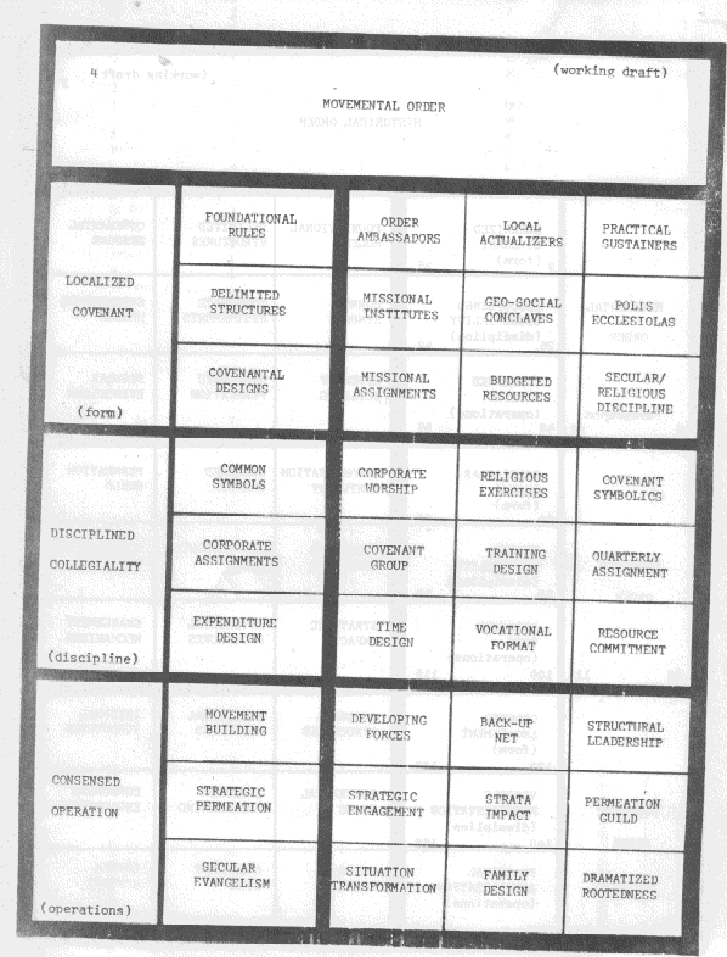
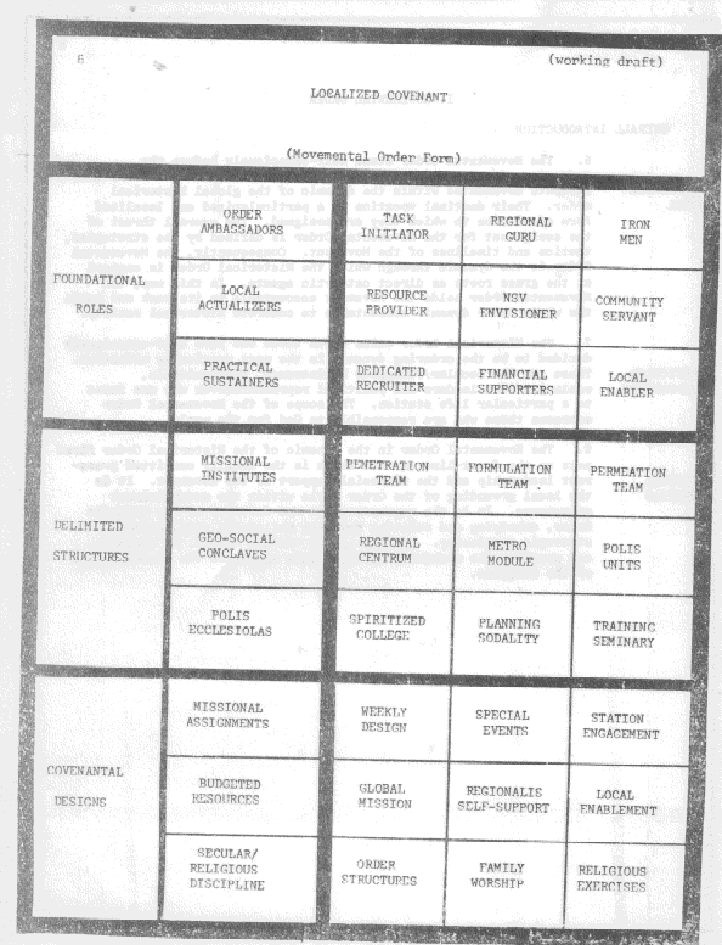
| 9. The form of the Movemental Order is Localized Covenant, consisting of Foundational Roles, Delimited Structures, and Covenantal Designs. This covenant sets the context for the missional relationships embodied by the ovementa1 Order and manifested in the Foundational Roles assigned by the Historical Order. The Localized Covenant also sets the context and direction for concrete engagement in the task of the Historical Order. This engagement is delimited by the particular structures of the Movemental Order such as Missional Institutes, Geosocial Conclaves, and Polis Ecclesiolas. Finally, this covenant provides the corporate operational accountability for the assigned tasks through its Covenantal Designs. Within the context of the Movemental Order member's vocation, family, and geographical limits, this covenant transforms fate into meaningful destiny.
|
FOUNDATIONAL ROLES
GENERAL
DESCRIPTION
|
- Local Foundational Roles give selfconscious form to the Movemental Order's decision to be the global Order in the local situation. Within the Historical Order these roles focus the universal context within a particular situation where a selfconscious Order member acts out his missional decision, and identify the individual's participation in the Order. The role or roles define a story of missional engagement and enable him to "reap the unique gift he is to the mission. The region's unique style is created out of the embodiment of those roles; the sustenance of the individual 's spirit is assured by participation in the symbolic life of the Order. The characteristics of each role may be embodied individually or corporately; they are not mutually exclusive but one individual may embody more than one role for missional effectiveness.
|
ORDER
AMBASSADORS
| 11. The Order Ambassadors are those covenanted with the Historical Order who work with the regional dynamic through Movement structures such as the Religious House. As part of the Order they provide
leadership for the region and relate the Movement and the Order to ecclesiastical and social dynamics, preparing the way for Movement activity at all levels. Task initiators are those who build overall regional/metro rationales and models and assure completion of the necessary deed. Regional gurus discern the mood of the region or metro, and provide creative intellectual and spirit leadership. Iron men are established individuals who serve as intermediaries and provide common ground for the meeting of
Movement, Order, ecclesiastical and societal forms, providing the common thread in the social web.
|
LOCAL
ACTUALIZERS
| 12. Local Actualizers stand within the local situation, committed to specific Movement tasks and experiments, and working for change in the local situation where they are deeply and totally committed.
Resource providers are the stewards of unique and irreplaceable resources which provide backing for the Order and Movement as a whole in limited by significant availability. NSV envisioners
are the indirect tacticians, the subtle embodiers of the NSV in the every day. Community servants are the indispensible citizens.who employ their servant roles within the community for direct missional use.
|
PRACTICAL
SUSTAINERS
|
- Practical Sustainers are those grassroots people who, operating out of the RSI context, see themselves as the broadbased supporters of the mission of the Historical Order. These people are the prototype for how most men can participate in the NSV, for they are a practical observable example to every man of the possibility of immediate particular engagement. Dedicated recruiters are those whose stance is systematic, thorough, and evangelistic. Financial supporters are committed to assuring the financial support of missione1 activities. Local enablers provide resources and transparently perform the missional task.
|
DYNAMICAL
RELATIONS
| 14. Foundational Roles are related dynamically to each of the other forms of the Movemental Order, and to the forms as a whole. Foundational Roles creates Delimited Structures by demanding tasks that require troop involvement; it limits Delimited Structures by defining specific roles of involvement; it sustains Delimited Structures by organizing the troops for involvement. Foundational Roles creates Covenantal Designs by demanding the context of partici pation; it limits Covenantal Designs by requiring actualization of intentions; it sustains Covenantal Designs by providing examples of obedience to the covenants. Foundational Roles create Localized Covenant in giving a framework of involvement, it limits Localized Covenant by providing guidelines; it sustains Localized Covenant by providing the nurture of constant involvement.
|
DELIMITED STRUCTURES
| GENERAL
DESCRIPTION
|
- The second aspect of the Localized Covenant of the Movemental Order is Delimited Structures. These are the structures through which the Movemental Order concretely embodies the total vision and task of the Historical Order. They are the social framework in which the Movemental Order shows up. It expends itself through these structures in global mission in the particular locale which is its chosen fate. These structural forma provide the polity, priorship, nurture, and missional direction for the Movemental Order.
|
| MISSIONAL
INSTITUTES
| 16. The Missional Institute is the delimited structural form which directly engages the Movemental Order in the external thrust of the Historical Order within the given fated limitations of the members of the Movemental Order. The Missional Institute is the structure by which the Movemental Order is concretely engaged in recruitment, nurture, and social outreach within a specific geosocial area. This Missional Institute is not a structure apart from the current ongoing structures of the Order and Movement, rather it delineates a peculiar structural form of missional engagement which characterizes the Movemental Order. Penetration team indicates the form which engages the Movemental Order in the recruitment, teaching and enabling of courses. Formulation team is the form by which the Movemental Order is uniquely engaged in the task of catalyzing, giving form to, and sustaining the Movement. The permeation team is the form by which the Movemental Order is engaged in actualizing the New Social Vehicle in certain given structures.
|
GEOSOCIAL
CONCLAVES
| 17. The third delimited missional structure is the Geosocial Conclaves which include regional centrum, metro modules and polls units. These Conclaves are primarily responsible for comprehensive caring of the Spirit Movement. Regional centrum is the inclusive polity dynamic which is responsible for the appropriate overall contexting of Movement forces and the inclusive assignment rationales. The metro modules are the missional priory of the region who in their various metros operate out of common time designs and operational formats. The polls unite who are responsible for providing trained missional priorship of the polis are obedient to the module priory. The Conclaves set the overall context for the Movement's decision making, provide the trained priors who guard the comprehensive vision, and give directions for concrete missional tasks.
|
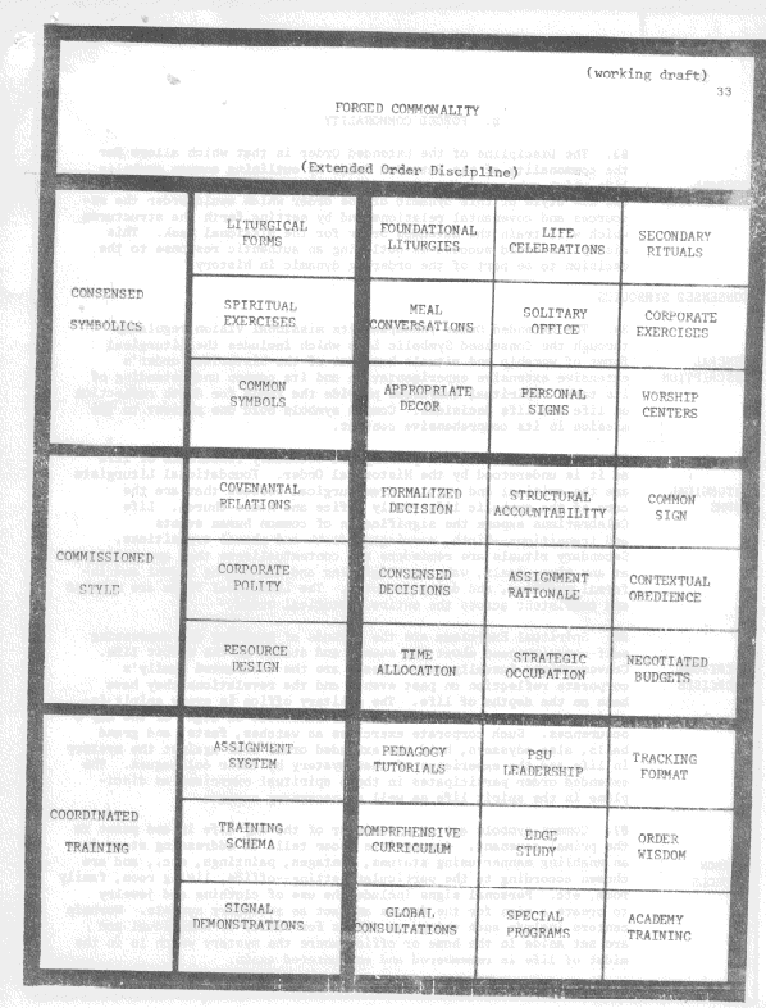
POLIS
ECCLESIOLA
|
- One of the delimited missional structures within the forms of Movemental Order is the Polis Ecclesiola. It is designed to provide comprehensive care for those who grasp themselves as the movemental order dynamic of the Historical Order. It includes the dynamics of spirit intensification, intellectual nurture and appropriation of task assignment and accountability. The forms of spirit intensification would be the spiritized college, while the planning sodality would create a comprehensive context for the teak of relating the ecclesiola to the total mission, and a training seminary which would be the intensified study dynamic which sees that the Movemental Order maintains clarity on the Word and senses after the edge points of engagement relative to the world. The Ecclesiola would appear where needed but the Religious House Ecclesiola would be attended where feasible. Other forma might be a traveling ecclesiola which moved from metro to metro. The point is to provide the Movemental Order with a care construct, not to reduplicate structures. As leadership is the Key contradiction today, it is suggested that the Symbolic Order provide and train ecclesiola leadership.
|
| DYNAMICAL
RELATIONS
| 19. Delimited Structures are related dynamically to each of the other two forms of the Movemental Order, and to Localized Covenant as a whole. Delimited Structures is dynamically related to Foundational
Roles by creating particular points of involvement, delimiting the tasks to be accomplished and sustaining a constant demand for participation. Delimited Structures creates Covenantal Designs by calling for structural commitment, limits it by defining the necessary covenant, and sustains it by providing an area of expenditure. Delimited Structures create forma of the Movemental Order by demanding organization of the mission limit them by providing specific actional arenas, and sustain them by setting forth the rationale by which Localized Covenants are created.
|
COVENANTAL DESIGNS
GENERAL
DESCRIPTION
| 20. The third arena of the Localized Covenant is Covenantal Designs, which illuminates types of covenants within the Movemental Order, and consists of Missional Assignments, Budgeted Resources and Secular/religious Discipline. Covenantal Design objectify the decision to be the Historical Order and enable corporate accountability to that covenant. Missional Assignment provides the form through which
assignments are made within the context of one's assigned station, and includes both the Week I and Week II rationale. Budgeted Resources enable missonal use of available resources on the global, regionalis, and local level. The Secular/religious Discipline gives form to the symbolic life to which the Movemental Order has covenanted itself, both the individual/family and corporate aspects common to the Historical Order. Through Covenantal Designs the Movemental Order formalizes the covenant to which it will be held accountable.
|
MISSIONAL
ASSIGNMENT
| 21. The first form of Covenantal Designs is Missional Assignment, which specifies engagement of time and includes weekly design, special events, and station engagement. Weekly design calls for commitment
of selected weekly time through Week I and II assignment patterns to ongoing Movemental activities such as ecclesiola, recruitment, and training. Special events assignments refers to the use of time for necessary missional events requiring special skills, such as the assignment of a dentist to a dental convention. Station engagement means assigning a worker to his job 80 that he sees his fated calling as integral to his comprehensive commitment. Missional Assignment call. for an overall time design which sets station, family, and movement teaks in the context of the total mission.
|
| BUDGETED
RESOURCES
|
- The second form of Covenant Designs is Budgeted Resources which symbolizes that all resources belong to the mission. One aspect of Budgeted Resources is sustaining the global mission or contributing to the global backup systems which sustain arenas where the Movement is not yet selfsupporting. An example of this is contributions made to the development team or money sent to support the ITI's. A second aspect is regionalis selfsupport or contributions to keep the Movement selfsupporting missionally in the particular regionalis in which a person shows up such as contributions made to support RSI courses. The third aspect is local enablement or the use of resources to sustain the individual and family, and the local church or extra expenses incurred while on missional assignment. The Movemental Order stands as a sign, through the use of its resources, of total expenditure on behalf of the world.
|
| SECULAR/
RELIGIOUS
DISCIPLINE
| 23. The third form of the Covenantal Designs is Secular/religious Discipline which gives a structured relationship to the symbolic life of the Historical Order. The first aspect of Secular/religious Discipline is the participation of the Movemental Order in the ongoing syrnbolic structures of the Symbolic Order such as Odysseys, treks, House Church, worship, and celebrations at the Religious House, during Movemental councils or Local Church Galaxies. The second aspect is participation in particular experiments in individual and family symbolic life. The third aspect of the secular/religious discipline is scheduled participation in corporate religious exercises such as the fast and the watch.
|
DYNAMICAL
RELATIONS
| 24. Covenantal Designs are related dynamically to each of the other two forms of the Movemental Order and to the entire Localized Covenant. Covenantal Designs create Foundational Roles by demanding style creation; limit Foundational Roles by providing the context of responsibilities; and sustain them by symbolizing accountability. Covenantal Designs create Delimited Structures by providing arenas of expenditure; limit Delimited Structures by demanding consensed participation; and sustain them by providing a common focus. Covenantal Designs create forms of the Movemental Order by articulating
the indicative of selfconscious participation; limit forms by proscribing the types of decisions; and
sustain them by creating the common mind.
|
CONCLUSION
OVERALL
DYNAMICS
| 25. Within the Movemental Order Localized Covenant creates Disciplined Collegiality by providing a framework to release selfconscious community; it limits Disciplined Collegiality by defining the arena of missional thrust, and sustains it by rehearsing the common context, in corporate symbolic life. Localized Covenant creates Consensed Operation by organizing commonminded forces in a missional direction; it limits Consensed Operation by defining roles and setting a style; and it sustains it by calling forth the missional family and providing necessary resources. Localized Covenant creates the Movemental Order by naming and organizing it; it limits the Movemental Order by focusing in the arena of commitment to give direction; and it sustains the Movemental Order by giving global commonness and visibility.
|
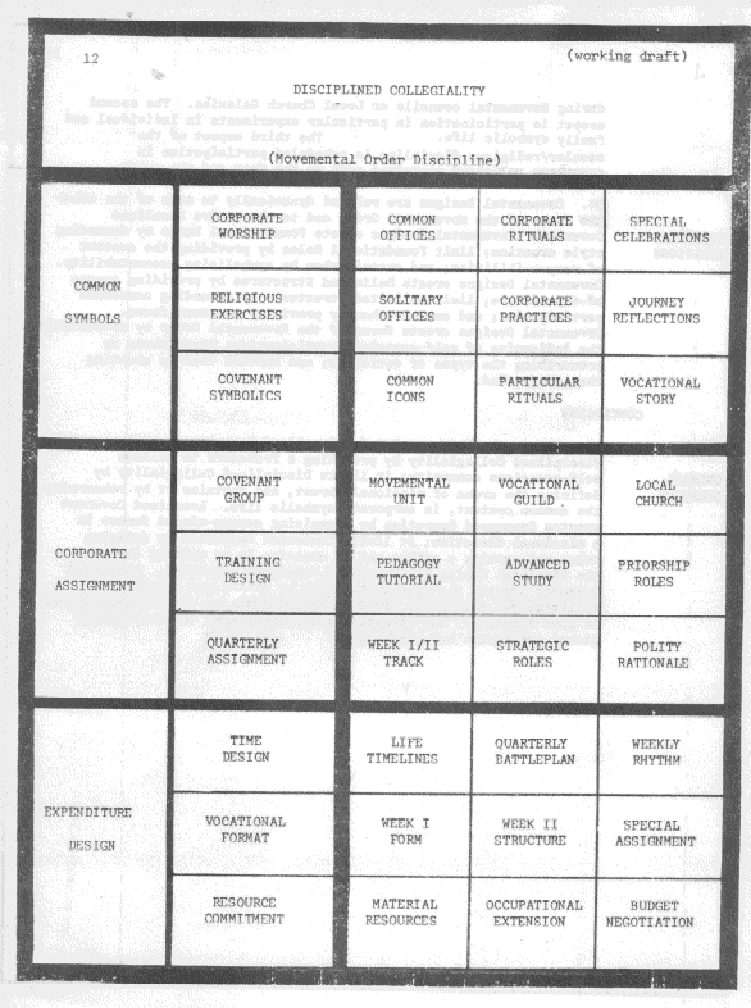
Page 12 of the original goes here - Not scanned
- DISCIPLINED COLLEGIALITY
INTRODUCTION
OVERALL
DESCRIPTION
|
26. The disciplined movemental spirit man undergoes continual preparation and training within the context of being missionally assigned by the Order. His 1ife is a journey intentionally directed, moving comprehensively out from the spirit deeps toward the futuric restructuring for a global society on behalf of all mankind. Toward this end he wills his time, his money, his gifts as a celebrational human being who is a concrete sign of the new individual in the new society.
|
.
COMMON SYMBOLS
GENERAL
DESCRIPTION
|
- Common Symbols is that reality in the life of the Movemental Order which focuses its worship 1ife and points to its commonness in relation to the other dynamics of the Historical Order. Corporate Worship enables a Movemental Order member to rehearse his common lifeunderstanding, recalling his individual decision to be one of the People of God. Religious Exercises dramatize and intensify his discipline as a solitary man of faith. Covenant Symbolics consists of myths, rites, and symbols thst remind him of his decision to participate in the ordering dynamic of history.
|
| CORPORATE
WORSHIP
| 28. Corporate Worship is the activities of common offices, corporate rituals and special celebrations, which enable the Movemental Order to rehearse the way it is; thereby evoking a selfconscious decision to participate in an inclusive corporate order. Common offices are those regularly scheduled corporate times when the spiritman intentionally rehearses the way life is; this would be daily morning office, Geneva offices and local church worship services. Corporate rituals are those informal times when the corporate body acts out life's drama through singing, special prayers, and accountability and absolution. Special celebrations are those crucial times when key turning points of life are dramatized corporately such as rites of passage, church year rites and special work days.
|
RELIGIOUS
EXERCISES
|
- In the aspect of Religious Exercises, we see the Movemental Order in the discipline of solitary office, corporate practices and journey reflection. The solitary office calls for the rehearsal of life as one reality through meditation, contemplation and prayer. There is a myriad of rehearsal activities such as the odyssey, the watch, the fast, and logkeeping that are corporate practices which allow the strengthening of the spirit depths of an individual. In the midst of the task, journey reflection enables the journey to the center by means of the solitary study, discontinuity and journal keeping. These various exercises sustain the solitary decision to be a man of faith.
|
| COVENANT
SYMBOLICS
| 30. Covenant Symbolics, which functions to remind the Movemental Order of its covenantal relationship with the Historical Order, includes common icons, particular rituals, and vocational atory. Common icons
|
Page 14 of the original document goes here - Not
scanned
15
to broaden the context and to move toward leadership.
Picking
up the priorship role includes accepting training
assignments
for leadership positions (such as Regional Council
planning) or to
a practice workshop, where strategies and tactics
for a particular
situation will be produced.
QUARTERLY
ASSIGNMENT
| 35. Quarterly Assignment is the overall rationale for the quarter that gives form to the movemental thrust and spells out how it is that every Movemental Order member will participate in the movement. It includes the Week I and Week II track assignment and within the tracks, assignment to specific tasks such as recruitment, course
enablement, child care, pedagogy, advanced courses, regional structures, guild or a local church cadre. Strategic role assigns the Movemental Order person to particular occupational work and/or to the permeation of secular structures and organizations within the community. The polity rationale designs the internal relationships that hold the Movemental Order person in care structures such as teams and units. Through Quarterly Assignment every Order member responsibly engages in the impact of the movement at the grassroots level.
|
EXPENDITURE DESIGN
GENERAL
DESCRIPTION
| 37. Expenditure Design describes the three dynamics held in the expenditure of life, first in the building of timelines from the very broad to the more explicit daily actional activities. The second is the context out of which the decisions are made relative to expenditure and the rational form used in holding them. The third is the expenditure and use of available personal resources for missional activities such as house, car, finances and political influence that deal directly with enabling the mission, thus expanding his whole context toward total mission.
|
TIME
DESIGN
| 38. The Movemental Order engages itself in mission through the use of several time designs. These designs enable a person to order his time so that all of his time enables the mission of the Historical Order. The most comprehensive design is the life timeline. A person recontexts his past and projects his future so that his entire life time is seen as a single expenditure. In order to act out this life timeline, a battleplan is laid over the timeline for the quarter. This locates a person in his role, as he actualizes the missional priorities for the quarter. Finally, a person has a weekly rhythm which meshes all 0a covenant responsibilities into one missional thrust. In this way, the tension of various covenants is held, and the assigned tasks are allotted the necessary time for their completion. In this way, the activity of time designs transforms his chronological time into kairotic time.
|
VOCATIONAL
FORMAT
|
- Making use of destinal rootage the movement assigns itself to every form of the Order's corporate life through a Vocational Format. The emphasis of the Week I form is the ongoing vocation of the movement colleague, his symbolic corporate life with the Order such as ecclesiola meetings, his local church commitments as well as movemental tasks. Week II structures is direct involvement with the corporate order dynamic by working on course recruitment, teaching, and any necessary enablement assignments. With the understanding that all assignments are flexible relative to need, the movemental colleague is ready at all times for special assignments such as making a development call instead of enabling a course.
|
RESOURCE
COMMIT-MENT
| 40. The arena of Resource Commitment deals with the decision to intentionally expend one's gifts of humanness for the sake of the global mission. There are many ways that Resource Commitment is practically manifested in the Movemental Order. For instance, such material resources that can be used include one's automobile for
missional travel; his house and telephone for recruitment and special events; and in some cases, one's business facilities. On the area of occupational extension the Movemental Order member can offer such gifts as his knowledge and skills, business contacts and data for research PSU's. His influence in political and economic circles can also be used for the sake of the mission. And finally, his negotiated budget stands as a sign of his total commitment to the work of the Spirit Movement.
|
DYNAMICAL
RELATIONS
| 41. Expenditure Design creates Common Symbols by providing the rationale for symbols that are needed; it limits Common Symbols by prioritizing the necessary symbolic life; it sustains Common Symbols by locating one in places where the symbols will be rehearsed. Expenditure Design creates Corporate Assignment by focusing the corporate arena of work; it sustains the Corporate Assignment through continual reminding of the necessity of corporate nurture. Expenditure Designs creates Disciplined Collegiality through delimiting the arena in which
time and resources are required; it sustains Disciplined Collegiality through investing individual expenditure in a corporate effort.
|
CONCLUSION
OVERALL
DYNAMICS
| 42. Within the Movemental Order, Disciplined Collegiality creates Localized Covenant by demanding commonness; it limits Localized Covenant by dictating a covenantal framework; and it sustains Localized Covenant by constant rehearsal of the symbolic life. Disciplined Collegiality creates Consensed Mission by providing accountability and absolution; it limits Condensed Mission by naming the arena of operations, and it sustains Consensed Missionby building strong troops. Disciplined Collegiality creates the Movemental Order by maintaining a common rhythm and style; it limits Movemental Order by dramatizing seriousness of the mission and by structuring thrust; it sustains the Movemental Order by building a network of collegiality enabling spirit struggle and growth.
|
Page 18 of the original goes here - Not scanned
19
C. CONSENSED MISSION
INTRODUCTION
OVERALL
DESCRIPTION
| 43. The operations pole of the dynamic called Movemental Order is described as Consensed Mission. The missionaI task, which embodies the Consensed Mission, strategies and tactics of the movement, defines
and prioritizes the particular engagement of the Movemental Order. It can be seen in the sustenance of the ongoing penetration, formulation and demonstration structures of the movement along with the actual
economic maintenance of the Historical Order. Again, within the context of the Global Spirit Movement, Consensed Mission engages the Movemental Order in a strategic plan, and the implementation of that plan, which impacts professional, civic and societal structures. And, finally, Consensed Mission creates the dynamic of spiritizing every given situation, such as family or primal community, within the context of the
other world. Where one sees such missional tasks going on, one sees the operations of the Movemental Order.
|
GENERAL
DESCRIPTION
|
- The Movemental Order acts as the backbone of the formulation forces in a locale, plays the role of mediator between the movement and establishment, and insures the historical continuity of the movemental thrust on the local level. Movemental Order members can be counted upon to do any Week II assignment, whether it be enabling courses, leading presidiums, or establishing cordial relations with a denominational representative. Also, the Movemental Order is in a position to provide the Order as a whole with a steady flow of both money and inkind gifts. The stability and respectability of the Movemental Order is a great gift which is sometimes useful to establish a necessary image of the Global Spirit Movement. Finally, within the whole Order the Movemental Order particularly holds the values of respect for history, thorough planning and orderly implementation.
|
DEVELOPING
FORCES
| 45. The Movemental Order carries out the operation of Developing Forces through the dynamics of area formulation, troop training, and recruitment and enablement. Area formulation is carried out through building the enabling machinery which develops an area beyond its initial stage of penetration by creating course followup structures, cadres, and other needed support structures. Troop training is actualized by offering comprehensive curriculum, pedagogical opportunities and priorship training. The recruitment and enablement dynamics are realized by creating comprehensive structures to enlist clergy and laymen for movemental training opportunities while providing the basic practical support systems that enable the training.
|
Page 20 of the original goes here - Not scanned
STRATEGIC PERMEATION
GENERAL
DESCRIPTION
| 49. Strategic Permeation as a major operation of the Movemental Order impacts society through Strategic Engagement, where the economic, cultural, and political dynamics are recontexted by the movement;
Strata Impact, which deals with the whole economic, political, and cultural community that surrounds one's work and the movemental contact possible within each strata; and finally the Permeation Guild
where research coordination and the implementation of practical model building begins to plot the actual implementation of the seven New Social Vehicle strategies and the regular systematic evaluation of
permeation procedures relative to global impact. The Permeation Guild is the key dynamical operational activity in that it gives practical application to the other operational dynamics.
|
STRATEGIC
ENGAGEMENT
| 50. Strategic Permeation as it relates to strategic practical engagement falls into three fundamental arenas economic investment, political influence and cultural patronage. Economic investment has to do with the availability, access, and usability of funds and resources of and within the movement from corporations, families and designs both outside and within the movement. The investment of, use of, and influence of other's investment and use of global resources is key to the redirection of economic patterns as a whole and to the sustenance of the Historical Order in particular. Political influence relative to Strategic Engagement would point to how the movement strategically plans to use its political relationships for the ongoing movement. This influence could impact the political from the local neighborhood contacts, to the state and national, to the international political community. This net of "political" friends could aid in movemental
impact across the globe. Cultural patronage as Strategic Engagement has to do first with human motivity and how you engage and encourage those dimensions of the arts and the cultural activities which will
provide the human freedom necessary for the implementation of the seven pressure points of the New Social Vehicle. This cultural fellowhood would provide the climate for a global, movemental, grassroots, tactical engagement.
|
STRATA
IMPACT
| 51. Strata Impact is an arena of operation within Strategic Permeation by the Movemental Order which affirms the reality of an individual's sociological relationships as seen through his occupationa1 thrust, his
relationships with the establishment and the community he shows Up in. The Movemental Order member is concerned with building the kind of relationships within his occupational situation which will be helpful in providing resources for the support of the movement. He is concerned with creating the climate within those relationships which will make implementation of the New Social Vehicle strategies possible. Beyond his relationships as defined by his occupation, he is working to address and influence the establishment he has access to through the use of the New Individual and Society course and other edge socio methodologies. In his given community he demonstrates a selfconscious posture embodying the style of transestablishment in relation to the issues and problems confronting that community.
|
Page 22 of the original goes here - Not scanned
SECULAR EVANGELISM
| GENERAL
DESCRIPTION
|
- Secular Evangelism is that ongoing catalytic agent which exposes the mystery in everyday life. This is accomplished through transforming the particular situation to encompass the comprehensive. This happens when, through popular preaching you enable the drug store clerk to grasp in a brief time his role in the totality of the Social Process. As the family designs itself to be mission, the presence of mystery is known in intentional conversations at meal times. Crucial to the creation of new humanness is the dramatization of radical and joyful embracement of the very particular situation, i.e. expressing your joy at being a file clerk for the next twenty years.
|
SITUATION
TRANSFORMATION
| 55. Situation Transformation is the dynamics of event contextualizer, comprehensive symbolizer, and popular preaching. Event contextualizer is the role portrayed by one who understands himself to be responsible for seeing that every situation is contexted in such a way as to have it become an event that all present participate in. Comprehensive symbolizer says through decor, rituals, songs and other symbolic activities that the future is created by decision, out of the past established structures, the critique of the disestablishment and on behalf of all men. Popular preaching is creating the brief but crucial occasions
to speak the Word of possibility? through minute courses, to those encountered in daily life and work. Thereby, Situation Transformation enables every situation to burst forth with new creativity and new life.
|
FAMILY
DESIGN
|
- Family Design engages the missional family to be the signal for the possibility of renewal by involving every individual and family in community reformulation. Through such concrete activities as the intentional use of money, the structuring of the gifts of each member of the family within the framework of the consensed family goals and the regulated rehearsal of the family destinal story, a missional de sign is evolved. It is thus that the family is equipped for its role as evangelist of the new life.
|
DRAMATIZED
ROOTEDNESS
|
- The decision to dramatize one's rootedness is the primal community is the self-conscious designing of one's time to accomplish the particular missional task; for example, planning comprehensively and structuring one's vacation to participate in the summer research assembly. The movemental man embodies the servanthood role by being the invisible nobody while enabling the continuation of the task; the cooking of meals for an RS-1 course is an example. Furthermore, while serving and sustaining the task he embraces life, and joyously continues his day to day participation in renewing the world.
|
Page 24 of the original goes here - Not scanned.
MOVEMENTAL ORDER
CONCLUSION
SOCIOLOGICAL
ARENA
| 60. Across the whole globe at those points where men have been awakened and motivated to participate in the renewal of the church and society, the Movemental Order appears in local communities, communities which
range from small towns to major metropolitan centers. The Movemental Order is found within the whole historical church: in the local congregation, in the administrative and educationa1 bodies related to all of its denominational forms. To find Movemental Order members one would also look to the major occupations or professions. These are especially in the fields of education, medicine, or law, in corporations' in mass media production, or in managerial and secretarial levels. Its dynamic is seen appearing in places of leisure, such as recreational clubs, golfing, surfing, or bowling; or at women's gatherings. As a living reality, the Movemental Order is seen working in and related to service organizations, women's societies, community groups and social service agencies. It plays this role as a method and a means to spreading the Word and being the style of servant to every secular man.
|
HISTORICAL
EMERGENCE
| In 20th century society the Movemental Order dynamic emerged in response to the technological revolution which resulted in urbanization and modernization, and in response to mass secularization, which result in the global collapse of religious myths. It emerged when liberal causes and movements proved an inadequate response to these sociological occurrences, and when the resulting despair gave way to a deep passion for life in the midst of its pain and ambiguity. The Movemental Order emerged as men received selfconscious permission to be the awakened ones. It is empowered by the recovery of religious and cultural traditions, by the awareness of individual significance and by the undeniable call to live on behalf of the future. It has come to selfconscious form in response to events such as RS1, Summer Assemblies and the Academy. Operating with a common story, the Movemental Order stands as the corporately disciplined ones forging out the future at the local level. Selfconsciously religious, it demonstrates a life style which is a radical responsibility within and transforming the established society.
|
| SELF
CONSCIOUS
APPEARANCE
| 62. The Movemental Order becomes visible when the Symbolic Order offers new possibility that is made viable by Extended Order demonstration in an event that illuminates personal election within the Movemental
Order. The Movemental Order concretizes the demand to replicate the new possibility in the local situation. The Movemental Qrder visibly participates in Spirit Movement sustenance and expansion such as Order Councils and movement development.
|
Page 26 of the original goes here. Not scanned
27
- EXTENDED ORDER
OVERALL INTRODUCTION
EXTENDED
ORDER
| 63. The Extended Order is that body of people with the common missional thrust of the Symbolic Order under particular assignment. Due to the crucial uniqueness of their vocational station, they are more valuable in a particular assignment than as the serving order. The Extended Order is commissioned by the serving order to be the manifest demonstration of possibility for local man. It understands itself to be under total assignment and grounds its accountability to the historic order by way of direct relationship to some manifestation of the serving or Symbolic Order. The Extended Order is the concrete bridge between the serving order and the world, serving as the backup system in implementing models and providing the comprehensive and particular context for the mission at the local level.
|
PARTICULAR
COMPOSITION
|
- The Extended Order is made up of people who have made a self-conscious decision to remain in the local situation to pull off the local demonstration sign. For example, they are people such as the North Shore Cadre and Galaxy Church Pastors. Included are members of the Symbolic Order who have been assigned to serve in the secular world to enable the mission. There are the 5th City Board of Managers who are deeply committed to the Order who live out of assignment rationale, and are the selfconscious church. In addition are members of the Galaxy pastorates who understand themselves as being covenanted and corporate and have given overt declaration of the same.
|
| SOCIETAL
FUNCTION
| 65. The Extended Order is a dynamic of the Historical Order and shows up as assigned where it is best able to serve and enable the mission. He holds the tension of operating as the secular and as the religious. He is dispersed and not gathered as is the case in the Symbolic Order. This enables the Extended Order to operate more covertly than their colleagues in the Symbolic Order. The Extended Order is involved in particular engagement to enable the mission whether that be to show up as a local church pastor, an architect, or a lawyer in a particular location or institution. It is always mobile and usually secular in appearance. It operates as a permeating, penetrating, formulating, researching force on behalf of the Symbolic Order.
|
Page 28 of the original goes here. Not scanned
- PARTICULAR THRUST
OVERALL
DESCRIPTION
| 66. The Extended Order is that body of people with the common missional thrust of the serving order under particular assignments due to the crucial uniqueness of their vocational station. The forms are distinctive only to the extent that it is missionally necessary to accomplish the task. The same economic, political and cultural categories are used in ordering the life style; however, the uniqueness of the mission would particularize them appropo to the situation. For example, training auxiliary forms, station guilds and community, forums, would be used in the Extended Order to maintain its missional assignment. The forms of the Extended Order, then provide unique opportunities for the kind of leadership, training, enablement research and experimentation needed by the Historical Order.
|
DEMONSTRATION AUXILIARY
|
GENERAL
DESCRIPTION
|
- Demonstration Auxiliary is the arena in which members of the Extended Order pour out their lives into the particularized social demonstration of being the church in the twentieth century. This is shown by such demonstration projects as the 5th City Experiment, the Local Church Experiment and the formation of the Spirit Movement. The 5th City demonstration shows the possibility of community reformulation; the Local Church Experiment demonstrates the possibility of exploding every man's context of responsibility to that of the whole world. Through these demonstrations, the Extended Order participates in the renewal of society.
|
REFORM-
ULATED
COMMUNITY
|
- Reformulated Community is the social structure where the Extended Order may serve as a catalytic agent in the replication of models by serving on the Managerial Board, the community council or the social auxiliary. The Managerial Board is that visible group of individuals who create and initiate the necessary models for global community reformulation. The community council understands itself assigned to control and regulate functions and celebrations for the entire community. The social auxiliary is that special task force which is responsible for developing training and injection of spirit in that total community in a strategic manner. The Extended Order shows up in these three aspects of community demonstration.
|
LOCAL
CHURCH
| 69. The Local Church is the religious body where the Extended Order is able to be prior and catalyzing leadership as part of the Cleric Assignment, Local Consultant or Primal Catalyst. The Cleric Assignment is that group of people who work together in the pastoring of the Local Church. The Local Consultant does the planning and actualyzing of the tactical systems of the Local Church Experiment. The Primal Catalyst is the catalytic leadership. These three bodies form the movemental aspect of the local church in which the Extended Order participates.
|
SPIRIT
MOVEMENT
| 70. The Spirit Movement in the secularreligious body wherein the Extended Order member transparently enables the regional dynamic in serving as Regional Coordination, faculty or as a worker in a regional or metro office. Regional Coordination is assigned as symbolic and practical head of a region; the faculty is available for teaching assignment anywhere in the region and the metro office handles and coordinates all metro activities within the region. The Extended Order shows up here in the aspect of community demonstration and participation.
|
DYNAMICAL
RELATIONS
| 71. The Demonstration Auxiliary in relation to the Extended Chapter grounds it in a local community, demands a missional focus, and provides a social vision. The Demonstration Auxiliary in relation to
permeation guilds creates a local base, delineates the arena of permeation, and provides structural channels. The Demonstration Auxiliary in relation to the Extended Order forms grounds it in a local community, demands a missional focus, and provides social vision
|
.
EXTENDED CHAPTER
GENERAL
DESCRIPTION
|
- The Extended Chapter is the life line of the Extended Order that relates local man to the global mission through inclusive participation in corporate forms of engagement within the family, the Local Church, and the Historical Order. The Training Auxiliary is the means by which the Extended Order becomes equipped for the global task and embodies the decision to take responsibility for the global mission. The Local Ecclesiola is the means by which local man regularly participates in the humanizing dynamics of the global mission which in sure effective engagement within the total Church. The Missional Family provides a framework for primal nurture and decisionmaking that enables each individual to continually dramatize his destiny as the Extended Order.
|
| TRAINING
AUXILIARY
| 73. The Training Auxiliary is the form which provides the primary relationship between the Symbolic and the Extended Order at the level of participation in depth spirit nurture and training. One form of this training would be a House Sojourner, which would offer experience of the secularreligious life style within the Religious House Design. Participation in the teaching mission of the Order as a Movement Academy staff member would be a means of global engagement and leadership development. The Global Research Net, in such forms as local or metro PSU's and the Summer Research Assemblies, would be led by members of the Extended Order. The Training Auxiliary stands as a sign of what it means to take responsibility for the decisions that shape his destiny.
|
LOCAL
ECCLESIOLA
| 74. The Local Ecclesiola is that form which creates corporate consensus for missional priorities. Within the Local Ecclesiola, the College Friary is similar to that used by the Symbolic Order in that is provides nurture. The Seminary Rectory of the Local Ecclesiola is similar to that used in the Symbolic Order in that it involves
study of material related to the mission. The Sodality Apostolate is similar to the Symbolic Order in that it would include both work shopping and model building relative to station and post assignments. The Extended Chapter sustains the Movemental Order by the corporate method of the Local Ecclesiola in sustaining the spirit life, study, and nurture of the Extended Order.
|
31
75. Missional Family is the primal social unit that
provides the
decisional framework out of which missional engagement
as the Extended
MISSIONAL Order can emerge. The Family Celebration
is the means by which the
FAMILY family ritualizes the decision to receive
all of life as a gift and to
symbolize a particular thrust of its missional engagement.
Family
Curriculum is the means by which an inclusive context
for training
enables the total family's appropriation of cultural
wisdom in and
through varied methods and social forms. Family Meeting
is the means
by which corporate consensus, tactical palnning,
and leadership devel
opment effectively operate in order to actualize
the family's mis
sional vision. The Missional Family stands as a sign
of total expen
diture for every local man.
76. The Extended Chapter in relation to the Demonstration
Auxiliary
provides trained missional forces, demands obedience
to corporate
DYNAMICAL models, and provides continually training
and nurture resources. The
RELATIONS Extended Chapter in relation to Permeation
Guilds prioritizes assign
ments, holds accountability for the task, and enlists
troops for
permeation. The Extended Chapter in relation to Extended
Order Forms
is the local manifestation of the global, demands
corporateness, and
creates common nurture formats.
PERMEATION GUILDS
77. Permeation Guilds are social impact forms in
which the extended
order can engage in recreating the social structures
of their community
GENERAL and occupational arenas. One section of the
Permeation Guild is the
DESCRIPTION Vocational Guild which is the orientation
toward a single occupational
arena for the reappropriation of the secular vocation.
Another section
of the Permeation Guild is the Community Forum which
is a local cross
vocational gathering to provide means for the extended
order to parti
cipate with the community in problem solving. The
third section of
Permeation Guild is the Cultivation Force in which
the Extended Order
team impacts the establishment and the disestablishment
structures to
enable specific movemental goals. Thus it is that
the Extended Order
is involved in impacting secular society.
78. The Vocational Guild enables the Extended Order
to impact the
secular occupational arenas. Educational guilds organize
those members
VOCATIONAL of the Extended Order assigned to renew
educational structures. Civil
~UILDS guilds focuses the Extended Order forces upon
common ways of impacting
the civil structures of society. Social Guilds movilizes
the influence
of the Extended Order to impact the servant forms
of social welfare.
Thus the Extended Order recreates every occupational
arena as a sig
nificant vocational thrust.
 35
35
88. Consensed Symbolics is the basis of the discipline
of the
extended order. It raises to selfconsciousness
the selfunder
DYNAMICAL standing of the church, holds accountability
for all arenas of the
RELATIONS discipline, and rehearses the selfconsciousness
on a regular basis.
It articulates the universal context for the necessary
style, demands
depth spirituality and constantly reminds
one of the decisional,
resurrectional style. Consensed Symbolics calls forth
the decision
to be the trained reliigious, demands that the task
be relevant to
the total missional thrust and holds one present
to the mystery
in the midst of the everyday task.
COMMISSIONED STYLE
89. Commissioned Style is the structured discipline
of the Extended
Order as it directly engages in mission. In covenantal
relations
,ENERAL the ~elationship to the Historic Order
is articulated through
DESCRIPTION Formaiized Decision, Common Signs and
Structural Accountability.
Corporate polity is demonstrated in participation
in Consensed
Decisions, Assignment Rationales and Contextualized
Obediences.
Resource Design holds missional commissioning through
Negotiated
Budget, Time Allocation and Strategic Occupation.
Covenantal Relat
ions, Corporate Polity and Resource Designs are discioline
forms
directing the missional life of the extended order.
90. Covenantal Relations is the aspect of Commisioned
Style that
~ rehearses the corporate disciDline of the
life decision to be order
2OVENANTAL in its extended form. Formalized Decision
is the corporate symbol
{ELATIONS ization of the radical decision to be the
order and imaginally seals
that decision to be in covenant. Structural Accountability,
both
symbolic and actual, is the regular rehearsal of
obedience to the
covenant and the absolution that objectifies the
past and Dronounces
the future open. The Common Sign is the visible or
concealed reminder
of the decision to stand within the relationship
of covenantal
obedience. It is through Covenantal Relations that
the Extended
Order symbolizes and maintains direct ties of obedience
with the
Symbolic Order and is that without which the rehearsal
of being the
league has no grounding.
91. Corporate Polity is that aspeot of discipline
that brings order
to a given body in history and is composed of Consensed
Decisions,
ORPORATE Assignment Rationale and Contextual Obedience.
The Extended Order
OLITY functions at all times in obediene to
the consensed will of the
Symbolic Order. The style of the Extended Order is
exemplified
in its response of obedience to any and all assignments
made by the
Symbolic Order. The category of Contextual Obedience
points to the
particular ambiguity in which the Extended Order
must operate and
to the fact that while its first response is necessity
invariably
"yes" certain contradictions and complexities
may need to be specif
ically dealt with in terms of long range strategy
and overall miss
ional goals. The operating polity of any group
is a crucial dimension
of its style formation.
92. The Resource Design within Commissioned Style
of the Extended
Order makes available their human and material resources.
Ne~oti~t~d
3,
7
97. Signal Demonstrations consists of Global CDnsultations
that will demand the laity participate cutting across church hierarchy.
Special
SIGNAL Programs such as summer research assemblies
will pave the way for
DEMONSTRATIONS sojourner programs and Academy Training
which will make obvious the
need for guild participation, hence participation
in advanced training
programs.
98. The training dynamic is important in an overall
discioline of an
Extended Order because it is that arena which creates,
articulates
DYNAMICAL and demonstrates what discipline is. Coordinated
Training works to
RELATIONS define the general area itself and studies
to give meaning to the
symbolic life and delineates the parameters of style
formation.
Without the training dynamic intellectual methods
would not be fostered,
depth would not be added and purpose would fade.
99. The Extended Order discipline must be held in
tension between
forms and operations. The discipline of the Extended
Order creates
OVERALL form by demanding that adequate forms be
provided. The discipline
DYNAMICS of the extended order limits form by discerning
which forms are
necessary. The discipline of the Extended Order sustains
form
by keeping the necessary forms in use. The discipline
of the Extended
Order creates operations by demanding a missional
focus. The
discipline of the Extended Order limits operations
by requiring that
the operations be comprehensive. The discipline of
the Extended Order
sustains operations by preparing troops to cary out
the operations.
The discipline of the Extended Order creates the
Extended Order by
commissioning the Extended Order with a specific
task. The discipline
of the Extended Order limits the Extended Order by
assigning its
arena of operation. The discipline of the Extended
Order sustains
the Extended Order by holding it in constant awaremenss
of its function.
39
C. ASSIGNED TASK
STRATEGIC IMPACT
100. The Extended Order is comprised of those individuals
who are
wholly committed to the twin task of renewing the
church for the sake
OVERALL of reconstructing the world. Their commitment
is in no wise, nor to
DESCRIPTION any depree whatever, less than the commitment
required by those who
belong to the Symbolic or Serving Order. They differonly
in respect
to the assignments which have been given to them:
whereas their collea
gues in the Svmbolic Order are assigned to live and
work continuously
within the immediate structures of the Order, their
colleagues in
the Extended Order are assigned to adapt themselves
to schedules,
structures and styles of life which enable their
maximum working
effectiveness in the secular structures. They participate
fully
in Order disciDline, but the discipline is adaDted
to circumstances.
They participate in study and symbolic life but in
a fashion which
will not impede them in the other tasks required
by their secular
calling. The primaryfunction of
the Extended Order, as opposed to
the Movemental Order and
the Symbolic Order, is to maintain the
humanly impossible tension between
the demand of the life of spirit
and the demands of this world's concrete practicality.
When seen
from the standpoint of
this world, the position of the Movemental
Order, the Extended Order is the manifestation of
pure symbolic
power, standing amid secular
structures. When viewed from the
standpoint of the world
of spirit, or from the position of the
Symbolic Order, the encounter with the Extended Order
is exDerienced
as pure factual concretion. The Extended Order is
responsible
to guard and protect the Symbolic Order against the
temptation to
lose itself in flights of ungrounded spiritual vision.
At the same
time, the Extended Order guards the primary contradiction
of the
Church over the past 500 years. The Serving Order
constantly
beckons the cruciform deed and passionate concern
for the suffering
of the world. The relationships among the Symbolic,
the Extended
and the Movemental dynamics are not based on morality,
or upon
gradations of loyalty to some cause. Rather, they
are founded upon
facts of geographical and Dersonal contingency and
availability.
101. The Extended Order, by its nature, is in a strategic
position
to lay a substantial nart of the groundwork for the
building of
,ENERAL the New Social Vehicle. It
deals continually with the daily real
DESCRIPTION ities of the world, but at the
same time, it is able to maintain
a detachment from the world that allows it to focus
upon the missional
task with a "chasteness" not available
to those who sense themselves
as being utterly dependent upon the secular structures.
The
Extended Order is comprised of people who are working
in secular
structures because they excel in their task, or because
they are
related to these structures in such a waV that they
have acces to
the core of power. Therefore, they use the gifts
of their circum
stances to cultivate influence for the benefit of
the Movement and
the Order. They have estahlished reputations in their
vocational
fields, therefore they are strategically placed to
locate other
Movement colleagues in significant employment opportunities.
They
41
of significant structural alteration in preparation
for the New Social
Vehicle. One activity of the vocational guilds will
be the intensi
GUILD fication of each individual's vocational motivation.
It will dev
FORMATION elop the new symbols which will provide
the spiritual power for that
motivation. The Extended Order will engage in research
coordination
directly related to the comDlexities of already established
and
effective secular disciplines, calling upon expertise
where it is
necessary and appropriate, ':ut able~ to differentiate
,between the need
for expertise and the need for broad, popular engagement.
Furthermore,
the Extended vrder will be in the position of being
able to develop
competent social leadership. Sometimes it will work
at cultivating
individuals for particular tasks of great social
importance. At other
times, it will simply seek to call forth, by virtue
of its social
influence, the very best ca?acities of individuals
who have already
demonstrated their leadership ability.
105. Strategic Impact is, above all, dependent on
the influence
cultivation for the effective execution of its unique,
assigned task.
D~IAI.IICAL The successful cultivation of its vocational,
professional and social
RELATIONS influence is precisely what gives this
group of people power in com
municating the Movemental story. Its influence is
what makes it
possible not only to find strategic employment possibilities
for
Movemental colleagues, but also, it is what makes
it possible for it
to find those strategic positions in the first
place. Moreover, any
kind of structural tamperin,g within
the established structures would
be highly suspect save that it were suggested and
implemented by
people whose respect was already clearly affirmed.
The cultivation
of influence for its own sa,ce, is hardly a significant
missional goal.
Guild Formation and Strategic Employment are the
ways in which powerful
expression is given to influence for the sake of
the broader, long
range objectives. Employment and ~uild structuring
are really the
critical catalytic beginning points for significant
social change.
By its position, the Extended Order dynamic is uniquely
qualified to
set up their structures, and set their processes
in motion.
'~lOVEIIEi'~TAL PROCE3URES
106. 1viovemental Procedures is designed to coordinate
and strategically
use the resources of the Extended Order by placing
them in key areas
GENERAL determined by the master strategy of the
movement. Design Coordination
DESCRIPTION is the mechanism by which the Extended
Order participates in the form
ation and implementation of movement consensus.
Assignment System
is designed to maintain comprehensive assignment
rationale. Movement
Services coordination is designed to give order to
the systems of back
up activities to movement tasks.
107. The Design Coordination is responsible for the
decisions and the
embodiment of these decisions. The Movement Councils
are where the
DESIGN Extended Order would account, report on its
research and participate
COORDINATION in the consensus process of the movement.
The Corporate Research units are responsible for the research
of the social structures that lays the basis for social structure
permeation and reformulation. The Symbolic Leadership within
the Extended Order as that of the Serving Order also functions
as a visible core of people who are a

43
its secular/social wisdom and relationships to broaden
the scope, extend the vision and advise the Serving Order and
the '10vement. Logistical Support describes the everyday service
the Extended Order provides on an immediate basis by always being
available for emergency assignment and on a continuous basis by
distributing materials and preserving archives.
112. Financial Empowerment is the way the Extended
Order provides
enabling funds, materials and services to the Serving
Order through
FI.TA`CIAL Development Visitation, In~ind
Services and Corporate giving Units.
Ei~lPOWERIIENT The Extended Order enable financial
empowerment through Development
Visitation to individuals and corporations to develop
the financial
base of the Order. The Extended Order also calls
upon their contacts
to provide inkind gifts and services to empower
the people with
financial resources for the riven task and
symbolize thier missional
commitment. Corporate Units, such as cadres, also
pledge and raise
money for use of the Movement and the Order.
113. Penetration Participation is the operation through
which the
Extended Order share in the recruitment and COIlrSe
staging? of pen
PE~ETRA~IOLi etration courses. Recruitment
Assistance provides the man?ower for
PARTICIPATION the recruitment of penetration courses
through strategic contacts,
telephoning and transportation assistance. Course
staglug provides
the course site location, the course setup,
the transportation of
pedagogues and the reset of the building.
Social Contacts provides
the strategic contacts that are needed for recruiting
certain
influential persons, or for obtaining scholarships,
or securing first
rate accommodations inexpensively.
114. In Logistical Support, the necessary tools,
goods and services
are made available without distracting attention
from the strategic
LOGISTIChL objective. Materials Distribution can
encompass print shops and
SUFPJ?T mailing lists with the function of ensuring
that all documents, arti
cles, models, decor and other materials are in the
hands of those who
need them. Archives Preservation is the system of
storage and
accessibility of date crucial to the work of the
Order and the
'.`'ovement, such as family data, financial records,
key models, etc.
Troop Availability refers to the ability of the Extended
Order to
'plug in" on short notice to accomplish particular
tasks such as
child care, decor creation, course enablement, or
special mailings.
115. Enablement Mechanisms creates Movemntal Procedures
by demanding
structured responses to movemental needs, it limits
Movemental Pro
DYiIAMICAL cedures by the quantity and type of recources
it makes available in
RELATIONS a particular place at a particular time,
and it sustains Movemental
Procedures thorugh expanded resources made available
to the Movement.
Enablement i~lechanism limits Strategic Impact by
recalling the Extended
Order to be mission for the sake of the world, and
it sustains
Strategic Impact hy increasing consciousness of corporateness.
And it
creates Strategic Impact by intentionalizinsr vocational
direction.
Enablerr~ent ilechanism creat~ i the [ssigned
Task by beinfr the visible
arm, tl~e actual working bodl of the Assisned l'asl<;
;t lir~its tlie
Assi<,ned Thsk by structurini, tl~e use
of s~oods, time anrl en~rS~y tower
missional purposes; it sustain thr Assisrned Task
by l~r`~vidinl, money,

45
Q7ERALL CONCLUSION
117. As it has been assigned by the indicative of
the situation and by a corporate missional consensus, the Extended
Order can be found
SOCIOLOGICAL in many different arenas. It carries
the responsibility of regional,
ARE;xA movemental structures. It :, the prioring
dynamic of the local
church experiment. It holds key business and industry
positions for
the sake of long range permeation. It is the catalytic
force in
urban organizations.
118. The Extended Order ar ears as leadership and
priorship poten
tially in any movemental form and/or secular structure.
It is the ones
HISTORICAL who have the vision of the future and
live in response to what they
Ei'.'~RGE!CE see. ~hey are the ones who appear as
nurturers of the movement and
express agape care in the T idst of requirement of
insurmountable odds.
Knowing that everyone has the spirit deeps within,
they operate as
corporate power, not from the front of the room but
from the rear,
enabling the total group to come off as a new priorship
emerges.
They are the new form of the secular cleric, the
catalytic ingredient
in the march, and whatever
else they do, they always appear as
recruiting for the revolution.
119. A person becomes a visible part of the Extended
Order when he
declares his intention to live out of the context
that all time is
SELFCONSCIGUS assigned time, and take on defined
assignments. This is a decision
APPEARANCE. made with the intent of it being a lifetime
decision and yet has the possibility of being redecided at any
point.
47
III. SYMBOLIC ORDER
OVERALL INTRODUCTION
120. The Symbolic Order is the visible arm of the
Historic Order,
revealing itself as the sign and symbol of service
on behalf of all
SYMBOLIC civilization, past, present, and future.
It dramatizes the spirit
ORDER journey of man through its forms, disciplines,
and operations. The
forms are Objective Structures, Basic Constructs,
and Internal Rela
tions. The disciplines are those decisional dynamics
that enable
participation in the mission, while training and
sustaining the en
tire Order. The disciplines include Symbolic Life,
Internal Training,
and the Covenantal Frame. The Operations aspect of
the Symbolic
Order deals with practical implementation of the
mission by actual
izing the external missional activity, enabling corporate
life and
maintaining the common context. These interrelated
functions of
forms, disciplines, and operations create the framework
for inten
tional representational life expenditure, where all
activity is self
consciously decisional, within the rhythms of the
corporate thrust.
121. The Symbolic Order is a family order composed
of both multiple
and single member family units, made up of lay and
clergy from all
PARTICULAR denominations and religious heritages.
They are those who have made
COMPOSITION or are on the journey of making a life
decision to be anchored in a
common covenant with the Symbolic Order,
obedient and accountable to
the rule of the order. Characteristic of the Symbolic
Order is the
assignment of all time and space, the living in corporate
structures
and the receiving of stipends relative to the missional
needs of
each family unit.
122. The Symbolic Order acts primarily as servant
in relation to the
Historical Order through the servant roles of edge
experimenter and
intensifier. As the experimenter it invents new religious
styles,
SOCIETAL trains the teachers of the Historical Order,
and engages in edge
FUNCTION research. As the ~ntensifier, it ensures
the effectiveness of the
Historical Order by continually reclaiming the past,
guarding the
future against reductionism, and providing avenues
through which the
Historical Order can intensify its mission.
49
A. ;''~1L~L: ENGAGEMEN'r
123. The symbolic Ori;_e~~ ~,pe~te.s
withir~ vat,i~,uc .orms throuvh whic~h
it serves as the symb~o1 ~ir,d sign of the total
order. In EXTERNAL
OVERALL STRUCTURES the symbolic orcier manifes~ iself
in ~r.~ particular geo
DESCRIPTION social realities of Symbolic Centr~m,
~reca~,ol~: and Religious House.
In COVENENTAL RELATIONS inolviduals an. .~.~;; :1
~s are engaged in the
decisional forms of Permanei~t
~Jows~ ll,~i~ r~ .,.~;.,rne<, or Preliminary
Exploration. INTEP..NpL' '~~I~S po r.
'<. rt,~ ~ingoing forms which
are used in al1 the ~D>~ cia1 locarr^~ns
a>:~ dec~sL.onal relationships
where the symbo?ie o`~.~.~n ~p~uears; these a.re
.~olity Forms, Missional
Frames, and Nurttue i.'nit..
A~' of tr~e ,~~r~'i. provide the structures
which discipline an Z ir le. ~ 'le Inissiona1
enga~;ement through which
the symbolic order pla~ i i r 5 "ole
in the ~isople of God.
EXTERNAL STRUCTURES
124. The Symbolic Order can be expr~sed in t orrns
, discipline and
operations. The forms of ~iae Sym??o] iC ord',~'
can be further divided
GENERAL into external structures, ccvenental relat~ons
and internal structures
DESCRIPTION The external structur~s being syn?bolic
centr'~m' area node and reli
gious house; symbolic eentrl~3l? deals with deTt:h
h~lmanness, corporate
vision, creating s~rucrures for spirit ~??~rtUre
and ~lobal grounding
of mans decision. A`'ea node deals wi~h th~ tree
as such through the
prigs council to plan
out the new strategies and ~acctics, project
coordination for providing
all the material and ~ia~a for initiation
and carrying out projects fcr the movement thrust
at the Area level.
The Religious House es~ab~
is? es missior~a, stations, provides prior
teams for permeation, penetration and
forn?u1ation of the area and for
creating care structures for corpora+e living and
mlssional families.
125. The symbolic centrwm is a form of the externa'
structure of the
Symbolic Order. It deals with depth h~.~mdnness and
corporate vision.
SYMBOLIC It acts as a coordinaring catalyst to pr~
r.i de basic symbolic leader
CENTRUM ship. It helps in the creation of new symbols.
It also plans and
enables Area prigs council. It collects, compiles
and disperses the
data from all over the globe to ma: n~ain the ,ngoing
research and to
channel it to the areas. rr c~o~s ~ 1! ~ thirou~,h
the Room E structure
for guiding and in ta~r.r, ne.~ prc`ecs
a. the area levels. Its pro
ject centrum keeps researchi.~g to ~ceep the data
up to date in these
fast changing times. Lt alsc ~xperiments with projecrs
like 5th City
and Local Church Experiment on a glc:ba~l basis.
126. The Area Node is an external structure and ma,or
form of the
Symbolic Oder and involves a prioship coordinate,
a program coordinate
and signal project coordinate, The prioship coordinate
is the form
which maintains the commoress .iithir. the area and
consists of the
priors council which is m:~cie up of the 36 priors
of the metro houses
and the assignment coordinate, which consists of
the supervision,
training and distribution of troops. The program
coordinate is the
form which oversees the direction of development
designs, traininF
courses, communication net and finances for the ~lobal
area. The sig
51
The confriars embody the wisdom and tradition as
elders in the order.
The colleagues are at the shift from being the order
and this is the
time of the decisional shift to be symbolized. This
is the category of
those married for life to the mission and may be
symbolized with common
garb such as a ring or a vestment as a token to symbolize
the decision.
131. One who decides to be in the order becomes one
who is on a train
ing journey. In this journey the fellow is the one
who has decided to
TRAINING be in the order for longer than a year and
most likely for the rest
JOURNEY of his life; as such he is the one who decisionally
engages in advanced
training to enable him to shift his journey from
the decision to be in
the order to the decision to be the order. The intern
is prior to be
coming a fellow in that he is the Derson who has
made the initial deci
sion to be a part of the order for one year and therefore
decides to
submit to corporate discipline and care so that he
mav get his basic
order training journey for missional servanthood.
The order youth is
also one in the training journey hut slightly different
in that he is
an apprentice and the decision to be in the order
is made representa
tionally by parents or guardians until the time when
he decides to
continue in or to leave the order.
132. A normal step in becoming a covenanted member
of the order is
preliminary exploration by participating in the life
of the order.
PRELIMINARY Such exploration can take the form of
a short visit such as to Eccle
EXPLORATION siola or House Church. Another form is
the sojourn which involves
resident participation in the full life of
the order for lengths of
time from a few days to a fortnight. Finally, exploration,
or often
participation for internship, is a period of resident
participation
for perhaps a month or longer.
133. Covenental Relations create the Symbolic Order
by providing the
framework for the the journey toward being the order,
accountability
DYNAMIC to depth selfconscious decision to
be the servant of mankind, and
RELATIONSHIPS sustain constant renewal by enabling
full participation at every stage of the journey. In relation
to forms, Covenental Relations brings selfconsciousness to the
decision to embody those forms, demands that the forms include
all phases and journey stages, and maintains the dynamic nature
of the firm by occasioning repeated symbolization of the decisions
of the order. The dynamical relationships of Covenental Relations
to External Structures include creating of the body of troops,
holding the External Forms accountable to the missional task,
and guarding the sustaining effect of continuity. Covenental Relations
interacts with Internal Structures by providing the comprehensive
wisdom by demanding that those structures be missional, corporate,
and inclu
sive, and by providing the context for decisional
participation.
53
138. The Internal Structures of the Symbolic Order
create the External
Structures by establishing the frame, tools and raw
material out of
DYNAMICAL which they are called forth. They create
Covenantal Relations by de
RELATIONS fining the applicable categories and allowing
the unwritten rule to
be a functioning force. Internal Structures limit
the External Struc
~ tures by holding them accountable, defining the
boundaries of their
responsibilities and providing trained personnel
for leadership. They
limit the Covenantal Relations by demanding missional
engagement which
precludes in~group consciousness or status ranking
by requiring constant
decision to be the order by regularly restating the
context and need.
The Internal Structures sustain the External Structures
by pronouncing
absolution after receiving reports, giving permission
to experiment
and by providing initial grist for missional visioning.
They sustain
Covenantal Relations by adjusting forms and functions
to the levels of
relationship, providing for renewal of vows and providinp
means of in
creasing selfconsciousness in the covenantal
journey.
139. Forms create the Symbolic Order by making visible
the structures
in which it operates, they limit the Symbolic Order
bv fixing the
OVERALL structural framework of the common task and
life, and, Forms sustain
DYNA"ICS the Symbolic Order by focusing the
energy expenditure which cuts over
against the entropy of that energy. Forms also creat
discipline by
providing the occasions for selfconscious decision;
limit discipline
by objectifying engagement which keeps accountability
related to the
missional thrust; and Forms sustain discipline by
formalizing covenantal
relations and task delineations. Finally, Forms create
operations hy
defining the areas of engagement; limits operations
bv prioritizing
and functionalizing missional taks: and sustains
operations by Drovid
ing continuity and coordination which finally enables
chastity in the
mission.
55
B. VISIBLE REPRESENTATION
140. The Symbolic Order is the visible expression
of the Historical
Order, revealing itself as the sign and symbol of
service on behalf
OVERALL of all civilization, past, present, and future.
It dramatizes
DESCRIPTION the spirit journey of man, through its
forms, disciplines, and opera
tions. The forms are Objective Structures, Basic
Constructs, and
Internal Relations. The disciplines are those decisional
dynamics
that enable participation in the mission, which train
and sustain
the entire Order. These disciplines include Corporate
Enpagement,
Interior Programming, and the Covenantal Frame. The
operations
aspect of the Symbolic Order deals with practical
implementation of
the mission, coordinating External Mission, enablinp
Corporate Life,
and maintaining the Common Context. These interrelated
functions
of forms, disciplines, and operations create the
framework for
intentional, representational life expenditure, such
that all
activity is selfconsciously decisional, within
the rhythms of
the corporate thrust.
COVENANTAL FRAME
141. Covenantal Frame is the basic context for discipline
in the
Symbolic Order. It provides the basic objective understanding
of
GENERAL the missional thrust and decisions required
in the Corporate
DESCRIPTION Charter. The relationships and cractical
focusing of enerpy are
delineated in the Common Rule, including Distributed
Goods,
Assigned Time, and Structured Relations, while Customary
Practices
suggests the dynamics of rehearsinF the decisions
which are the key to
discipline through Liturgical Forms, Sustaining Symbols,
and Life
Rites. Covenantal Frame provides the broad background
of dynamics
which insure that discipline is not a legalistic
fulfillment of
contractual obligations. Discipline is seen as flowing
from a clear
picture of the actual situation, and the resolve
one makes and dis
covers within himself. The rational ordering of corporate
life out
of resolve, and the rehearsal of the decision to
be the resolved one,
appear as continued acknowledgement of that which
is, rather than
striving for a wishdream of what ought to be. The
framework of
discipline is never the promise to live up to an
ideal of perform
ance, but common joining as a people who declare
what they stand
before, how they decide to live before that reality,
and the ways
in which they will rehearse that decision.
142. Throughout history bodies who have declared
themselves to be
historical orders have specifically delineated their
mission to the
CORPORATE church and the world throuFh a CorPOrate
Charter. The Corporate
CHARTER Charter gives objectivity and rational clarity
to the corporately
held understaddinp of Apostolic Mission as en~agement
in the
renewal of the Local Church for the sake of the world.
Once the
broad operatin~ principles have heen articulated,
the sDecific
action unique to its a~e appears in the Practical
Vision. In the
20th Centurv the vision is the renewal of the 1,ocal
Church for the
sake of the resurFence of the spirit in the entire
world as catalvet
of the restructurinp of society. ~;ipnal demonstratTons
are raised to
point to the possThility of local human community
participatin~ in
57
which holds the vision and allows one to constantly
reaffirm his relationship to the mission. The Customary Practices
create the Covenantal Frame by rehearsing the context out of which
covenantal decisions are made. They define the actual decision
required, and they continually call forth a renewal of that decision.
INTERIOR PROGRAMMING
146 Interior Programming is that aspect of
discipline that pro
vides the corporate context for reinforcement and
enrichment of
GENERAL the solitary decision to intentionally expend
one's life. In
DESCRIPTION the symbolic Order it is composed first
of Collegial Nurture which
demands missional accountability, enacts the ecciesiola
dynamics,
and embodies symbolic roles. The second dimension
is Intellectual
Care, which informs the spirit journeys, insures
vision expandin~,
and requires memory building. The third dimension
is Religious
Formation, which demonstrates Corporate Practices,
deepens
Solitary Exercises, and assures immersion in the
Transparent
Journeys. Taken together, these dynamics form a montage
of interior
F'uidance that provides a constant encounter with
the eschatological
demand on the life of every order member.
147. Intellectual Care, which enables interior discipline,
is
elicited throuFh Memory BuildinF, Journey EnablinF,
and Vision
INTELLECTUAL Expanding. Corporate memory is huilt
through the study of edFe
CARE writing, the rehearsal of common order wisdom,
and analysis of
siFnal movement documents. Journey Enabling is the
process of
allowing a person to existentially ground his own
life journey
by gaininF rational clarity in intentional, sequential
study, and
to motivate his own spirit bv recreating the context
through which
he lives. Vision Expanding is occasioned by corporate
focusing
on specific aspects of the ongoing mission, through
collegiums
which inform consensus, by problemsolving units
which formulate
description and plans for meeting the particular
needs of the
mission, and by councils and evaluation/planning
sessions which
enable local decisioning as and on behalf of the
global order.
r 148. Collegial Nurture embodies the dynamics of
Symbolic Roles,
~Ecclesiola Dynamics and Missional Accountability.
Symbolic Roles
COLLEGIAL demonstrate Collegial Nurture by giving
permission to embody
NURTURE the dynamics of the mediatinp priest who
sustains and enacts
the power of rites and symbols through liturgist
roles, the
witnessing rabbi who provides the necessary instruction
in the
word, and the spirit Furu who unfailingly discloses
the spirit
event in any corporate situation. The Ecclesiola
Dynamic
crystallizes Collepial Nuruture throuF,h the celebration
of all
life dynamics and covenants in the college, through
the FroundinF
and appropriation of all history throuph corporate
studY, and
throuFh the clarification of future enFaF~ement in
the comprehensive
mission in sodality. Missional Accountability releases
ColleFial
EnFaFement by objectifyinp the accomplishment of
assipned tasks,
accounting for the presence of teams and units, and
holdinF the
body selfconscious to its covenantal decision
to be the order.
59
CORPORATE ENGAGEMENT
151. Stability in the missional growth of the disciplined
community
is shaped by the designing rationale for forms of
Corporate En~a~e
GENERAL meet. Volitional Discipline is
enabled by the structuring of
DESCRIPTION missional task assignments that develop
leadership responsibility
and give form to the ongoing vision. The common rationale
of
celebrations honors covenantal responsibilities as
the movemental
dynamic within a secular culture that has grounded
its celebrational
life in the historical Church. The designing of community
respon
sibilities intentionalizes the corporate use of available
facilities
and space, and modifies the ongoing structures for
the individual
missional needs.
152. Common celebrating is the vehicle that
nurtures and honors the
order's relationships by rehearsing the covenants
of the global
COMMON movement, the historical church, and the secular
world. The con
CELEBRATING tinuity of the global order is created
through the dramatization
of the particular tasks of a missional unit, the
key pivotal events,
and the gathering of an order convocation. The cruciality
of the
heritage of the historical church is grounded through
the reenactment
of the life of Christ as held in the seasons of the
church year.
Ecclesiastical Events, such as Baptism, celebrate
and symholize the
selfstory of holy and sacred covenants recognized
by the church. The
celebration of Holy Days mark the steps
of the spirit journey of
churchmen throughout history. External relationships
of secular
covenants are particularized and honored by celebratin~
them, hy
family discontinuity, and by participation in local
holidays and
global occasions.
153. Volitional Enabling develops discipline hv the
way in which it
clarifies the order's stance of care as structurin~
relevant
VOLITIONAL engagement in the missional task through
assignments for tactical
ENABLING engagement, the coordination of prior and
leadership roles and
structures which hold the corporate vision and allow
continuous
planning. Tactical Engagement is concretized in the
deployment of
troops across the globe and local assignments. These
include specific
track assignments as well as quarterly week one assignments.
PriorshiD
roles which provide struc~u~e i resoonsib;2ity for
continued enahling
of a group or individual's decision are designated
in the areas of
internal life, the external mission, and geographical
coordination.
The corporate vision is continually articulated by
the creation of
timelines, the formulation of objectives, and the
grounding of
priorities in order to intent onalize the missional
task.
154. Community Designing orders the individual and
corporate house
hold needs of the community so that the group may
focus its time and
COMMUNITY energy on the missional thrust. This includes
the intentional use of
DESIGNING' space, organizing common services and
enabling individuals with
special needs. The Space T?ationale prioritizes and
assi~ns the use
64
by rites of passage in both symbloic and concrete
forms. The Pastoral
Heritage of the Order is honored in the elders who
hold the common wisdc
167. Corporate life creates, limits, and sustains
External Mission
as follows: it creates by channeling expenditures;
it limits by
DYNAMICAL concretizing immediate demands, it sustains
by maintaining the troops.
RELATIONS Corporate Life creates, limits, and sustains
Common Context as follows:
it creates by channeling community wisdom; it limits
by particularizing
expenditure; it sustains by directing spirit energy.
Corporate Life
creates, limits and sustains Symbolic Operations
as follows: it
creates by providing actional arenas; it limits by
consuming troops in
nittygritty; it sustains by turning matter
into spirit.
COMMON CONTEXT
168. The Symbolic Order maintains Common Context
by participating in
decisionmaking, assignment rotations, and visionary
strategizing.
GENERAL Decisionmaking is the human function
of every man in the Order by
DESCRIPTION consensus
which enables every man to reflect and act out both his own
will and that of th total bid ~ which in turn stands
before the gaze of
those chosen to be guardians of the body at large.
Assignments are
rotated according to the need regarding engagement
to the mission, the
nurturing construct of the situation, and priorship
placement.
Visionary Strategizing holds the inclusi~e constantly
before
each Order member.
169. Participatory Decisionmaking which allows
all to shape de
cisions while not impairing the practical missional
effectiveness of
PARTICIPATORY the body, is a critical dynamic within
the Symbolic Order. Consensus of
DECISION the whole body, whether formally taken
or merely implied is the founda
MAKING tion upon which all polity rests. Those bureaucratic
structures which
can execute the consensus of the body relative to
a particular issue
or on an ongoing basis exist as a vehicle for actualizing
that con
sensed will. In addition, a symbolic guardianship
dynamic continually
broods over, defends, and interprets the consensus
relative to given
situation.
170. Assignments are made out of a common context
and rotated according
to missional demands. Engagement Rationale is an
overall plan for
tSSIGNMENT engaging each Order member in a variety
of missional assignments such
tAKING that the necessary tasks are accomplished
effectively and individual
journeys are furthered. Nurturing Construct is an
underlying design
of all assignments which provides care structures
to sustain each person.
Priorship placement is the master assignment overlay
which initiates
and carries out Movement strategies by determining
the selection of
Area, Religious House, andBase Centrum priors with
respect to location
and duration.
171. Visionary strategizing is the futuric planning
which builds the
guidelines and creates a common context out of which
the Symbolic
ISIONARY Order operates. The inclusive objectives
lay out the goals which the
TRATEGIZING Order is marching toward. Current priorities
discern the critical issues and arenas which are demanding urgent
attention. An operational timeline delineates the sequence in
which the longrange objectives will
63
semination of the results of the work produced in
the bodies.
Resources development "ensures the motiviation
and mobiliztion
of all enabling personnel to provide monetary and
inkind donations
necessary for the external mission.
162. The operations aspect includes the relationships
of External
Mission to the Common Context, the enabling Corporate
Life, and the
DYNAMICAL operations themselves. The External Mission
creates the Common Context
RELATIONS by establishing a sign and limits it by
demanding objectivity.
The mission sustains the common context through concern.
The relation
ship of the External Mission to the enabling corporate
life is that it
creates it by establishing the needs and limits it
by delineating the
arenas, while sustaining by giving corporate life
a reason for
being. In relationship to operations, the external
mission creates
by requiring concrete actions and limits by weeding
out irrelevancies.
It also sustains by demandin the impossible deed.
Through these
relationships external mission participate as a dynamic
in symbolic
order operations.
CORPORATE LIFE
163. The operations aspect of the symbolic order
dynamic performs the function of Corporate Life through administrative
control, GENERAL sustaining services, and pha al care. Foundational
control allows the DESCRIPTION necessary bureaucratic functioning
to take place which will enable the body to function as a unit.
Sustaining process provides and maintains those foundational elements~necessary
for any human community to exist. Phasal care assures that every
member of the community is .fully cared for within the missional
framework of the order. The function of the symbolic order for
practically enabling itself to exist allows all other functions
to continue.
164. Foundational Control allows the necessary bureaucratic
functioning to take place which will enable the body to function
as a unit. SelfFOUNDATIONAL support is the fundamental operating
principle of the total body of the
CONTROL Symbolic Order holding each entity as an
autonomous resource.
Materials Supply insures the distribution of necessary
goods to facili
tate common Symbolic Order operations. Information
Records compiles
and assembles current constructs and historical data
concerning Order
commonality.
165. Sustaining Processes provide and maintain those
foundational
elements necessary for any human community to exist.
Quarterly and week
SUSTAINING ly assignments designate whose task it
is to maintain the functional
PROCESSES operation of housing systems including
decor of the facilities.
Health Care is provided to ill order members by small
operating units anc
health insurance provides for all. Order members
are regularly assign
ed to Food Services for given blocks of time thus
gaininr skill in
sustaining the spirit of the corporate p,roul) as
well as its physical
wellbeing.
166. Phasal Care assures that every member of the
community is fully
cared for within the mission, 1 framework of the
Order. The emerging
PHASAL generation is equipped with the c ommon memory
of the Order in its
66
OVERALL CONCLUSION
174. The Symbolic Order shows up sociologically as
a gathered body of people in structured units scattered throughout
the world's geogPanhy. The manifest sociological forms include
religious houses and outposts where small groups live and work
communally and a symbolic centrum which is the seat of leadership
and the coordinating headquarters recognized by all members of
the body. The structured units are strategically and rationally
distributed across the globe in primary and secondary cities.
Within these urban areas they are intentionally housed ;n middleclass
or ghetto areas, according to the kind of sign they will be required
to be. As a scattered body, the Symbolic Order shows up never
separated from the flow of the social process. It shows up in
both secular and religious structuresmost often in
edge experiments either as leaders, enablers, or unobtrusive researchersin
areas where the social collapse of the times calls for new creativity.
The Symbolic Order is unlimited in its capability to work in any
area in anv discipline ? and can be found in strategic areas of
the glohe en~aFed in almost any occupational arena.
SOCIOLOGICAL ARENA
HISTORICAL EMERGENCE
SELFCONSCIOUS
APPFARAMOF
175. The Symbolic Order is called forth in the midst
of the collapse of the structures that maintain the sociological
forms of humanness. In this century it is called forth by the
cry for a sign of possibility that emerges as innocent suffering
amidst the collapse of archetypal images and relevant social mythology.
The Symbolic Order appears in history as it hears the Word of
God, responds to the social malaise, dares to prophesy a different
situation for the future. It emerges as a body of individuals
who have decided to be the chosen People of God who channel their
corporate power into the missional task of the reconstruction
of society through the renewal of the church. As such a body the
Symbolic Order follows in the footsteps of the Symbolic Orders
of the middle ages which emerged as part of mother church in the
time of her weakness of the sake of healing her and enabling her
to resume her crucial mission in society. The Symbolic Order manifests
its response to human need by totally committing itself to operating
on behalf of all, corporately consensing on the missional priorities
and strategies, and assigning all its members' time always honoring
its relationship to the historical church.
176. The Symbolic Order becomes visible when it decides
to declare itself before God and man. Such declarations come when
it does a signal project as a sign of possibility to collapsed
social structures and visionless local churchmen, and when it
tells publically its story in order to gain financial support
for its pro~rams or to make available the tools of sociological
reconstruction.
67
MASTER OONCLURION ~
177. An historical order comes into being only to
serve the church and the world. It formulates itself as a presence
in the worlddesigning internal and external forms for itself,
forging a discipline, and outlining its operationsonly
so that it might act as a sign of the future and better serve
the needs of the church and the world. Yet the religious in history
have never moved hastily or impetuously to formulate their internal
life. DesigninF the embodiment of the future must come from universal
human insi~hts and hold what will be humanness for 1000 years.
HISTORICAL
nRnFR
THIS
DOCUMENT
ORDER
RESEARCH
THREE
ARENAS
ORDER
TMP~T11R
178. But ours is a time in the history of mankind
when a sign of ordering and reconstruction is called for. New
forms need to be developed by those who are willing to use themselves
as experimental prototypes of what is needed for all men. It is
in this light and out of this context that this document has been
written. The turn toward the world requires a selfconscious
formulation of the historical order as a presence in the world.
This document, therefore, is a pulling together of research done
over the past several years on the ordering dynamic in the 20th
century, and a projection of the historical order as a response
to the needs of the church and the world at this time in his :ory.
179. With the basic outline of this document, the
total order will be able to research the historical order during
the coming year in all of the Religious Houses and at Order Base.
We will clarify and develop what the historical order in its tripolar
dynamicthe movemental, extended and serving dynamicsneeds
to look like in its form, discipline and operations.
180. This document discloses at least three arenas
of research for the year ahead. The first of these is to articulate
the basic human dynamics which are structurally namifest in the
forms, discipline and operations in the historical order. This
task includes makinc a clear definitional statement of the one
reality which is the historical order and its three major aspects,
movemental order, extended order, and symholic order. The second
research task is to demonstrate the continuity between a 20th
century historical order and those which have historically preceded
it. Save that today's forms, discipline, and operations display
such continuity, the essential dynamic of historical order cannot
be articulated. The third research task is to discover the means
of appropriating the historical order dynamic authentically in
the postmodern context. This research task will clarify
and direct alreadyexisting experiments as well as provide
a context for necessary relationships to future experiments, such
as New Social Vehicle tactical activity.
181. Prom this first draft of the theoretical practical
shape of the historical order comes the impetus and the context
for the crucial research of the next year.
62
OVERALL
DYNAMICS
C. PRACTICAL ACTUALIZATION
INTRODUCTION
157. The operations aspect of the Symbolic Order
deals with the practical dimensions of the Order's activities,
and is held by the categories of actualizing external mission,
enabling corporate life, and maintaining common context. Actualizing
external mission includes catalyzing thorough demonstration, training
in methodology and coordinating missional networks. Corpprate
life interrelates separate organizational qualities contributing
to the wholeness of the Symbolic Order's life and includes enabling
administrative control, the sustaining services, and phasal care.
Maintaining common context includes participatory decisionmaking,
rotational assignments and visionary strategizing. This is in
contrast to the arena of discipline which deals with the symbolic
life and intenal training; and in contrast to the arena of forms
which deals with the structures and qualities of the Symbolic
Order.
EXTERNAL MISSION
158. External Mission comprises demonstration catalysis,
methodology training and network coordination. Demonstration catalysis
GENERAL is the embodiment of an exemplary style and
the elicitation of move
DESCRIPTION mental support. Methodology training
is practice in developing necessary sociological and pedagogical
skills and lifespiritizing methods. Network coordination
is the nerve center of external operations involving a regulatory
control of missional thrusts, corporate research processes and
development of resourses.
159. Demonstration Catalysis is the thrust of external
mission in which the symbolic Order generates models for replication
by exemplifying
DEMONSTRATION the necessary style in its own life.
The priorship dynamic enables
CATALYSIS local man to realize and appropraite his
own insights by showing a dept}
sensitivity in corporate care. An exemplar style
is witnessed in
thosewho portray intentionality, comprehensiveness
and future vision in
their stance. Movemental support is elicited when
the Symbolic
Order presents a global context in which movemental
colleagues can res
pond to the demands of their local situation.
160. Methodological Training is the process of equipping
the order with
a conprehensive set of tools to engage in the external
mission.
METHODOLOGY Pedagogical prowess in teaching and priorship
is developed by partici
rRAINING pation in ongoing Week I structures and
special traininF F~i 1 ~Q
='~^A~ ~ ~
~xperiential training is carried out by grounding
sociological tech
niques in life situations and serious experimentation
with spirit
methods such as conversations and visits, creating
a new grasp after
secular piety for postmodern man.
161. Nework Coordination is the regulatory center
of external opera
tions. Maintaining surveillance over outward thrust,
ongoing
IETWORK research and sustaining resources. Missional
control catalyzes and
'OORDINATION coordinates grassroots penetration,
secular permeation and movemental formulation. Corporate research
creates and is responsible for the dis
60
of all space. Rooms for symholic activities such
as a worship area, common rooms used for meetings, meals, and
children's structures are provided for. Solitarv space is provided
for each individual or family. Common Services provide domestic
commonality such as corporate meals and their enablement, health
guidelines and infirmary care for children and establishment relations
dealing with the Froup insurance and other secular structures.
Individual Necessities order physical emergency procedures, individual
disabilities and "phase" care to enable the significant
engagement of all individuals.
155. Discipline is acted out in the Corporate Engagement
dynamic
of the Symbolic Order. In creating celebrations,
enabling assign
DYNAMICAL meets, and designing community space, Corpo?~ate
Engagement gives
RELATIONS meaning to the Covenantal Frames and Interior
Programming aspects
of the discipline arena. The engagement aspect illuminates
the
Covenantal Frame by rehearsing the community's covenant
on symbolic
occasions, by elaborating the common rule and by
providing the
rationales for the customary practices of the order's
formal cultic
acts. Corporate Engagement gives form to the Interior
Programming
aspect by structuring intellectual care of colleagues,
by ritualizing
sacred space in corporate facilities for religious
exercises. In this
way Corporate Engagement focuses the discipline of
the Symbolic Order
in particular forms of symbolic life, mission and
space design.
156. The discipline aspect is related to the entire
symbolic dimen
sion of the Historical Order, and the other two aSPects,
in terms of
JVERALL creating, limiting, and maintainin~ dynamics.
In relationship to the
DYNAMICS whole, discipline invents the iron man,
who responds out of his own
most personal freedom in obedience to the mission.
Discipline main
tains the common missional style by corporately guarding
such
solitary responsibility. It intensifies the selfconscious
journies
of the Symbolic Order throu~h Interior Programming.
In relationship
to the aspect of form, discipline requires objectification
throu~h
concrete occasioning of disciplined response. At
the same time,
discipline transcends form and through its contentless
exercise
overcomes sterility. Discipline insists upon missional
relevance as
its context rather than any formal obedience. Finally,
discipline
relates to the operations aspect by providing motivity,
by requiring
functional chastitywherein the mission
is the value, the troops are
the given and expertise is relativeand
by equipping manpower with
the prowess to endure.
149. The discipline of the Symbolic Order includes
activities that
forge the authentically religious individuals necessary
to our secular
RELIGIOUS age. Corporate Practices are done by missional
groups as a sign of
FORMATION radical corporateness. Solitary Exercises
are performed either in
private or in the silent proximity of colleagues
doing the same
exercises. Depth plunges into the human journey of
consciousness are
illuminated by sharing of the individual human struggle
in a way that
reveals the common journey of all mankind. Through
Corporate Practices
the order dramatizes and intensifies its participation
in the universal
human experiences of poverty, chastity and obedience
by particular
activities as the Fast and Feast, the Grand Ball
and the Watch and
Wake. Solitary Exercises begin with immersion into
the order's
foundational charting of the interior spirit dynamics
of the spirit
odyssey. It is rehearsed and grounded regularly in
solitary offices
and is manifested in the journal that enables the
prayerful
direction of one's expenditure in history. The Transparent
Journeys
are enabled by treks and visits which expose the
mysterious presence
of the other world within this world; by scriptural
exercises in which
the participant allows the scripture to interpret
his life; and by
spirit conversations which reveal the journey of
each man to he the
same as the journey of all men. These three tyr)es
of Religious
Formation activities are for the sake of the unfoldin~
of authentic
human churchmen who can relate to their own mystery,identh,
and
greatness as gifts to be ex~ended and who stand at
the center of
being itself, constantly grounded in and revealing
the face of the
mystery that is the Ground of Being for every man.
150. The dynamic relationship between Collegial Nuruture,
Intellectual
Care, and Religious Formation demonstrates the solitary/corporate
!NAMICAL tension in Interior Programming. Depth intellectual
care, grounded
.LATIONS in the common memory of the order, expresses
the spirit journey of
each order member, and projects into an expanded
vision of the future
demand as foundational to the entire montage of Interior
Programming.
This dimension is deepened and enriched by Religious
Formation, where
Corporate Practices, Solitary Exercises, and Transparent
Journies
order and spiritize the struggle toward rationality
exposed in
Intellectual Care. The spirit explosion of Religious
Formation and
the rational struggle of Intellectual Care are crystallized
and
missionally focussed in Collegial Nuruture, where
the Ecclesiola
Dynamic welds them into a corporate missional expression
while the
Symbolic Roles permit the emhracing of the demand
to recreate both
the intellectual and the religious dimensions in
one embodiment as
missional accountability provides the final context
for the realization
of Interior Programming.
COMMON RULE
it~ own destinal decisions. Participation in
the mission is a solitary decision given corporate form by Order
Vows. The vows hold the journeying of the intern engaged in being
trained to the role of the serving fellow to finally being the
nobody, the nothing, the friar for iife.
183. The interr`n life of the Symbolic Order is described
in the Rule of the order. One aspect of the Rule deals
with missional poverty. While personal possessions are retained
by Symbolic Order members it is understood that any possession
is available to meet the missional demand. Common economic support
is symbolized by the structure of stipend allocations, based on
missional need. Further economic stability is provided through
participation in special funds for such things as health insurance,
emerging generation education, and cultural events. Ano~her aspect
of the Common Rule is that of assignment of time. Th~s can be
held imaginally by "All time is assigned time." Practically
this means an assignment to a missional task, an overall quarterly
and yearly design, and a weekly/daily schedule. Also included
in the Common Rule are the Structured Relations within which a
Symbolic
Primarv in these relations is that of the is a chaste
relationship shaped by the family the apostolic mission of the
order. Within
Rule are the
Order member lives.
family unit. This
decision to bring off
the life of the order each member finds himself at
once in a
particular task team assigned to work with people
he may or may
not like and with a prior to whom he owes primary
responsibility
and who like himself is assigned to the task.
144. Customary Practices delineate the normal ways
in which the
significance of life is illuminated, in order to
sustain the
CUSTOMARY beaac coatext for discipline. Liturgical
Forms of Daily Office,
PRACTICES Canonical Hours, and the Common Meal hold
the rehearsal of the
Word as the final ground for any decision, while
Sustaining Symbols
symbolic rituals, order icons, and common garb recall
the
particular thrust of the Symbolic Order, and Life
Rites of birth,
anniversaries, and order affiliation celebrate the
significance of
individual, familial and corporate journies. The
practices prevent
the discipline of the Crder from becoming separated
from the
unsecured significance of life as it is given and
the missional
expenditure that is the bedrock rationale for the
discipline.
145. The Corporate Charter creates the Covenantal
Frame by pro
viding the context of comprehensive mission, and
the particular
DYNAMIC vision out of which covenantal decisions
are made. It limits the
RELATIONS Covenantal Frame by defining one mission
and one task; and it
sustains the Covenantal Frame by providing a framework
for con
tidual redecision. The Comrn`~n Rule estahlishes
the framework
which holds one selfconscio sly before the
mission to which he
is covenanted. It defines t?,e Covenantal Framework
through the
intentional distribution of 5~00ds, assignment. of
t$me and
structuring of relations. tt maintatus the daily
framework

52
INTERNAL STRUCTURES
NURTURE
UNITS
134. The Internal Structures of the symbolic order
are maintained in
Polity Forms, Missional Frames and Nurture Units.
Each of the forms
GENERAL is intended to operate comprehensively. These
forms are arranged from
DESCRIPTION smaller selective units to larger bodies
of people which deal with the
particular and practical arenas of study, research
and consensusmaking.
135. Polity Forms within the Symbolic Order allow
every member to
participate creatively in the making of decisions
which shape the
POLITY direction and movement of the Symbolic Order.
Order Council, including
FORMS the entire membership of the order, serves
as the sounding board or
townmeeting dynamic where consensus on broad
missional engagement is
reached. The Representational Presbytery, made up
of crosssectional
representation from the established groupings of
the order, is sub
divided into the Consistory ~^~hich serves as the
guardian of the sym
bolic life, the Senate which oversees the study life
and the Session
which directs the life of the stations. The Symbolic
Panchayat, whose
membership embody the wisdom and memory of the order,
states the con
sensus and builds the contexts out of which the order
makes its deci
sions. The Panchayat makes representational decisions
on behalf of
the entire order in crucial situations where time
precludes the parti
cipation of the entire order.
136. Missional Frames are the internal structures
which enable the
order's engagement in its task. They are supporting
and delineating
MISSIONAL forms relative to its mission. They embody
the dynamics of research
FRAMES and training and direct the doing or action
of the order. The Pedagogy
Tutorial trains order members in the teaching mission
and style. The
Research Choir carries out the exploration and probing
of new areas
preliminary to the experimental work of the order.
The Working Collegiu
studies and workshops edge areas relative to the
order's mission,
sharpening its mission and refocusing what it knows
to reinforce or
redirect its missional brooding.
137. Nurture Units within the Internal Structures
of the Symbolic
Order provide the necessary care for missional engagement.
Unlike
Polity Forms and Missional Frames which order and
involve troops in
direct mission, the Nurture Units are composed of
the Primal Team,
Spiritizing Ecclesiola, and Enabling Congregation
all of which give
form to the multiple care dynamic of the Symbolic
Order. The Sustain
ing Congregation functions to rehearse the inclusive
vision and spon
sors the practical accomplishment of the total task,
giving missional
thrust to both Ecclesiolas and Teams. The Ecclesiola
grounds intell
ectual care, planning and study for members of the
Congregation. Like
wise, the Team provides members with missional direction
as well as
volitional and physical care.

50
nal project coordinate directs and coordinates all
special projects
such as local church galaxies and 5th City'demonstrations
for the
entire area. All of the forms of the Area Nc`]e direct
futuric plan
ning necessary for global expansion.
127. The Religious House is the presence of the s'~r~`lic
order in a
particularized location such as a met~o. The prioship
team is the first
RELIGIOUS and second prior families, ac signed by
the s'~mtol~c crder, who are res
HOUSE r~onsible for the internal life of the Religlous
House and for the act
ualization of missional pr~o~ if ies wit~in ~n assgn~a
~eographical
area. Members of the Religious House are ass.~gn~i~
to missional sta
tions. geographically or runctionally oriente`~ such
as a penetration
station or a polls station which allows effective
engagement in the
external mission. The internal life of the Religious
House forms a
care matrix which provides total care for ea~h member
and is an ob
servable demonstration of corporate missional li~e
style. The symbolic
order disperses its presence globally through a network
of Religious
Houses.
128. External Structures create covenantal relationships
by calling
forth serious troops to commit themselves to the
mission in a struc
DYNAMICAL tured form. The',r limit covenental relations
by ~emanding of individuals
RELATIONS a particularized geographical participation.
Finally, these structures
sustain covenantal relations by enabling all to form
formalized self
conscious relationships. External structures create
internal struc
tures by calling forth found~tional care forms
in order to sustain
the external missiQr. They limit in~ernal structures
by demanding
global commoness. They sustain inte,mal structures
by enabling fu
turic global visioning. Externa] structures creates
itself by demand
ing global linkage. It limits itself by operating
out of grassroots
consensus. Finally, it sustains itself by guarding
local autonomy.
~OVENENTAL RELATIONS
129. The form of tire order includes the frame that
takes into account
the stages of the journey decision as well as common
memory and corpor
~ENERAL ate wisdom. Covenental relations can be divided
into three categories.
DESCRIPTION The first of these is PERMANENT VOWS,
the friars, the confriars, and
colleagues. These individuals have made a lifelong
decision about
PERMANENT
VOWS
being the order. The second category is that of TRAINING
JOURNEY, which includes the fellow' t'le intern' and order youth.
This category includes individuals who are ready for initial and
advanced training journeys. The last categor`,r is that of PP~ELIMINARY
EXPLORATION. This category includes the mork for a month' sojou~ner,
and the visitor who are considering a year's internship and have
come to explore that possibility.
130. Under covenent.~, relations the rirst
arena is the permanent vows, or those who are wed for life
to the mission, these are the friars, the confreres' and col'eagues.
The friars are the symbolic and spiritual examples an~ ein~ody
tne wisdom of the ages in the midst of the order.
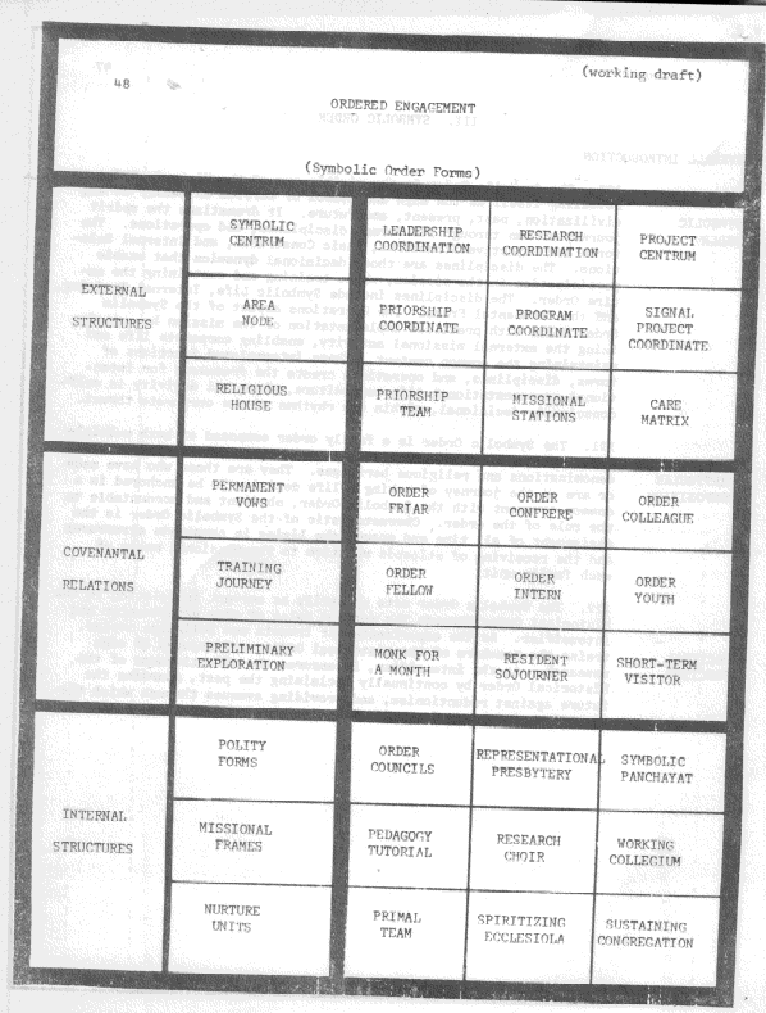
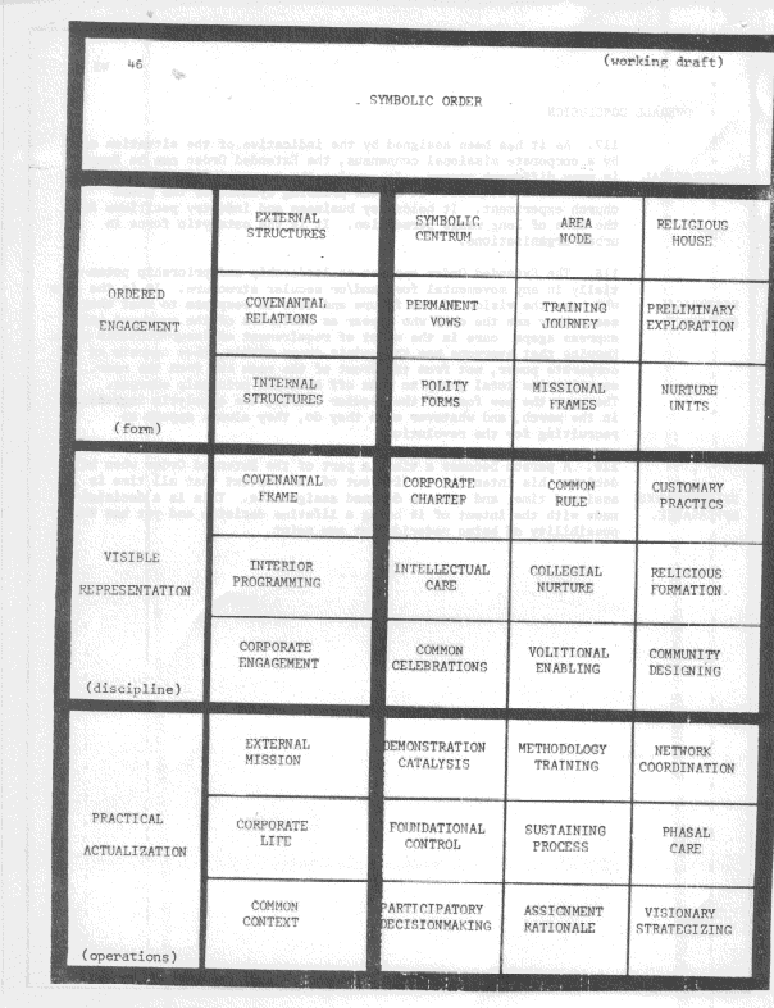
44
OVE~iALL
BYNA>5 ICS
inkind services, recruitment for courses, and
manpower for local church projects.
116. The operations of the ..xtended Order create
the forms by demanding a structural response. The operations limit
the forms by calling into question the~ function of the forms
already in being. The operations sustain the forms bv providing
activities with missional intentional thrusts. The ooerations
of the Extended ()rder create the discipline by demanding the
provision of trained troops. The operations limits the discipline
by calling into question its relevance hummanness and comprehensiveness.
The operations sustains the discipline by engaging the troops
in relevant mission to society. The operations of the Extended
,rder create the Extended Order by providing relevant activities
which ar? the foundations on which it is built. The operations
limit the total Extended Order by desigTnating the particular
role of the Exten`led Order. The operations sustain the
total rxtended Order by providing relevant activites which give
continuous mobilization to the troops.
42
sign tothe Extended Order in discerning the
task of the Extended
Order. The Design Coordination of the Extended Order
holds the
Movement overagainst the current structures
and are responsible to
the Movement for the partic pation of those structures
in the recon
struction of society. ~
108. Assignment Systems intends to assure comprhensive
participation
of Extended Order members in all dimensions of the
Movement structures
ASSIGNMEIiT through local church assignments, Signal
Participation in local
SYSTEMS movement structures and Movement Faculty
assignments. Church Responsi
bility is designed to place E'xtended Order men~ers
in strategic
positions within local churches by assignment to
cadres, galaxy
involvement, and pastorale positions. Signal Participation
is designed
to coordinate the intentional experditure of Extended
Order members
through comprehensive assignnments to local aspects
of movement life,
such as recruitment. I~iovemen al Faculty is designed
to employ the
Extended Order in pedagogical participation bv leadin:
corporate
workshops, teaching courses and holding consults.
109. Movement Services is the means through which
the Extended Order
~ provides the Movement with the local enablement
functions that sustain
MOVEMENT the total mission. The Movement needs local
iron men who will put
SERVICES up with whatever task is needed to unblock
cadre formation' local
church renewal and movement expansion. Metro Communication
Networks
is the way the Extended Order forms the crucial links
to keep the
grassroot movement informed of issues crucial for
the life of the Order,
the state of the Church, and the state of the hTorld.
Administration
Machinery is the means throu~h which the Extended
Order enable courses,
as well as offices, files, and records for the sake
of course follow
up and cadre development. r'`esources Management
is how the Extended
Order cares for the movemental financial records
and meeting facilities.
110. Movement Procedures creates the Strategic Impact
by priorit
izing secular target areas. It limits it by establishing
defined
DYNAMICAL strategic goals. It sustains it by giving
missional form and focus
REI.ATIOIiS to daily activity through providing comprehensive
models. riovement
Procedures creates Enablement MechanisTns by defining
and evaluating
and redefining the needs of the Movement. It sustains
it by assigning
the necessary manpower to malutain this dynamic in
operation. Move
ment Procedures creates Extended Order operations
by giving form to
the thrust of the Movement. It limits the Extended
Order operations
by giving form to the thrust of the Movement. It
limits the Extended
Order operations by providin>, concrete strategy
and goals. It sustains
it by providing the missiional context from which
the Extended Order
exists.
ENABLEI`IENT MECHANISMS
111. E:nahlement Mechanisms descri!,es the action
of the Fx.tended
Order ar. it enables the Mov'`'nent eithe~r as a
whole or in a ',eograph
,ENERAL ical locale in the arenas oF finance, penetration
and lol!,i<:tical
JESCRIPTION support. F'inancial Emoowerrn`>nt
provides the basic support system
whic}~ makes available continZlous funds, goods and
services. Pen
etration Participation is the way in which the Extended
Order uses
40
are in a position to make their voices heard in secular
councils
and circles, and thus they are in a position to make
suggestions for
organization and structural innovation. Also, they
are the ones best
placed to form vocational guilds which will catalyze
and evolve into
the structures of the New Social Vehicle. ~
102. There are two ways in which the strategic secular
impact is felt
within the economic, political and cultural structures:
First of all,
INFLUENCE the Extended Order is out t¢ lay the
foundations for the future
CULTIVATION structures of the New Social Vehicle.
But next, and secondarily, it
is out to enable and heighten the effectiveness of
the Movement and
the Historical Order. At the same time, it is out
to implement the
strategies and tactics by which the economic community
will be made
more human, more conducive to the creative expression
of human life
Political strategizing by the Order operates, first
of all, to
assess the relationships and resources to enable
the order mission.
Out of that assessment it takes responsibility for
cultivating and
nurturing those dimensions of the political establishment
to which
it has access. In this way, it directs its activity
toward the
ideological goal of allowing "all the people"
the possibility of
participation in "all the decisions." The
Extended Order also
bears the burden of being the public relations liaison
between the
Historical Order and the secular community. It uses
all available
secular media, first, to proDagate the movemental
ideological pos
ition, and, at the same time, to begin
practical field research
in massive public reeducation.
103. The Extended Order is then, in the unique position
of being
able to serve as the clearinghouse which brings together
the move
STRATEGIC mental employment and labor pool with the
employment possibilites
EMPLOYMENT available in the secular world. At the
same time, in order to be
able to continue to do this over a sustained period
of time, it is
necessary that it serve as the guardian of professional
and occup
ational excellence among movemental personnel. As
part of that
concern for excellence, it will also be uniquely
responsible for the
development of permeation training schools. Through
this training
process, it refines the methods and performs the
necessary background
which will make it possible to take the movemental
dynamic into
secular structures. The Extended Order alao provides
assignment
enablement. It assists in the necessary background
work of preparing
dossiers, maintaining files of available personnel,
preparing
references and maintaining other forms of records
and files of
information. The Extended Order comprehends the significance
of
rotating employment, so that no individual is ever
locked into one
narrow, stultifying position tar ionger than is missionally
necessary.
It works out the necessary procedures and maneuvers
by which it
becomes possible for individuals to shift employment,
either from
one field to another, or, within the same field,
from one geographi
cal location to another.
104. Guild formation, as distinct from strategic
employment and
influences cultivation, is primarily concerned with
development
of the catalyzing guilds which will eventually ~rovide
the backbone
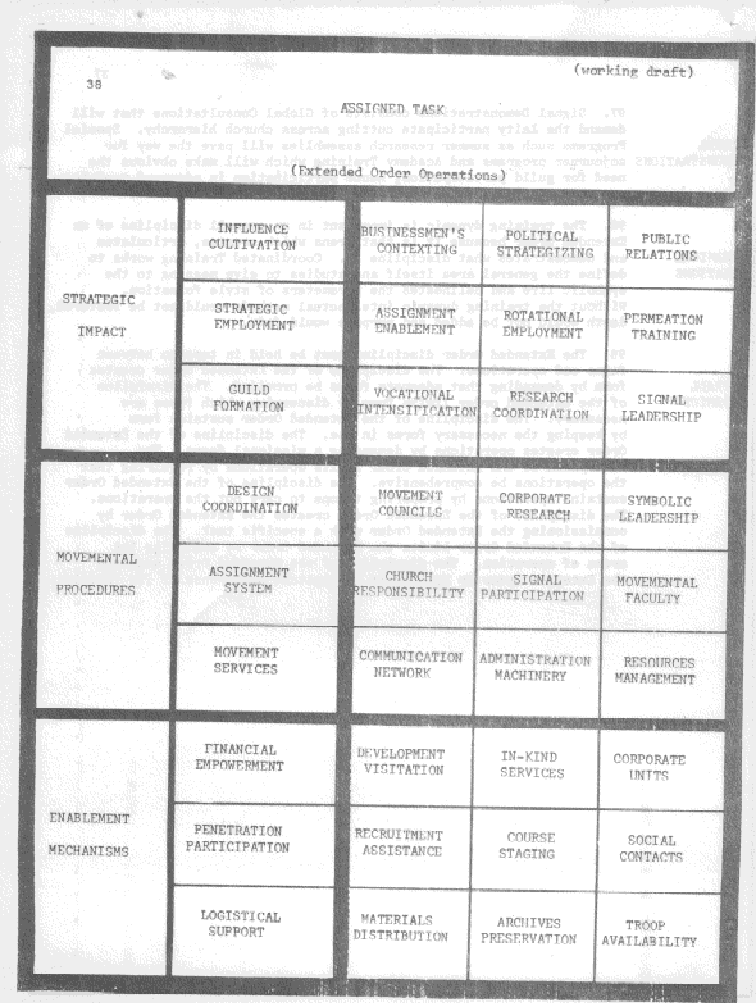
36
Budget is the corporate plan for missional use of
funds, space and
goods. Time Allocation is nlanning time expenditure
for strategic
RESOURCE corporate obJectives. Strategic Occupation
is the selection and
DESIGN maintenance of a vocational station for particular
missional object
ivea. Negotiated Budgets, Time Allocation and Strategic
Occupation
are the arenas of expenditure structured into the
Extended Order
relationship.
93. Commissioned Style creates external behavioral
patterns which
express the interior deciaion to be the Extended
Order. It limits
DYNAMICAL legalistic tendencies of discipline by
providing f r absolution and
RELATIONS by pointing constantly to the context of
mission which requires a
disciplined life. It sustains discipline by providing
commonality
in patterns and thus a collegiality among order members.
Commiss
ioned Style formation catalyzes the Consensed Symbolics
by requir
ing frequent and dramatic rehearsals of the context
in which one
lives. It further requires that the symbolic life
in fact relates
to the realities of a mission ~1 life. It sustains
the symbolic
life by maintaining consciousness of the ultimate
decisions required
of a person. It creates Coordinated Training by producing
persons
with time and energy for radical engagement in the
order task. It
limits that training by demanding effectiveness in
the expenditure
of energy. Finally, it sustaina training by providing
the motiva
tion for continued participation. Without serious
attention to style
formation the decision to be the order is soon either
dissipated
into a frenzy of shallow activism or rationalized
into a realm of
hollow abstraction.
COORDINATED TRAINING
94. Coordinated Training assures the development
of skills and
knowledge, grounded in a broad base of order memory
and 20th century
:ENERAL secular and theological wisdom. It is coordinated
in the sense that
DESCRIPTION the experience and wisdom of the order
ensures its comprehensiveness.
An assignment system provides a way of matching curriculum
to the
needs of the order member and the task demands, a
training scheme
conveys formal and informal wisdom and signal demonstration
provides
the several arenas for practical "on the job"
study.
95. The Extended Crder would be open to a regular
Assignment System
which would enable its training. It would be assigned
to pedagogy
~SSIGNMENT tutorials. It would play a key leadership
role in P.S.U. groups.
,YSTEM It would also further its training
through participation in tracking
formats. These would provide it with adequate skills.
96. Training Schema is an assigned study schedule
to expose the
extended order members to the Comprehensive curriculum,
current Edge
RAINING Stutics and Order Wisdom. The Comprehensive
Curriculum include& the
CHEMA entire Academy curriculum. The Edge Study corresponds
to ongoing
edge study of the Symbolic Order such as current
books, lectures and documents. The Order Wisdom includes documents,
books, constructs and methods which have become part of the oral
tradition. Study in these areas would prepare the extended order
members to carticipate in e~der functions and to better perform
his particular assignment iT. society.
_
34
B. FORGED COMMONALITY
83. The Discipline of the Extended Order is that
which allows for
the commonality of the Extended Order by outlining
common symbolic
OVERALL life which rehearses the story of the Historical
Order, by forging
DESCRIPTION the new style of this dynamic of the
order which would order the re
sources and covenantal relations and by setting forth
the structures
which will train the Extended Order for the missional
task. This
discipline would succeed in outlining an authentic
response to the
decision to be part of the ordering dynamic in history.
CONSENSED SYMBOLICS
84. The Extended Order rehearses its missional vision
regularly
through the Consensed Symbolic Life which includes
the liturgical
GENERAL forms of worship and rituals born out of
the historical order's
DESCRIPTION extensive extensive experimentation and
its common understanding of
its task. Spiritual exercises provide the tools for
depth reflection
on life and life decisions. Common symbols hold one
present to the
mission in its comprehensive context.
85. Liturgical forms are primary and secondary rehearsals
of life
as it is understood by the Historical Order. Foundational
Liturgists
LITURGICAL are the critical and regular dramaturgical
offices that are the
FORMS core of the symbolic lifedaily
office and House Church. Life
Celebrations expose the significance of common human
events
and transitionsbirth, marriages, death
and phasal transitions.
Secondary rituals are reminders and contextualizers
that are utilized
at any timemeals, wake up, beginning
and concluding formal and in
formal meetings, and daily sendouts. The Liturgical
Forms are regular
and consistent across the entire Historical Order.
86. Spiritual Exercises are the methods of enabling
and expressing
selfconsciousness about the events and states
of the spirit life.
SPIRITUAL Conversations (usually over a meal) are
the covenanted family's
EXERCISES corporate reflection on past events and
the revelations they have
been on the depths of life. The solitary office is
every spirit in
dividual's rehearsal of the depths of humanness in
light of the day's
occurences. Such corporate exercises as watches,
fasts, and grand
balls, also odysseys, hold the extended order over
against the mystery
in life and the experience of that mystery by their
colleagues. The
extended order participates in these spiritual exercises
as disci
pline in the spirit life as well as necessary nurture.
87. Common symbols act as a reminder of the way life
is and point to
the primal covenant. Appropriate decor tells an addressing
story in
COMMON an enabling manner using statues, montages,
paintings, etc., and are
SYMBOLS chosen according to the particular settingoffice,
living room, family
room, etc. Personal signs include the use of clothing
and jewelry
to create a sign for the future and act as secondary
symbols. Worheip
centers include such things as altars for family
or individual and
are set aside in the home or office where the mystery
which is in the
midst of life is remembered and encountered again.
32
79. Community Forums are local crossvocational
meetings providing
opportunity for the extended order to be involved
with the community
COMMUNITY in problem solving endeavors. One aspect
of community forum is the
FORUMS Communication Station which is the parish
level group that publicizes
and disseminates information about community decisions
and concerns,
and evokes public participation. Another aspect of
the forum is the
Impelmentation Station which actualizes community
decisions. The
third aspect of the forum is the Consultation Station
that serves
as an advisor to individuals and groups regarding
participation in
local concerns and activities. Thus, the Extended
Order is involved
in the whole arena of public service and problem
solving.
80. Cultivation Forces are extended order teams that
impact the
establishment and disestablishment structures
enabling specific
CULTIVATION movemental goals. One arena of the force
is the Civil Post which is
FORCE the occupational location of Extended Order
poeple dispersed and as
signed to particular secular jobs. Ecclesiastical
Post is another
arena of the force which is the position to which
an extended order
member is assigned by the order and appointed by
the traditional church
hierarchy. The third arena of the force is the Movemental
Post
which is a responsiblity task to which extended order
people are as
signed to call forth the movemental forces,
the establishment, and the
disestablishment to more fully participate
in the ongoing civilizing
force in the building of the human earth.
81. The Permeation Guilds in relation to the Demonstration
Auxiliary
provides professional expertise, demands replicability,
and elicits
DYNAMICAL broad base support. The Permeation Guilds
in relation to the Extended
RELATIONS Chapter provides the credentials for the
task, requires comprehensive
engagement in social structures, and maintains contacts
with all
levels of the social arena. The Permeation Guild
in relation to the
Extended Order Forms illuminates the social relevance
of the forms,
demands practical application, and maintains structures
which provide
basic social data.
82. Forms create the Extended Order by providing
local operating
units. Forms limit the Extended Order by holding
it to its unique
OVERALL mission or assignment. Forms sustain the
Extended Order through
DYNAMICS being selfsustaining structures for
the troops. Forms create Discipline
by providing selfconscious direction. Forms
limit Discipline by
holding it accountable for the mission. Forms sustain
Discipline by
holding to the vision of what is possible in the
future. Forms
create Operations through demanding
a goal. Forms limit Operations
by keeping a sharp focus on the activities. And Forms
sustain
Operations through contexting.

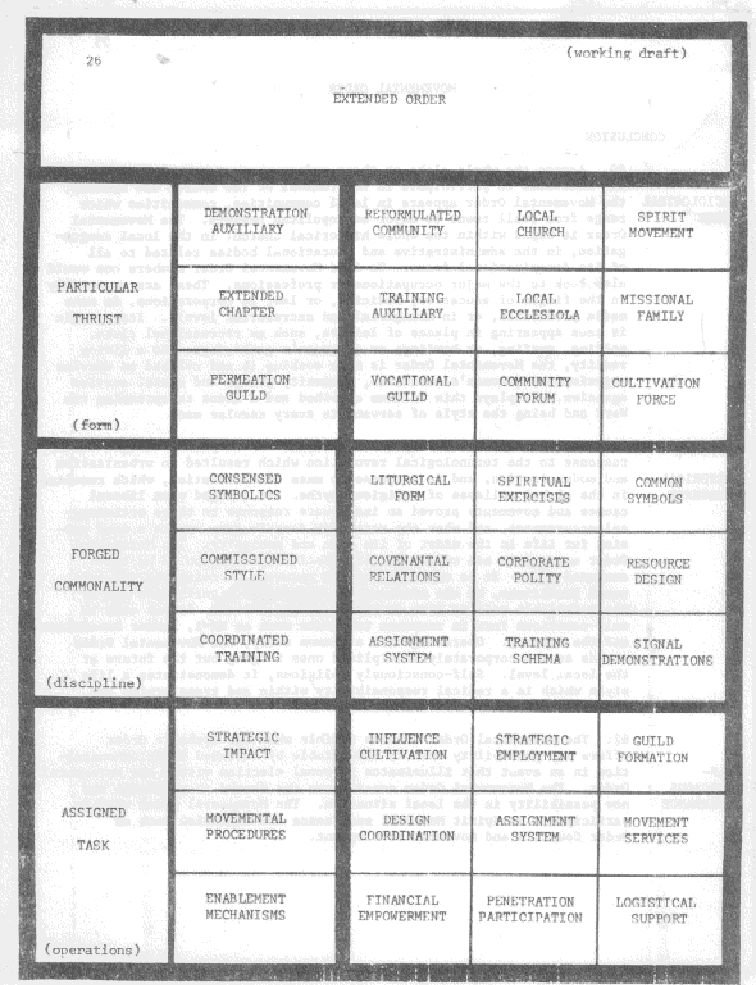
24
DYNAMICAL RELATIONS
58. Secular Evangelism creates Movement Building
through common short courses. It limits Movement Building by maintaining
the transestablishment style and it sustains Movement Building
by establishing the servanthood image; it creates Strategic Permeation
through contextual cur riculum, & limits Strategic Permeation
through the tiscernmel~t of role demands and finally, formulates
corporateness thereby sustaining Strategic Permeation; it creates
Consensed Mission by signalling the deeps and limits it through
maintaining a corporate thrust, and lastly Secular Evangelism
sustains the Consensed Mission of the Movemental Order by the
development and use of spirit tools.
CONCLUSION
59. The Consensed Mission of the Movemental Order
creates Localized
Covenant by providing the necessary task for missional
engagement;
OVERALL it limits Localized Covenant by specifying
the types of activlties
DYNAMICS appropriate to the task; and it sustains
Localized Covenant by focusing
the missional task. The Consensed Mission also creates
Disciplined
Collegiality by providing the reason for discipline;
it limits Disci
plined Collegiality by questioning its relevancy;
and it sustains
Disciplined Collegiality by supplying it with a rationale
for continu
ously providing discipline for all the troops. Lastly,
Consensed Mission
creates the Movemental Order by providin g concrete
missional focus;
it limits the Movemental Order by concretely demanding
prioritized en
gagement; and it sustains the Movemental Order by
constantly authenti
cating its missio.l.
1
22
PERMEATION GUILD
DYNAMICAL RELATIONS
52. Permeation Guild is one of the operations of
the Movemental Order. Within the strategic permeation of society,
order members operate Permeation Guilds to implement research,
to conduct model building sessions, and to provide a means of
close evaluation of the task. Within the global research net Permeation
Guilds would be given particular assignments appropriate to their
wisdom, task and location. The carrying out of such assignments
is not only direct participation in recreating grassroots polity
but creating the comprehensive context and pioneering mode of
order members and compilation of necessary data to insure universallty
and practicality. Regular model building is the process by which
guilds lay out the specific tactics to be employed in their occupational
or task area to create the New Social Vehicle. Some guilds will
do detailed planning Gimilar to tertiary actualization in the
Local Cougregation Experiment whereas others (e.g. denominational
bureaucrats) may do corporate broad planning once or twice a year.
Objective and corporate means of evaluating the effectiveness
of individual ana guild models in relation to ~trategic permeation
provides opportunity for redirection.
53. To talk about the dynamical relationships of
Strategic Permeation, Movement Building, and Secular Evangeliam
is difficult because you cannot point to groups of people or structures
but must relate activities to activities. Strategic Permeation
creates Movement Building by continually providing new contacts;
it creates Secular Evangelism by providing situations or opportunities
for dramatization of meaning or new relationships; and it creates
the Consensed Mission of the Movemental Order by providing immediate
access to the social structures which are to be changed. Strategic
Permeation limits Movement Building by demanding that movemental
structures be relevant to the sociological realities; Strategic
Permeation limits the Consensed Mission of the Movemental Order
by demanding rootedness, that is, by requiring tbat it be engaged
concretely in the renewal of social structures; and Strateglc
Permeatioln limits Secular Evangelism by discerning the depth
human struggle and requiring a relevant word of possibility be
addressed. Strategic Permeation sustains Movement Bullding by
prioritizing impact arenas relative to new courses for increasing
numbers; Strategic PermeatioD sustains Secular Evangelism by grounding
selfconscious secular mythology; ana strategic permeation
sustains the Consenset Mission by maintaining relationship webs
through the interrelatedness of operation"1 activities and
missional tasks.

20
46. The Backup Net embraces management representation
which is the
operation of common internal finances, the maintenance
of legal rela
BACKUP tionships and formal representation
of the Order with the established
NET civil structures of society. It includes an administrative
frame
work which plans celebrations, decides and implements
course schedules
assumes responsibility for public relations and makes
assignments to
facilitate the area's internal life. Through a development
net the
Movemental Order articulates the focus of current
global engagement
discerns avenues for financial support and maintains
the continuity
and nurture of those resources.
47. The Movemental Order engages in Global Spirit
Movement develop
ment through participation in movemental structures,
local churches
STRUCTURAL and signal demonstrations. The leadership
dynamic operates within
LKADERSHIP these structures as the Movemental Order
members corporately build
models and time lines, enable consensus formation,
and lead meetings
at the various geocoordinate levels. They provide
direction in the
construction and implementation of tactics to actualize
the movemental
strategies of the historical church in its local
form. Demonstration
events and projects provide another practical arena
for the Movemental
der's structural action. Crucial movemental development
occurs in
relation to the Movemental Order's necessarily obvious
and behindthe
scenes guidance and direction.
48. The dynamics of Movement Building, within the
Movemental Order,
is in relationship to the dynamics of Strategic Permeation,
Secular
DYNAMICAL Evangelism, and Consensed Mission operations.
It creates Strategic
RELATIONS Permeation by inspiring involvement, limits
it by its specific type
of participation, and sustains it by its common style.
Movement
Building plays a role in effective Secular Evangelism
by virtue of it
sensitivity to the spirit malaise. It limits Secular
Evangelism in
its concern with helpful establishment relationships
and it sustains
Secular Evangelism by continuously articulating the
research edge.
In its relation to Consensed Mission, Movement Building
is creative
in illuminating the need. It limits Consensed Mission
by demanding
that it live out of a long term vision and it sustains
Consensed
Mission by providing the forces for the task.
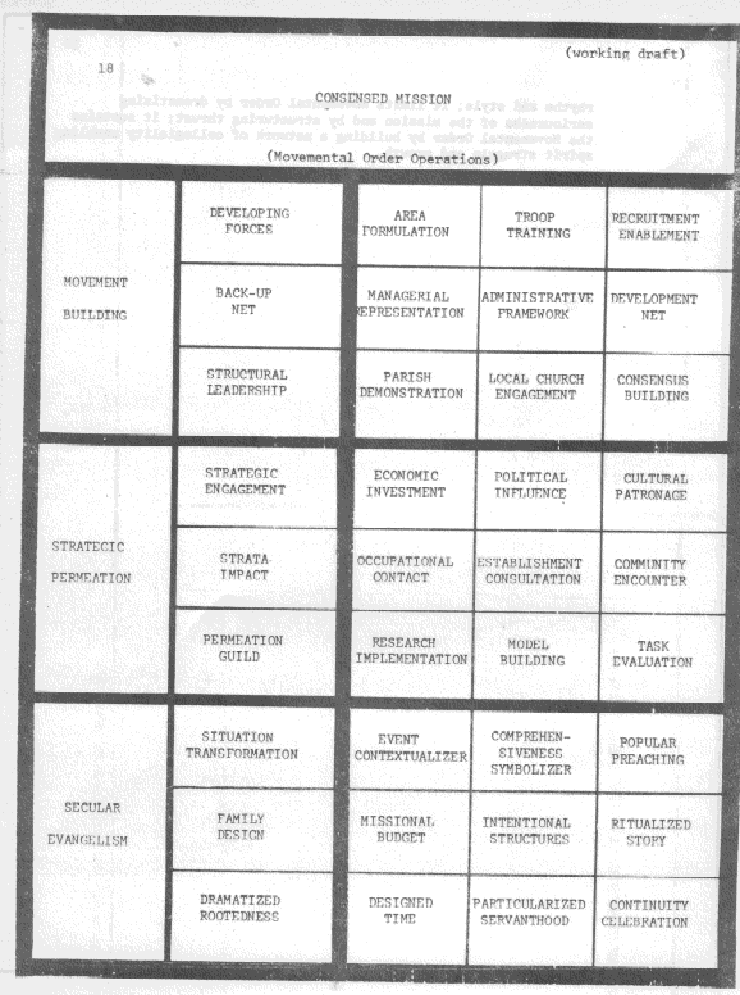
are those objects such as NPM charts, other world
pictures, the transestablishment wedge, and the iron cross, used
by Movemental Qrder members to visibly hold themse~ves before
their covenant to be the Order. Particular rituals point to those
ritualized activities sucn as ear rituals, per~e~~
011 a.s .;gi~m~n~sr and quarterly submitted course availability
schedul`` that are ~vmbels of an active covenant with the
Order. Vocational ~ tnry :I.~S tr lo with the putting to form
of one's public and private articuiation of his decision to stand
before Gbd in allegiance to an assigned area, doing the mundane
and being the mission as a sign of what it means to be the transestablishment
within the structures of society.
31. Common SYmbO1B creates Corporate Assignnent by
providing a
comprehensive visionary context for engagement; it
limits Corporate
DYbAwI TAT, Asaignment by dictating the rationale
for what is necessary; it
2L! ~l~lNS sustains Corporate Assignment by continually
rehearsing the group's
task in history. Common Symbols creates ~xpenditure
Designs by
placing the demand for prioritizing and structuring
human expenditure;
it knits Expenditure Design by focusing the arena
of time and
resources expenditure; it sustains the Expenditure
Design by providing
a serious nonchalant relationship to expenditure.
Common Symbols
creates Hovemental Order Disciplined Collegiality
by holdin~ the
corporate group before the task; i* limits Disciplined
Collegiality
by deli~eating the arena of engagei,~ent;
it susta ns Disciplined
r'olle,~s3ii~y ty con~inually r h~ar~ine the group's
reason for being.
CORPORATE ASSIGNMENT
32. The preparation and en~ageFen o, the Movemental
Order requires
participation in C~'orate A.`is.2r.ment to the covenant
group, the
&ENERAL train~ng desig~' as~d the quarterly ass~+nt
rationale necessary for
DE~OR PTION the mission. Study and tra ning i~ t.>torial
sessions, implementation
of NSV tactics through voca~.;;~aJ V3;~d structures
or participation
in a Nei igious ifo,Jse
Odysse<: i ci e~.,ple~ or Corporate Assignment
thr.~i~g' which the di%c~plir;~ cove>,ental
relationships within the
Movemental Order are intens:fied.
33 ~ Covenant ~:iroup assignm~nt 1s tr~ rmiQo~ng
groups such as
movemen~al units, vocational guild~ and a local church;
in order to
COV1:NANT demonstra~e and prepare Move'ntal
3rdre,r pe~sons for common missional
GR;)'~'F thrust,assignmen~ to movemental unitq fri,g,
~ care modules) oro~ides
training and experience irl the nurturing process
of the Order,
such as, synbolic life and movement accountability.
Vocational guild
assignmenta are aimed at impacting the specific social
arenas of the
Mcvemental Order person's vocational thrust. Assignment
to local
church structur¢s serves as prime opportunities
to develop and
demonstrate the style of the renewed churchman.
34. Training Design refers to training assignments
and events,
both formal and informal, such as pedagogy tutorials,
study sessions
TRAINING and leadership training roles. Pedagogy
tutorial assignments include
DESIGN regional pedagogy structures, or collegium
sessions in a Religious
House where pedagogical training is given. Advanced
study is an
assi~nment to advanced courses. Academv a~ "d~.
.Ctil~V Q~Q~^nQ ; ^~