MFTF
Jaipur SubContinent
Memorandum
February
1984
To: The Order Ecumenical
From: The Models Focusing Task Force
Enclosed is a report in three sections (Phase II
Narrative and Reflection, Phase III Images and Phase III and the
Year of Order Council). Also enclosed is a public report which
is being sent to GAB, NSC, Cosponsors, supporting organizations
and the Indian Government. You need to see and reflect on both
of the reports to grasp the full picture of the Central International
Event and Phase III. This is not intended as the definitive statement
on.Phase III but rather the beginning of the brooding process.
I. Phase II
A. Narrative and Reflection
The Setting: India was a befitting place to hold
the event not only because of the vast need of the villages but
also because of the years of significant work and experience in
that country. This work and experience greatly enabled the field
visits to rural development projects across India to be the pivotal
happening for all of us who were there. New Delhi was the focus
for the twoday Symposium and for the fourday Assembly
which followed the field visits. Colleagues, business executives,
government officials, hotel staff and many other people became
involved in and intrigued by what was happening. The delegates
and team leaders lived, slept and ate breakfast in three different
hotels. The display of exhibits, the workshops and the plenary
sessions were all held in a fourth hotel: the Ta; Palace. While
the Exposition has extended over the past 18 months and has at
least as long yet to go, the happenings in this hotel came to
symbolize what the event was for us. White marble decored with
Indian tapestry provided a fine backdrop for people from 54 nations
to meet and exchange their approaches. A focal point for the exchange
was the Exhibit Hall, with its 198 displaYs from aroun~ the elobe.
The Participants: Of the
650 participants, 400 delegates and team leaders attended from
outside of India and 150 came from India itself. Another 100 people
constituted the support force who handled hotel liaison, hosting
the delegates, working with the press and public media, the preparation
and set up of several events and managing the finances. As compared
with other large public conferences, the central event was unusually
well supported. The teams working in the background assured the
flow of the whole event and significantly involved guests, the
general public and the press. The delegates were village or project
residents, project directors and staff, agency or institutional
supervisors of projects, government officials and private corporation
personnel. The visual side was cared for by five different film
crews from Canada, France, Nigeria, the USA and India. The cosponsors
and support organizations were present from UNICEF, ILO, WHO,
World Bank~ International Council of Women, Ford Foundation and
a good number of embassies.
A team of seven international volunteers, possessing a range of professional skills especially related to holding conferences, provided their services, 25 volunteers from the University of New Delhi were an invisible but very practical auxiliary force to the whole process.
9L
Jaipur
SubContinent
IERD TASKFORCE
February
Memorandum p.2 1984
The Preparation: In several ways we were not ready for this event. Some delegates were only selected a few days before and many others came without much orientation other than what they had receiver "rom a supervisor or a support organisation. By contrast, however, extensive preparation had gone on in many countries over the last 12 months or longer. In India, 43 PDL's were held with specific projects. Of these, 30 projects were selected to host site visits during the eleven days. Several visits were made to each of these projects by the Indian Steering Committee and ICA staff.
The IERD preparation team was expanded in Brussels in.October and was basically shifted to New Delhi in early December. Another wave of faciI~itators began arriving in early January. A week before the inaugural event, a group of team leaders arrived and their training sessions be~an.
They reviewed the procedures that had been prepared, did a demonstration symposium, went over the steps and logistics of the field visits and acquainted themselves with India bv takin~ tours of NP~ DP1 h]
The prep task force had drawn together materials: trends and keystones in rural development and a concept paper on the research methodology used in the IERD and the central event. The first draft of the project directory was printed and supplements were added during the 11 daY Deriod.
The Event: The inauguration took place on Sunday afternoon, February 5. It was held at a convention hall called the Vigyan Bhavan where many international events are held. The keynote address was given by the Minister of Chemicals and Fertilizers, Mr. Vasant Sathe. At the Taj Palace Hotel, Dame Miriam Dell (ICW cosponsor) opened the Exhibits Hall. She also gave a fine speech to the Exposition during the Symposium.
The Symposium began on February 6. In 30 teams, the delegates spent a day visiting one another's exhibits and interviewing each other. The second day, each team identified between 5 and 12 priorities in rural development as they looked at the work of~all the teams. Slide shows from the Trickle Up Program and UNICEF were the events of the first two eveninQs.
In the afternoon and evening of February 7, the teams began to leave for field visits in 30 locations across India. A good number of delegates shifted teams to be able to pursue their particular expertise or interest. This proved to be a most helpful grounding of the interchange that took place during the 1I days. The teams returned having had a significant experience and with a sense of hope and encouragement from what they had seen and discovered.
The assembly began with a debriefinQ of the 30 teams meeting together to heari eachother's reports. A petition signed during the Symposium had called for more time_to exchange experiences among delegates in various fields of interest. Delegates also asked for a more "open process'N that allowed each group to deal with specific arenas of concern. During the Symposium, delegates had identified their particular interests: from these, the orchestration team discerned the following twelve particular arenas: Local Management and Planning; Leadership Development; Energy Alternatives and Appropriate Technology; Education and Skills Training at
_
25
MFTF
Jaipur
S1'h-Cr~n t i n~n t
IERD TASKFORCE
Memorandum p.3
February
1984
all Ages; Integrated Comprehensive Community Development, Agriculture (small farm development, organic farming, forestry); Role of Women; Health;;Communication and Information Technology; Sociological Factors Impact on Development; Environmental Concerns; and Rural Economic and Commercial Development. On the second day of the Assembly, the delegates met in these 12 arenas and wrote up their wisdom on some 68 subarenas. These were posted on the front wall of the major meeting hall and imaged as 12 chapters of "The Book". The Book is to be a significant statement on local rural development written by local practitioners.
The next day, a similar open process was used as the delegates met in 10 geographical regions or areas: Northeast Asia and the Pacific~, Southeast Asia and South Pacific (including Australia and New Zealand); South Asia (India and four other nations in four groups); East and West Europe; the Middle East and Africa; North America; and the Caribbean and Latin America. National groups also met during the day to decide what next steps were needed in rural development in Phase III of the IERD. The final plenary received these reports. The event ended with a banquet in which the 55 nations received the certificates for their delegates and concluding remarks were made by a delegate from India and a representative from the World Bank.
B. METHOD
It is important for you to be able to reflect on the 11 day event on the other side of this narrative. First, a chance to see the event through the method and the event's significance. Two factors played a key role in the capacity of the methodology built for the plenary event. First, the inability to determine who was really coming until they arrived. Second, the multiplicity of images of what people understood as the intent of the Central International Event. These factors came together in the reaction found among delegates who came for interchange and discovered they were in a tight research process to produce a book. This situation limited the corporate research effort, but allowed for the participants to seriously own the interchange process. This commitment to interchange is what allowed for the impact of the exhibit hall and field visit successes. The exhibits were so impressive that the Taj Palace Hotel rebooked events out of the hall to keep the displays up for the total plenary. During this period 2000 people (1200 school children) came to participate in the excitement.
The field visit, as you will grasp through the four team reports, was the
uniqueness of this event. Delegates:
went places where things were happening
discovered commitment and confidence in the projects visited
were grounded in the pain and possibility of India
became a team through the journey of the four days
cQuld compare "eyeball to eyeball" their own project, or see the practical
impact of their own expertise (the delegates, the prolects. the nlobal task)
The plenary function was inconclusive. In the interchange process you are not able, nor is it necessarily helpful, to use the plenary for consensus. The plenary events were more contextual. You experienced that the teams were where most of the consensus happened. Yet, you also saw consensus in the oneday "interest groups" and the "continental and international group planning". Delegates went away
26
IERD TASKFORCE
Memorandum p.4
February
1984
Jaipur
SubCnnrinPnt
recommitted to development and sustained by the global perspective. Yet they had not reached agreement on global trends, the 20 key approaches, etc. The "open process" surely did allow for a huge input of data, but it did not provide opportunity for creating screens and new gestalts.
C. Significance
What worked most dramatically in this event was the coming together of local practitioners. They did come and share approaches that work. This was manifest in the displays and the constant drive for interchange. Whatever else happened, the event did demonstrate that local practitioners can and need to~ be involved in the process of development/planning. Our ability to portray the event in this light, and the implementation of Phase III, could well conspire to bring an end to the macroconference mode. The written and visual documentation of the Central International Event that will be its finished product can impact many arenas of development such as health, education, the role of women in development, integrated community development, and will play a critical role in allowing Phase III to focus on strategic approaches for accelerated local development.
It i~ also clear that Phase I and II have birthed a new movement that is involved in creating critical insights the Order needs for the next 16 years. This new movement is involved in this Year of Order Council. They need to be journeyed to assume fuller responsibility for the 18 months of Phase III.
II. PHASE III
A. Strategic Advantages
As you read this memo, you also need to be studying the enclosed public report. Read the statements from the special group on "Funding Strategies for the Rural Poor". Study the list of participants. The local practitioners were present, but so were leaders in national governments and international organizations. You also need to review the summary of national plans and the scenarios at the end of the next section of this memo.
All these items will give you a feel for the whirlwind of advantages that were being birthed in this event. Here is a list of some: new nation invitations (25 nations, new to the ICA, at the CIE) major agency access (SIDA, CIDA, DANIDA, UN system) GAB, NSC global network track record as interchange agent East Europe (Hungary) and China possibilities major contact with media networks in Europe, N.A., subcontinent newimages of areal coverage (Area Madras re: Sri Lanka) pioneering in local documentation modes (directory; book(s) on approaches, audiovisuals).
~These advantages are valuable only if they are used. The ICA is in a great position to use the next four months to screen these advantages in dialogue with preparatiOns for the summer Coun~il.
27
IERD TASKFORCE
~February
Jaipur
Memorandum p.5
~ qRL
SubContinent
B. Phase III Intent
The primary intent of Phase III is to move beyond the interchange of Phases I & II to an acceleration mode. This process has happened naturally in some places. When participants from local exchange conferences (Rural Development Symposia) were invited to participate further in sharing approaches that work, they suggested we include those from other sectors who continue in old modes of development thinking. When this is done it pushes beyond sharing to acceleration of development efforts.
Going the next step with interchange can take other forms as well:
jointly reporting with the delegates to agencies, governments, etc.
using the [earnings from other projects to accelerate our own work in Phase III
Training opportunities are also emerging as a way to give form to Phase III:
HDTS's in Latin America are bringing together people beyond our own projects to be trained in effective methods.
In South India, the Rural Development Advisory Service has invited us to work on training programmes for village development workers throughout the state.
Impact openings are also presenting themselves:
Sri Lanka and Chile had delegates from the public sector and are now working through them to affect government policy.
Use of the CIE products in this regard has considerable promise videotape on cable TV networks, slide show presentations, poster dissemination, study sessions on the book.
New kinds of demonstration are clearly called for but the potential is there for moving in this direction:
Multisector coalitions are emerging: In Ontario, Canada, for example, where an Indian reservation, the provincial government and the ICA are teaming up to do the first ever grassroots planning process on a reservation.
Similar kinds of collaborative efforts which address structural contradictions and accelerate local development can be anticipated out of the swirl of interchange, impact and training activities.
These four whistle point dynamics are a useful screen for deciding what actions are appropriate to Phase III. They are meant less as pillars that should be done and more as a way of taking an intentional relationship to what is bubbling up.
A collection of five scenarios for five different national situations is attached as a way to catalyze your own thinking and maximize the advantages we have in entering Phase III. i
C. _ The Posture of the Order In Phase III
It was amazing how many people in Delhi rehearsed the statement, "We have always understood that implementation is the critical step". However, ICA is being pushed from many angles. The year of the Order Council, the mountain of work in producing the documentation of Phase II, the ever present selfsupport, etc. To guide us,
9s
MFTF
Jaipur
9lih-l~nnti n~nt
IERD TASKFORCE
Memorandum o.6
February
1984
this memo is trying to offer a variety of images to enable Phase III. As we ponder on our posture, let us remember these tensions:
Ilelpful image Unhelpful image
aggressive creativity in seeking take over and run it
new forms ~
coverage without moving there sit back and watch it happen
openness in intentional working super agency for networking and inter
relations change
practical action which illuminates lost advantages because we didn't use
our future options these next four months
The ICA finds itself in an unbelievable position of excited local delegates who
will want to move and the need to create the next sixteen years, the combination is
unbeatable.
III. The Year of Order Council and its relation to Phase III
A. The Order s Historical Task
The IERD is a three year event in the midst of which the 18 month Year of Order Council is taking place. In this way, the IERD provides a "doing mode" as the master context for the Order s historical role as both catalyst and exemplar.
In Phase III, the Order's self image is more that of a midwife of the future than an architect, although active planning and designing are still required. Phase III is about bringing people and organizations together so that practical forms of reconciliation come into being. The focus on Phase III is intensely local yet in a truly global setting out of the Central International Event.
B. The Futuric Models
Phase III of IERD provides on the ground societal research in Cycle 2 of the Year of Order Council through national symposia and other events. This research is in the mode of Sartre's remak that "to change the world is to know it". This is active, engaged and risking the new. Futuric Models of the Order's role in society will emerge out of Phase III activities as the Order serves the New Movement of Those Who Care. Phase III will continue interchange of effective approaches while shifting to an emphasis on strategy & implementation.
In this way, Phase III is creating our global mission afresh. It is birthing models & programmes out of engaged service. In Phase III we are casting our nets far out over the long term future. We are inventing our missional strategies for the next 16 years. We are extending our service to new nations allowing new requests & opportunities to emerge. This is indeed an adventure of throwing our lot in with Those Who Care regardless of their origins.
29
MFTF
Jaipur
S;~'h-Crtntinnnt
IERD TASKFORCE
Memorandum p.7
February
1984
C. The Strategy Leap: The next 18 months of Phase III (March '84August '85) will be positioned by what we do the next four months (March June 1984) in following up on Phases I & II. In the same way, the next 18 months will position the Order for its catalytic task of the next 16 years. In this way, Phase III is both preparatory of a foundation and a catapulting out. This is seen clearly as a key to the third cycle of the year of Order Council (the strategy leap). Without this posture of engaged service & experimentation, the GRA will he ungrounded & the GCP will lack vision & courage and the strategies, configuration designs and resurgence tools to be created will be off target. Even the pilgrimage might be out of touch with human suffering and compassion, both of~which are revealed in Phase III through "accelerating the replication of tested models & methods of human development."
D. Societal Reconciliation: Again, Phase III of the IERD is seen to be integral to the year of the Order Council as it compels the Order to act in reconciling the painful and dangerous divisions present in local communities and instutitions, nations and the global community as a whole.
If nothing else, Phase III is about reconciliation. This will save the Order from selfsatisfaction, as well as selfdoubt, from arrogance as well as from irrelevance.
30
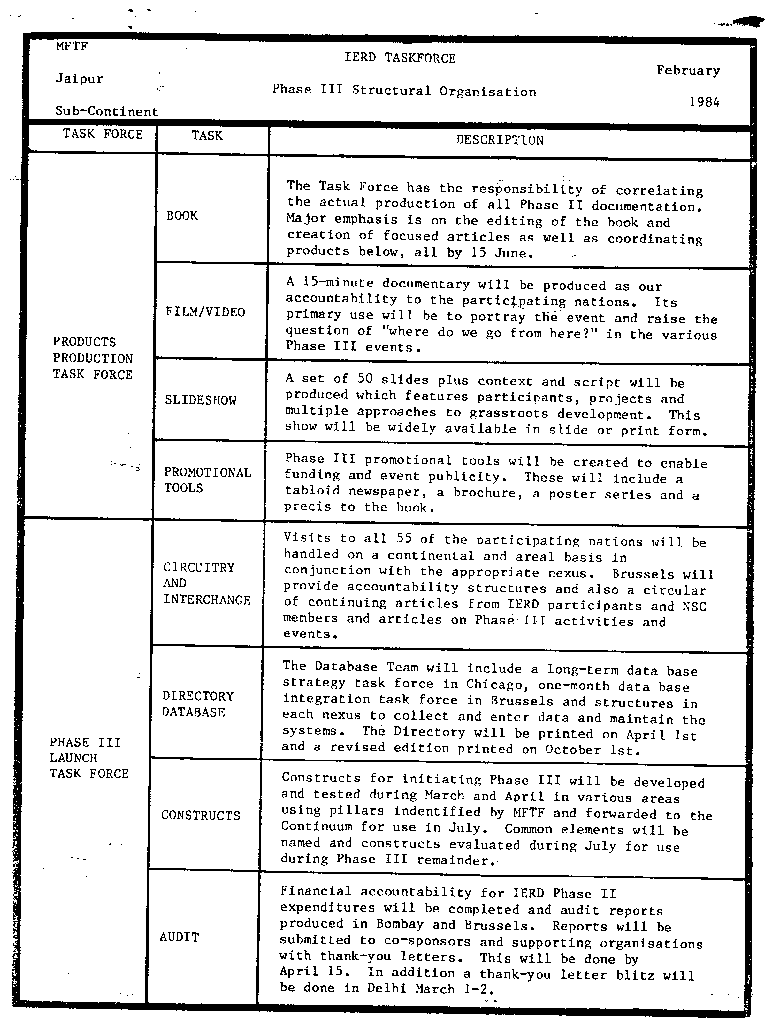
MFTF~
Jaipur
SubContinent
IERD TASKFORCE
Phase III Structural Organisation
February
1984
TA.qK FnQRF
TA.qK
DESCRIPTION
PRODUCTS
PRODUCTION
TASK FORCE
ROnK
FILM/VIDEO
RT.TnF.~lJ
PROMOTIONAL TOOLS
The Task Force has the responsibility of correlating the actual production of all Phase II documentation. Major emphasis is on the editing of the book and creation of focused articles as well as coordinating products below, all by 15 June. ~
A 15minute documentary will be produced as our accountability to the partic~pating nations. Its primary use will be to portray the event and raise the question of "where do we go from here?" in the various Phase III events.
A set of 50 slides plus context and script will be produced which features participants, projects and multiple approaches to grassroots development. This show will be widely available in slide or print form.
Phase III promotional tools will be created to enable funding and event publicity. These will include a tabloid newspaper, a brochure, a poster series and a precis to the book.
PHASE III LAUNCH TASK FORCE
CIRCUITRY AND INTERCHANGE
DIRECTORY
nATARA.qF
CONSTRUCTs
AIJIlTT
Visits to all 55 of the participating nations will be handled on a continental and areal basis in conjunction with the appropriate nexus. Brussels will provide accountability structures and also a circular of continuing articles from IERD participants and NSC members and articles on Phase III activities and events.
The Database Team will include a longterm data base strategy task force in Chicago, onemonth data base integration task force in Brussels and structures in each nexus to collect and enter data and maintain the systems. The Directory will be printed on April 1st and a revised edition printed on October 1st.
Constructs for initiating Phase III will be developed and tested during March and April in various areas using pillars indentified by MFTF and forwarded to the Continuum for use in July. Common elements will be named and constructs evaluated during July for use during Phase III remainder.
Financial accountability for IERD Phase II expenditures
will be completed and audit reports produced in Bombay and Brussels.
Reports will be submitted to cosponsors and supporting organisations
with thankyou letters. This will be done by April 15. In
addition a thankyou letter blitz will be done in Delhi March
12.